DISTRIBUTOR-FIRST SUPPLY PARTNER · SINCE 1999 Live · Compressed Air System

SPC Company
Compressed Air / Treatment / Air Dryers / Explosion-Proof Desiccant Dryer
Layer 02 · Treatment Emerging · Van Air Systems
01What it is

Explosion-Proof Desiccant Dryer

An explosion-proof desiccant dryer is a regenerative twin-tower desiccant dryer engineered and certified to operate inside a classified hazardous area — a location where flammable gas, vapor, or dust may be present and any unrated electrical equipment is an ignition risk. It is not a different drying technology; it uses the same adsorption chemistry as any desiccant dryer and reaches the same deep PDPs. What sets it apart is that the electrical components and enclosures carry hazardous-location certification — in North America, a National Electric Code Class and Division rating (e.g. Class 1, Division 1, Groups C & D); in Europe, an ATEX rating. It sits in the same place as any primary dryer (downstream of compressor, aftercooler, and wet receiver), with the area classification — not the dew point alone — dictating the product choice. The whole air train inside the classified area must carry matching ratings, not just the dryer.
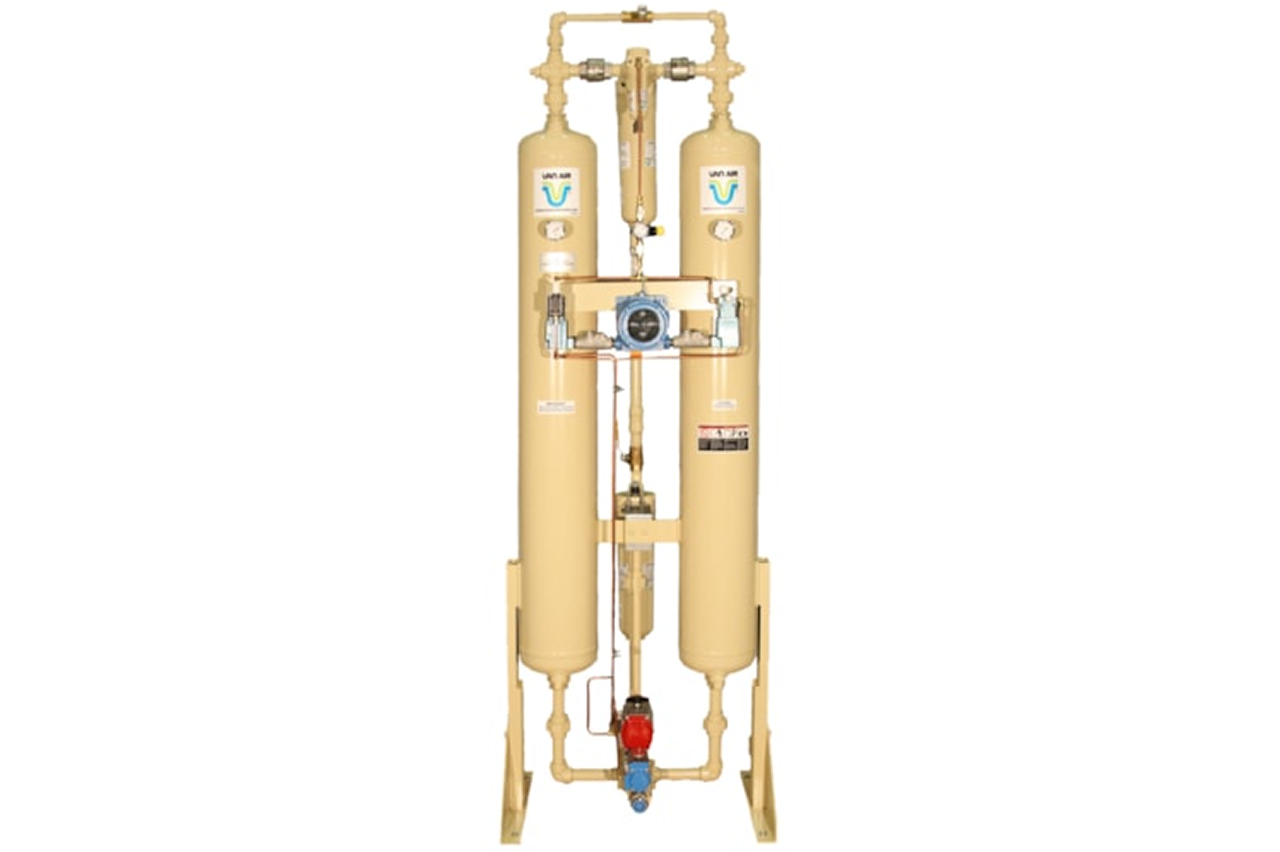
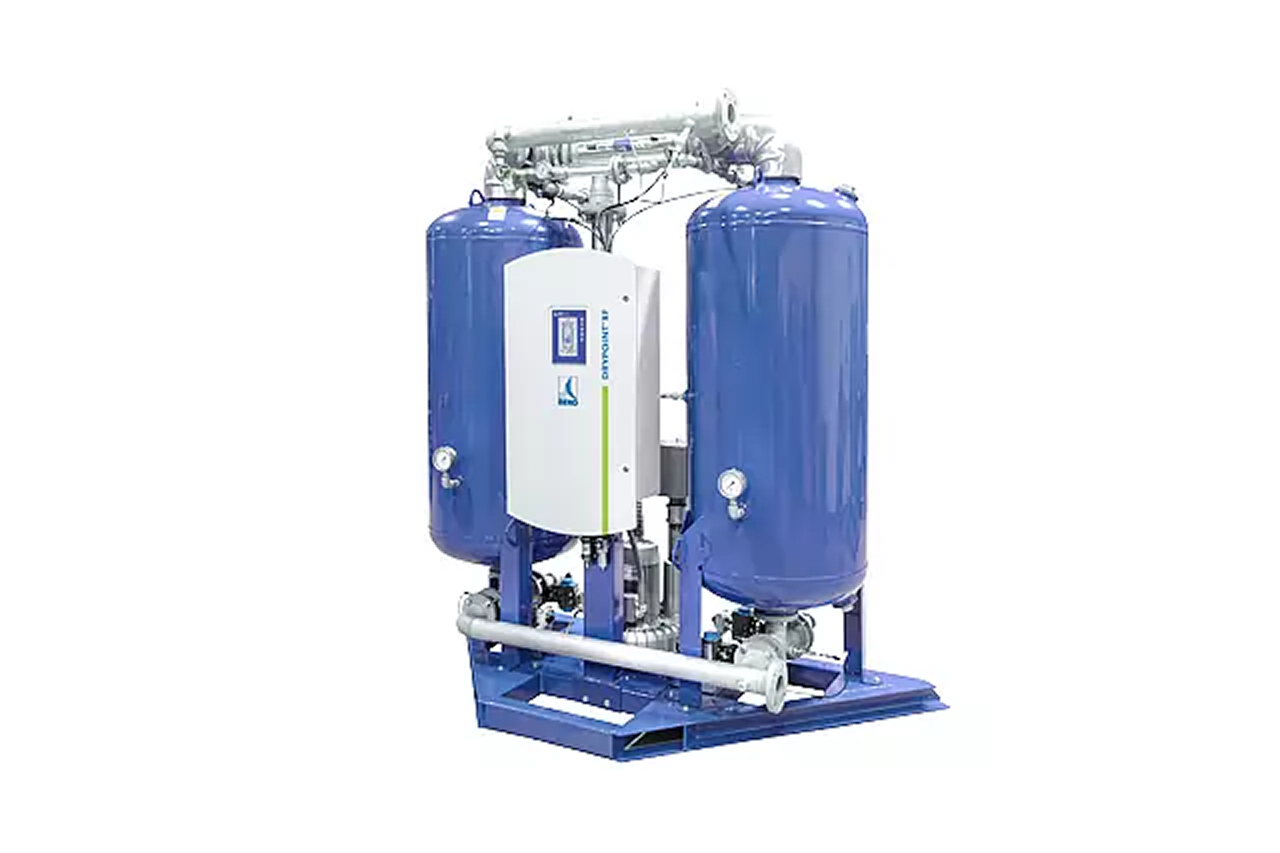
Real-world reference Representative explosion-proof desiccant dryer
Explosion-Proof Desiccant Dryer — representative product photo
02Why it's needed

Why this matters.

Tips and pointers on when an explosion-proof desiccant is the right call — and when to spec something else. Scroll the strip →

01 · Key point
It''s the only legal dryer inside the area.

Inside a NEC Class 1 Division 1/2 or ATEX zone, every unrated electrical component is an ignition risk and a code violation. A standard refrigerated dryer cannot be certified at any price — its refrigeration compressor and fan motor can''t carry the rating. Explosion-proof desiccant is the only path.

02 · Key point
Same chemistry, certified package.

Same twin-tower adsorption as any regenerative desiccant — same media, same -40°F to -100°F PDP. What''s different is the package: heaters, solenoids, controllers, drain valves all explosion-proof rated, sealed in classified enclosures, with code-compliant conduit and seal-offs.

03 · Key point
The certification is the moat.

No value-engineering, no aftermarket workaround, no field-modification path. The vendor either has the cert or doesn''t. Brand competition is on lead time, application engineering, and service network — not price. Recurring revenue on rated elements and 3-5 year desiccant refills is predictable and high-value per visit.

04 · Pro tip
Pull the exact rating before quoting.

"Explosion-proof" is a category, not a spec. Get Class / Division / Group (e.g. Class 1, Division 1, Groups C & D) or ATEX zone in writing from the plant electrical engineer or AHJ. Wrong rating = code violation + 8-16 week lead-time wasted. Set lead-time expectations honestly upfront.

05 · Where not to use
When the dryer can sit outside the area.

If layout allows the dryer in a non-classified utility room with only piped air entering the classified zone, the rated unit isn''t required. → Switch to standard desiccant at 1/2 to 1/3 the cost. Always walk the layout with the facility electrical engineer before assuming the upgrade is mandatory.

06 · Where not to use
Quoting just the dryer, not the train.

A rated dryer fed by a non-rated coalescing pre-filter, drain, valve, or sensor inside the classified area is a non-compliant install — the AHJ red-tags the whole package. → Spec the complete train to the classification: rated pre-filter, rated solenoid drain, rated after-filter, rated dew-point sensor. Single biggest install pitfall.

07 · Where not to use
Trying to field-modify a standard unit.

Certification applies to the unit as engineered, manufactured, and tested. Field mods void existing certs and create no new ones — no exceptions, regardless of lead-time pressure. → Bridge with a portable deliquescent during the 8-16 week wait, or relocate the dryer outside the classified area if process and layout allow.

03Key selection criteria

What we need to spec it right.

From the machine spec sheet → to the part number. Answer what you know — leave the rest blank — and send.

01 · Input
Per NEC Article 500, the facility's electrical engineer or AHJ assigns the rating. Pull the exact Class / Division / Group from the plant electrical drawings or area-classification study before quoting — "explosion-proof" alone is not a spec, and the wrong rating is a code violation.
Class I, Div 1, Group C & D (refinery / petrochem) · Class I, Div 2 (boundary / less restrictive) · Class II, Div 1/2 (combustible dust — grain / flour / sugar) · ATEX Zone 1 / Zone 2 (European equivalent)
02 · Input
Pull from the compressor nameplate. Size to at least 110% of compressor SCFM, plus purge allowance for the regeneration cycle.
Under 100 SCFM · 100-500 SCFM · 500-1000 SCFM · 1000-2500 SCFM · 2500+ SCFM
03 · Input
Pull from the application spec. Same desiccant PDPs apply — chemistry doesn't change with the rating. Media selection follows the spec.
-40°F PDP / Class 2 (activated alumina) · -70°F PDP · -100°F PDP / Class 1 (molecular sieve)
04 · Input
Confirm from the system gauge on the running line. Pressure rating must cover operating pressure with margin for the relief setting.
100 PSI · 125 PSI · 150 PSI · 175+ PSI (high-pressure)
05 · Input
Pull from the customer's production schedule. Drives heatless vs. heated-purge selection on the desiccant chemistry side, independent of the area classification.
Heatless (intermittent / smaller flow, 15-25% purge) · Heated purge (continuous, 2-10% purge) · Blower purge (500+ SCFM continuous, ~0% purge)
06 · Input
The dryer alone is half the install. Coalescing pre-filter is MANDATORY (oil/water carryover collapses desiccant); inside the classified area its housing AND drain valve must also carry matching hazardous-location rating. Standard non-rated components are a code violation regardless of how well they perform — AHJ red-tags the whole package.
Rated coalescing pre-filter + solenoid drain (mandatory) · Rated particulate after-filter · Rated activated carbon (oil-lubricated upstream) · Rated dew-point sensor (instrument-air loops) · Rated isolation valves
07 · Input
Number of dryer units for this configuration. Need a different size class? Add a separate quote line.
1 unit · 2-3 units (redundancy / staged) · 4+ units (multi-unit plant)

Need different sizes, colors, or quantities? Fill the form, add to quote, then fill again — each click is one quote line.

04Choose your solution tier  ·  core differentiator

Whatever your lever — spec, value, or price — SPC has the right brand.

Most distributors sell one brand per product type. SPC's 60-brand portfolio means every Product Type page surfaces three real options matched to how your customer is buying today. Pick the tier; the quote desk handles the cross-reference.

05How to sell this  ·  distributor talk track

The tier conversation closes the deal. The cross-reference catalog wins the next one.

You don't sell explosion-proof. The customer's plant electrical drawings sell it. Your job is to be the distributor who knows what to do when those drawings show up.
The SPC difference · how distributors actually buy

The 30-second positioning

Explosion-proof is a code-driven, no-substitute sale. The customer is not choosing it over refrigerated for moisture performance; they are buying the only product that can legally be installed in their classified area. That makes the conversation different from every other air-treatment sale — no tier comparison, no margin to "save" by downgrading, no brand-vs-brand commodity pressure. What matters instead is exact rating match, lead time, complete train compliance, and AHJ sign-off at commissioning.

The conversation has three pieces. First, pull the exact area classification from the plant's electrical drawings or area-classification study before quoting — "Class 1, Division 1, Group D" is a specific spec; "explosion-proof" alone isn't. The wrong rating is a code violation regardless of how close it looks on paper. If the customer can't produce the classification, the install is not ready to quote — route them to their plant electrical engineer or the facility AHJ. Second, spec the complete air train to the classification — coalescing pre-filter, particulate after-filter, condensate drains, isolation valves, dew-point sensors, and any other component physically inside the classified area must all carry matching ratings. The dryer alone is half the install. Third, set lead-time expectations honestly — explosion-proof dryers are low-volume catalog or engineered specials, typically 8-16 weeks from PO. Customers who think they're ordering a stock item are unpleasantly surprised; customers who know the lead time can plan the install around it.

Tier: The Industry Leader brand is effectively the entire North American category — purpose-built explosion-proof desiccant designs, full NEC Class/Division certification, deep experience with refinery and oil & gas accounts. The category doesn't have a meaningful "value tier" the way commercial refrigerated does — engineering the rated electrical package is expensive enough that low-cost competitors don't play. Brand competition is on lead time, application engineering, and service network — not price.

The recurring revenue is the desiccant media and rated filter elements — 3-5 year desiccant refill, 6-12 month coalescing/particulate element changes, all in classified-area-rated housings. Customers in oil & gas and petrochemical are typically on multi-year service contracts, which means MRO on this category is predictable, recurring, and high-value per visit.

Customer cue → talk move

"We're in a refinery / petrochemical plant / oil-gas facility"
Pull the area classification before doing anything else. If the install location is classified, explosion-proof is mandatory. If it's in a non-classified utility area outside the unit boundary, standard desiccant may be fine — confirm with the facility electrical engineer.
"The plant says we need explosion-proof"
Get the specific rating in writing (Class / Division / Group, or ATEX zone). "Explosion-proof" is a category, not a spec; engineering the wrong rating into the quote wastes weeks of lead time and risks a code violation at install.
"Can we just use a standard desiccant with the dryer in a non-classified room?"
Sometimes yes, sometimes no. If the dryer can be physically located OUTSIDE the classified area and only the air piping enters the classified zone, a standard desiccant in the non-classified utility room works. If the dryer must be inside the classified area, explosion-proof is mandatory. Worth checking layout before assuming the upgrade is required.
"Lead time concerns"
Be upfront. 8-16 weeks is typical for explosion-proof; some configurations longer. If the customer needs air drying immediately and the explosion-proof unit is months out, options are (a) install standard dryer in a non-classified location with piped air to the classified area, (b) rent a portable deliquescent for the interim, (c) accept the lead time.
"The whole air train needs to be rated?"
Yes. Pre-filter, after-filter, drains, valves, sensors — anything inside the classified area carries the same rating. Spec the complete train; quote it as a package. Customers who buy "just the dryer" and try to retrofit the rest fail the AHJ inspection.
"Replacing an existing explosion-proof dryer that failed"
Confirm the original classification is still current — area classifications can change with plant modifications or insurance audits. Pull updated drawings if it's been more than 5 years since original install. Sometimes the area has been reclassified to a less restrictive Division 2, which changes the product choice.
"We're in a Class II dust environment (grain elevator, flour mill)"
Different from Class I. Class II Division 1/2 is combustible dust (grain, sugar, plastic, metal powder). Class II rated options exist but the configuration is different from the Class I package. Confirm exact rating before quoting.
"What's the price premium vs. standard desiccant?"
Typically 2-3× the equivalent standard desiccant. Not a value-engineering opportunity — the certification IS the product. If budget is the constraint and the area can be reclassified or the dryer relocated, those are the only paths to cost reduction.
09Install · 8 critical steps

The things that matter on the first install.

Step 01
Verify the area classification matches the dryer's rating before uncrating
Pull the facility area-classification drawing and confirm the classified zone where the dryer will be installed matches exactly to the rating on the dryer's nameplate — Class, Division, Group. A Class 1 Division 1 dryer is correct in a Class 1 Division 1 area; it is NOT correct in a Class II dust environment. Wrong-rating mismatches catch on AHJ inspection, not at the loading dock.
Step 02
Spec and install ALL adjacent components to matching rating
Coalescing pre-filter, particulate after-filter, condensate drains, isolation valves, dew-point monitor, pressure gauges — every electrical or potentially-spark-producing component physically inside the classified area must carry matching hazardous-location rating. Plain pneumatic components (mechanical valves, non-electrical filters, copper piping) are usually fine; anything with a coil, contactor, or controller is not. Walk the full air-train BOM with the facility electrical engineer before install.
Step 03
Plan conduit runs and seal-offs per NEC code
Hazardous-area wiring requires rigid conduit (typically GRC — galvanized rigid conduit), explosion-proof junction boxes, and seal-off fittings at every transition between classified and non-classified areas. The wiring is a code item, not a convenience item — the AHJ inspects it and red-tags non-compliant runs. Have a hazardous-location-experienced electrician do the wiring.
Step 04
Pre-filter installation is mandatory and rated
As with any desiccant dryer, coalescing pre-filtration immediately upstream protects the desiccant bed from liquid/oil carryover. In a classified area, that pre-filter's drain valve must also be hazardous-rated — solenoid drains specifically; standard non-rated electronic-timer drains are non-compliant inside the classified zone. The dryer OEM and matching-rated component vendors supply rated drain packages.
Step 05
Route the dryer purge discharge per facility safety practice
The dryer's regen purge discharges air-plus-water to atmosphere — in a hazardous area this discharge must terminate at a location reviewed by the facility safety team. Some sites require piped routing to a safe vent stack outside the classified zone; some allow short local discharge with a silencer. The answer is site-specific and is part of the install permit conversation.
Step 06
Brine drain and condensate routing per facility hazardous-waste practice
Condensate from a desiccant running on oil-lubricated upstream air contains oil — in a refinery or chemical plant the routing to the facility's oil-water separator or hazardous-waste collection is dictated by site procedure. Confirm with the facility environmental team before install.
Step 07
Commissioning includes AHJ sign-off, not just OEM startup
Standard dryer commissioning (verify dew point, check switching, confirm drains operating) is necessary but not sufficient. The install also needs sign-off from the facility AHJ or the contracted hazardous-area inspector — they verify wiring, seal-offs, component ratings, and conduit runs against the area classification. Schedule this inspection in advance; AHJ availability is the most common cause of commissioning delay.
Step 08
Document the install for the facility hazardous-area file
The facility maintains a permanent file documenting every hazardous-area install — dryer model and rating, certification certificate, wiring diagrams, AHJ inspection sign-off, commissioning records. The customer's plant engineering team needs all of this for insurance audits, OSHA process safety management (PSM) compliance, and the next time the area is reclassified. Hand it over as part of the install package, not as a follow-up request weeks later.
10Troubleshoot · top failures

Most returns trace to one of these causes.

Symptom
Most likely cause
Fix
AHJ red-tagged the install at commissioning
A component in the air train doesn't match the area classification (most common — usually the pre-filter drain, an isolation valve, or a sensor that the installer assumed would be allowed because the dryer itself is rated), OR conduit runs / seal-offs don't meet NEC code, OR documentation is incomplete.
Pull the AHJ's red-tag notes — they will specify exactly what failed. Most failures are component-level (replace the offending non-rated component with a matching-rated equivalent) or wiring-level (have the electrician redo the run to code). Re-inspect once corrected. The dryer itself almost never fails AHJ inspection if it was specced to the correct classification; it's the surrounding train and wiring that catch.
Dryer trips on internal heater fault (heated-purge units)
Heater element has failed (standard desiccant troubleshooting), OR the explosion-proof heater enclosure has cracked or lost seal integrity and the safety circuit has tripped to prevent ignition risk.
Standard desiccant heater troubleshooting first — measure current on the heater during regen cycle. Electrical fault → replace the element per OEM (must be the explosion-proof rated replacement, not a standard heater). If the enclosure has lost integrity, the unit must be taken out of service until the enclosure is repaired or replaced — running a damaged explosion-proof enclosure in a classified area is a code violation.
Pressure dew point climbing above rated PDP
Same root causes as any desiccant dryer — desiccant contaminated by upstream liquid/oil carryover, desiccant exhausted at end of service life, switching cycle drift, or demand exceeding rated capacity.
Standard desiccant troubleshooting flow applies — verify coalescing pre-filter is functioning, inspect desiccant media for contamination, check switching cycle, verify actual flow against rated. The desiccant chemistry isn't different just because the dryer is explosion-proof. In a classified area, the inspection and service work must be done with the dryer isolated and the area gas-tested by the facility safety team — adds time and cost to every service event.
Purge discharge silencer damaged or missing
Silencer failed at high temperature, was removed during a recent service and not reinstalled, OR was never installed (occasional install oversight).
Replace per OEM with rated silencer. Purge discharge in a classified area without a silencer creates noise AND potentially-flammable mist discharge — the silencer is a safety component on these installs, not a quality-of-life addition.
Solenoid drain valve failure
Same wear modes as any solenoid drain (coil failure, valve seat fouling, controller drift) — but on an explosion-proof unit the replacement valve must carry matching hazardous-area rating.
Replace with OEM-spec rated valve only. A standard solenoid drain valve fits and works, but it is a code violation inside the classified area. Plant electrical and safety teams sometimes catch this on routine PM walkdowns and the customer gets a non-compliance notice.
Customer asking about field-modifying a standard desiccant to be explosion-proof
Lead time on the rated unit is too long; budget pressure to avoid the rated-unit premium; customer doesn't understand the certification model.
Honest conversation — there is no field modification path to an explosion-proof rating. The certification applies to the unit as engineered, manufactured, and tested. Field modifications void any existing certs and don't create new ones. The only paths are (a) buy the rated unit, (b) relocate the dryer to a non-classified area and pipe air to the classified zone, or (c) work with the facility to reclassify the area if process changes allow it.
Area has been reclassified since original install
Plant modifications, insurance audit, or process changes have changed the area's classification — could be more restrictive (Class 1 Div 2 → Class 1 Div 1) or less restrictive (Class 1 Div 1 → unclassified).
More restrictive reclassification means the existing dryer is now under-rated and must be replaced or relocated; less restrictive means the existing dryer is still compliant but the customer could have used a standard desiccant if it were a new install. Pull updated classification drawings to confirm; if the area has changed, plan the install update at the next major plant outage.

Get the right explosion-proof desiccant dryer on quote in 24 hours.

Send us the application — a specialist routes you to the correct tier with a configured part. Lead-times and pricing returned within one business day.

Request a quote