DISTRIBUTOR-FIRST SUPPLY PARTNER · SINCE 1999 Live · Compressed Air System
SPC Company
Compressed Air / Generation / Compressors
System · Compressed Air Layer 1 · Generation 6 product types

Compressors

Six compressor types, one decision. What's the duty cycle, what does the air touch, where does the unit live, and how much downtime can the plant absorb? This page walks the spec from "I need a compressor" to the right type, size, and brand tier on the quote — comparison first, decision tree second, questions to ask third.

The Compressors family 6 types · Generation

Tap any type to jump to its page. The Decision Guide further down asks three questions that funnel the spec to one of these.

01What this category is

The compressor sets the air system. Every layer downstream is sized to what this box puts out.

What it is
The head of the whole air system

Six compressor types make the air every other layer is sized, treated, and stored against. Start here or nothing downstream is right.

The decision
It's a duty-cycle call, not a horsepower one

Intermittent shop work routes to reciprocating or portable; continuous plant duty routes to rotary screw — fixed-speed if steady, VFD if demand swings.

Hard yes/no
Oil-free is a qualification, not an upgrade

Food, pharma, medical, electronics, fine finishing where air touches product = Class 0 oil-free, full stop. Downstream filtration never substitutes for it at the source.

Why it matters
Get it wrong and there's no fix downstream

Undersized starves the plant on every peak; oversized short-cycles and burns power; the wrong type for the duty overheats and dies young.

Watch out
A second pump at 100% isn't redundancy

Size duplex/triplex so one pump out still covers full demand, against a receiver sized on combined output — not nameplate.

The anchor
Every compressor is a 7-15 year service stream

Oil, filters, separators, rebuilds — the quote sets both the energy bill and the MRO cadence for the life of the plant. Quote the full stack.

02The 6 types · side-by-side

Best-for, key trade-off, capacity, price band, and how deep the brand bench runs.

Download PDF

Distributor-facing reading. The trade-off column is the one that closes the loop — every type buys something and gives something up. Knowing what each type costs you is how the right one gets on the quote without a callback.

Product type
Best for
Key trade-off
Typical capacity
Price band
Brands SPC carries
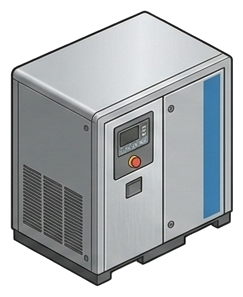
Rotary Screw — Fixed-Speed Continuous plant duty · steady load · ~4 CFM/HP
The industrial workhorse. Production-line air, automotive plants, plastics, woodworking, food packaging (non-direct-contact). Any operation that runs air all day at a roughly steady draw within ~30% of rated capacity. The default compressor for industrial duty when demand stays close to rated.
Wastes energy on swinging demand An unloaded motor still draws 25-40% of full-load power without producing air. If demand swings wider than ~30% of rated, the unloaded cycles burn $4-8K/year of electricity making nothing — that's the case for a VFD, not fixed-speed.
5 – 500+ HP · 20 – 2,000+ CFM
belt-drive (stocked) · direct-drive (lead-time)
$$ – $$$
5 / 5 · deep
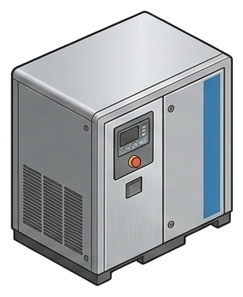
Rotary Screw — VFD Variable demand · 25-50% energy savings · single-setpoint pressure
Multi-shift and batch plants. Any facility where air demand swings hard across the day — multi-shift manufacturing, batch chemical, auto assembly, food packaging, plastics with cycling presses. Holds pressure on a single setpoint instead of drifting across a band, which is a second energy dividend on top of matched-demand savings.
Premium upfront · electronics to fail Roughly $2-5K premium over fixed-speed, repaid in 1-3 years on energy where demand actually swings. Drive cabinet derates above 104°F ambient. Multi-VFD plants need harmonic mitigation (line reactor or active filter) to stay inside IEEE 519.
5 – 450+ HP · 20 – 1,800+ CFM
induction motor · permanent-magnet (premium tier)
$$ – $$$
3 / 5 · solid
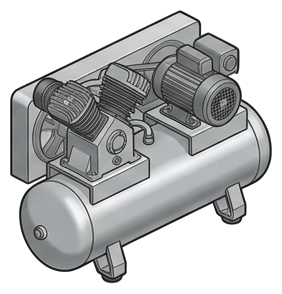
Reciprocating Intermittent shop duty · 60-70% loaded · field-rebuildable
Shops, body work, small fabrication. Two-bay auto shops, body shops, small machine shops, agricultural buildings, residential garages, equipment-rental yards. The entry point of the category — lowest upfront cost, simplest mechanism, common-parts rebuild. Two-stage cast-iron Quincy QR-25 class is a 15-year machine when the duty cycle stays honest.
Not continuous duty · loud Cast-iron pump capped at ~60-70% loaded time per hour; run harder and it overheats, the rings glaze, valves cook, and rebuild interval collapses. 80-90 dB versus rotary screw's 60-75. If the customer's real duty is continuous, recip is the wrong tool.
Fractional HP – 30+ HP · 1 – 120+ CFM
single-stage to ~175 PSI · two-stage to ~200 PSI
$ – $$
5 / 5 · deep
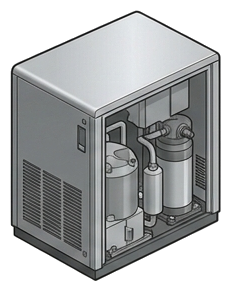
Oil-Free ISO 8573-1 Class 0 · screw / tooth / scroll
Food, pharma, medical, electronics, fine finishing. Any application where compressed air touches product, package, or process gas directly. Pharma fill-finish, food packaging blowoff, semiconductor wafer handling, dental and lab air, automotive paint, breathing-air supply. The architectural answer to "no oil allowed" — certified Class 0, not "low oil."
2-3× the cost · still needs treatment Roughly 2-3× the price of an equivalent oil-lubricated unit; ~5-10% lower full-load efficiency from tighter tolerances and extra cooling. Oil-free at the source does NOT dry the air or remove particulate — downstream dryer + filtration is still the full stack.
1.5 – 500+ HP · 4 – 2,000+ CFM
scroll · rotary tooth · two-stage screw
$$$
2 / 5 · Atlas Copco + ELGi
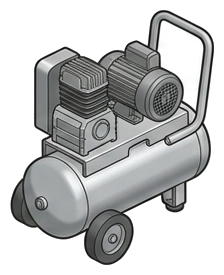
Portable / Contractor Wheeled or skid · 120V / 240V / generator / off-grid
Take the air source to the work. Framing and roofing crews, mobile auto service, body-shop frame work, agricultural service, disaster response, equipment-rental fleets. Reciprocating mechanics on a wheeled or skid frame — sized small (fractional HP to ~10 HP) for the air budget of one crew.
Off-grid needs the dryer pairing Most distributors quote the compressor and forget the dry-air problem. No-power sites need a deliquescent dryer paired with the compressor — passive vessel, dry-desiccant tablets, no electricity. The off-grid stack is moving compressor + passive dryer; ignore that and the customer can't run paint or finish work on the job.
Fractional HP – 10 HP · 2 – 35 CFM
hand-carry · wheeled · skid (forklift)
$ – $$
1 / 5 · Castair only
Duplex / Triplex System Two or three pumps · shared receiver · lead-lag staging
Uptime is the priority. Hospitals on NFPA 99 medical air (code-required redundancy), continuous- process chemical and semiconductor, automotive paint and finishing on JIT contracts, food and beverage packaging, plants outgrowing their original single compressor. When a day's air outage costs more than the second pump.
Size for one-pump-out, not nameplate Duplex with both pumps at 100% of demand is not redundant — it's just two compressors. Quote duplex sized so a single pump covers full demand (or triplex so two pumps do). Shared receiver goes against COMBINED output (4-6 gal/CFM combined); undersized tank short-cycles the lead regardless of how clever the stager is.
10 – 60+ combined HP · 35 – 200+ combined CFM
lead-lag staging · alternating-lead wear balancing
$$ – $$$
2 / 5 · Atlas Copco + Castair

Reading the brand bench column — the bar shows how many of SPC's tier slots (Industry Leader · Emerging · Economical · adjacent) carry an option at that product type. A deep bench means a price-driven and a spec-driven option both close cleanly; a narrow bench means the available brands map closely to the technical requirements and the comparison stops being a tier choice. Generation has SPC's deepest brand bench in the whole system on the reciprocating and fixed-speed-screw rows; the bench narrows deliberately on oil-free (Class 0 architecture has real engineering content that economical-tier makers don't deliver reliably) and on portable (most contractor portables in the field are Castair-class regardless of badge).

03Decision guide

4 questions “Funnel the Spec” to one product type.

Download PDF

Draw a line from the customer's answer at the top to the type name at the bottom. This is the page distributors screenshot and send to a customer the day before a quote call — so the customer comes prepared with the answers, and the call is about the brand and the budget, not the basics.

Use this Download the PDF above, print it, drop it in an email to the end customer, or screenshot the tree below. The questions and the type recommendations are designed to stand on their own without the rest of the page.
START AT THE TOP  ·  FOLLOW THE PATH DOWN  ·  END ON THE PRODUCT TYPE
Question 1
How does the customer actually use compressed air?
Continuous plant duty · runs all day
Question 2a
Does air demand stay within ~30% of rated, or swing wider?
If Steady within ~30%
Recommend
Rotary Screw — Fixed-Speed
The industrial default. Lowest upfront cost at continuous duty, simple load/unload control, 60-75 dB, 100% duty cycle. Deepest brand bench in the category — five tiers available.
See product type →
If Swings wider than ~30%
Recommend
Rotary Screw — VFD
Slows the motor to track demand instead of cycling loaded/unloaded. 25-50% energy savings versus fixed-speed on swinging loads; typical 1-3 year payback. Holds pressure on a single setpoint.
See product type →
Intermittent shop use · runs in bursts
Question 2b
Does the compressor stay bolted to the floor, or does it move with the work?
If Fixed install · shop or bay
Recommend
Reciprocating
Lowest upfront cost of any compressor type, field-rebuildable with common parts. Two-stage cast-iron at 5-10 HP is a 15-year machine in honest intermittent duty. Quincy QR-25 class for the durable spec; ABAC / Castair for the cost-driven shop.
See product type →
If Moves to the work · crews or service
Recommend
Portable / Contractor
Reciprocating mechanics on a wheeled or skid frame. Sized for one crew's air budget; single-phase, generator, or off-grid power. Pair with a deliquescent dryer when the job site has no electricity.
See product type →
Air-quality critical · oil contact is a problem
Recommend
Oil-Free
ISO 8573-1 Class 0 — zero detectable oil at the source. Mandatory for food / pharma / medical / electronics / fine finishing where oil contamination spoils product or fails an audit. Atlas Copco AQ + SF for spec-driven accounts; ELGi OF for cost-driven Class 0. Downstream filtration alone does NOT substitute architecturally.
See product type →
Uptime critical · outage stops production
Question 2d
Is the demand redundancy-driven, or capacity-and-redundancy?
If Single-pump-out coverage
Recommend
Duplex / Triplex System
Two or three pumps on a shared receiver with lead-lag staging. Size so a single pump covers full demand; the second is the insurance policy. Standard for NFPA 99 medical air and JIT-contract production plants.
See product type →
If Existing pump still serviceable
Recommend
Duplex / Triplex (replace-as-duplex)
The cleanest sale in the category. Old pump becomes the backup; new matched pump becomes the lead; lead-lag panel coordinates. Customer gets redundancy at the cost of a single new pump + panel + tank.
See product type →

If the customer doesn't know the answer to the root question, work it backward from the tool list and the production schedule: "Across an average hour, how many minutes is the compressor actually compressing — not just powered on?" Under ~40 minutes is intermittent (recip or portable). Over ~40 minutes is continuous (rotary screw — fixed-speed or VFD). Oil-free is layered on top regardless: if the air touches food, drug product, medical patients, semiconductor wafers, paint, or breathing air, route to oil-free first and pick the size second. Redundancy is the same overlay logic: if a day's outage scraps a batch or fails a customer contract, duplex / triplex is the right form factor for whichever type the duty cycle picks.

The compressor decision sets the air system. Get it wrong and every other piece of the system gets compromised — get it right and the rest of the layers have a clean foundation to work against.
SPC distributor playbook Compressors · how to quote in one call
04Questions to ask the customer · before you quote

8 inputs determine the right compressor.

Download PDF

If the customer answers most of these at the first call, the second call is the quote. If they can't answer any, the compressors are rarely the only spec gap — flag it and push for a site walk.

01
What's the duty cycle — across an average hour, how many minutes is the compressor actually loaded?
The single most important question on every compressor quote. Under ~40 min/hr = intermittent (recip or portable). Over ~40 min/hr = continuous (rotary screw). Customers who under-report duty cycle get a recip that overheats in 18-24 months; customers who over-report get a rotary screw that short-cycles and burns electricity. Pull run-hour records on replacement quotes, not just the customer's estimate.
02
What's the peak CFM at working pressure, and how steady is demand across the day?
Size to peak demand + 25% safety factor. Rule of thumb: ~4 CFM per HP at 100 PSI (rotary screw and oil-free), ~3.5 CFM/HP for reciprocating. Demand steady within ~30% of rated = fixed-speed wins; demand swings wider = VFD recovers 25-50% on the electric bill. Most customers underestimate peak by 20-30% because they don't account for simultaneous tool use.
03
Does compressed air touch product, package, process gas, or breathing-air supply directly?
The oil-free qualification, full stop. Food packaging blowoff, pharma fill, semiconductor wafer handling, dental drill drive air, automotive paint supply, breathing-air filling stations — all are direct-contact and require ISO 8573-1 Class 0 oil. Downstream filtration alone does NOT reach Class 0 from an oil-lubricated source; oil-free is architectural, not a filtration upgrade.
04
What's the available electrical service — single-phase or three-phase, what voltage?
Limits the model before any other conversation. Most recips above ~7.5 HP need three-phase; almost all rotary screw and oil-free above ~10 HP are three-phase. Single-phase shops asking for 10+ HP need either a service upgrade or a duplex of smaller pumps, not a phase converter on the motor. Verify panel capacity for the motor's inrush, not just steady-state.
05
Indoor or outdoor, and what's the compressor-room ambient temperature in summer?
Rotary-screw airends derate above 100°F inlet; VFD drive cabinets derate above 104°F ambient and fault around 122°F. The #1 warm-weather complaint on VFD installs is preventable with cabinet AC or drive relocation. Reciprocating compressors throw more heat into the room than rotary screw — ventilation matters more on recip rooms than customers expect.
06
What happens at this facility when the compressor goes down for a day?
The redundancy qualification. Job shop with two days of buffer inventory might accept the outage. Continuous-process plants, hospitals, paint lines, JIT-contract suppliers almost always have downtime cost that dwarfs the duplex premium — but they don't know it until the first outage. Quantify lost shift × labor + scrap + customer-penalty exposure honestly.
07
For portable / contractor work — what power source is available on the job site?
Single-phase 120V caps around 1.5-2 HP. Single-phase 240V handles 3-7.5 HP. Generator-fed needs the generator sized at ~2× motor kW for inrush. No power at all routes to the off-grid stack: portable compressor + deliquescent dryer (passive desiccant vessel, no electricity required). Most distributors miss the dryer pairing and the customer can't run paint or finish work.
08
What downstream treatment, distribution, and condensate handling is in place — or part of this quote?
Quote the system, not the box. Every compressor needs receiver (4-6 gal/CFM), dryer (refrigerated for indoor general, desiccant for pharma / outdoor / sub-38°F dewpoint), pre/post filtration, electronic- timer condensate drain on every drain point, and an oil-water separator on the OWS discharge. Don't let the customer "install the dryer later" — it never happens later, and the system rusts. Discharging oily condensate to sanitary sewer is a regulatory violation in most jurisdictions ($10K+ fines).
05Where this category lives

Generation is the head of the line in any compressed air system — everything downstream is sized, treated, stored, and distributed against whatever the compressor actually produces. Get this layer wrong and there is no fix downstream: an undersized compressor starves the plant on every demand peak; an oversized one short-cycles and burns electricity making air nobody is using; the wrong type for the duty cycle overheats and dies young; the wrong type for the air-quality requirement contaminates product the first shift and fails the audit the next. Generation is also where the recurring service relationship begins — every compressor sold is a seven-to-fifteen-year stream of oil, filters, separators, and rebuilds — so the decision made at the quote sets both the energy bill and the MRO cadence for the life of the plant. Get it right once and the rest of the system has a clean foundation to work against.

Categories in this layer

Not sure which type? Send us the use case.

Tell us the end-use, the rough flow, and what climate the unit would sit in. We'll come back with a configured quote — the right type, the right tier, and the upstream gear the warranty assumes.