DISTRIBUTOR-FIRST SUPPLY PARTNER · SINCE 1999 Live · Compressed Air System
SPC Company
Compressed Air / Treatment / Air Treatment
System · Compressed Air Layer 2 · Treatment 2 product types

Air Treatment

Two upstream knockouts, one job. The aftercooler pulls heat and drops the bulk water at the compressor discharge; the water separator catches the liquid still riding the line before it hits the dryer. This page walks what each one does, when to quote both, and how getting this stage right cuts the dryer's job — and its failure rate — in half.

The Air Treatment family 2 types · Treatment

Tap any type to jump to its page. The Decision Guide further down asks three questions that funnel the spec to one of these.

01What this category is

Air Treatment is the bulk-water work that happens before the dryer ever sees the air.

What it is
The bulk-water stage before the dryer

Aftercooler plus water separator — the two upstream knockouts that strip liquid out of the air before it ever reaches the dryer.

The decision
A sequence, not an either/or

The aftercooler cools and drops the heat at the discharge; the separator catches the liquid still riding the line. Humid climates need both.

Why it matters
70-80% of the daily condensate drops here

Air leaves the element at 200-300°F and fully saturated. Knock the bulk water out here or the dryer is flooded, tripping, and shedding carryover.

The payoff
It cuts the dryer's job in half

Every gallon caught here is a gallon the dryer doesn't handle as vapor — the stage that makes the dryer's spec actually mean something.

Watch out
Hot rooms and failed drains undo it

Air-cooled aftercoolers degrade hard above 100°F ambient; the separator's float drain is the wear item — fail it and bulk water dumps downstream.

02The 2 types · side-by-side

Best-for, key trade-off, capacity, price band, and how deep the brand bench runs.

Download PDF

Distributor-facing reading. The trade-off column is the one that closes the loop — every type buys something and gives something up. Knowing what each type costs you is how the right one gets on the quote without a callback.

Product type
Best for
Key trade-off
Typical capacity
Price band
Brands SPC carries
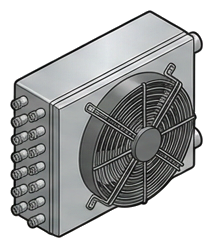
Integrated Aftercooler Air-cooled or water-cooled · approach 15-25°F over ambient
The single highest-leverage knockout. Standard on every modern packaged rotary screw and most packaged recip compressors. Retrofit answer for any older install where the customer is complaining about wet tools, short dryer life, or water at every drain point.
Inside the compressor envelope Almost always specified and warranted as part of the compressor itself, not as a separate quote line. Performance degrades sharply in hot compressor rooms (above 100°F ambient) — fouled fins and lost cooling airflow are the most common failure modes.
Matched to compressor full-load CFM
air-cooled · water-cooled
$ – $$
2 / 5 · Castair + Ozen Air
Water Separator Cyclonic bulk-liquid catch · no media to replace
The dryer's first line of defense. Humid-climate plant air, high-duty-cycle systems, any install where the dryer is sized close to capacity. The single highest-ROI retrofit for any customer whose refrigerated dryer trips on saturated outlet in summer.
Liquid only, not vapor Removes free liquid water by centrifugal force — doesn't touch water vapor (that's the dryer's job) or oil aerosol (that's coalescing). The float drain is the wear item; failed drains overflow and dump bulk water downstream into the dryer.
Sized to system SCFM + 25% headroom
cyclonic · vertical-mount
$
1 / 5 · Walker Filtration only

Reading the brand bench column — the bar shows how many of SPC's tier slots (Industry Leader · Emerging · Economical · adjacent) carry an option at that product type. A deep bench means a price-driven and a spec-driven option both close cleanly; a narrow bench means the available brands map closely to the technical requirements and the comparison stops being a tier choice.

03Decision guide

2 questions “Funnel the Spec” to one product type.

Download PDF

Draw a line from the customer's answer at the top to the type name at the bottom. This is the page distributors screenshot and send to a customer the day before a quote call — so the customer comes prepared with the answers, and the call is about the brand and the budget, not the basics.

Use this Download the PDF above, print it, drop it in an email to the end customer, or screenshot the tree below. The questions and the type recommendations are designed to stand on their own without the rest of the page.
START AT THE TOP  ·  FOLLOW THE PATH DOWN  ·  END ON THE PRODUCT TYPE
Question 1
Is the air already past the compressor's discharge, with bulk liquid still riding the line upstream of the dryer?
No · we're spec'ing a compressor install
Recommend
Integrated Aftercooler
Drop the heat and ~70-80% of the moisture right at the compressor discharge before anything else sees it. Verify the new compressor package includes one; retrofit a standalone on older recip installs.
See product type →
Yes · we have aftercooling but the dryer's getting flooded
Recommend
Water Separator
Cyclonic bulk-liquid catch immediately upstream of the dryer. Single highest-ROI retrofit for August dryer-trip complaints; no media to replace, just a float drain.
See product type →

These two products aren't an either/or in most plants — they're a sequence. The aftercooler is at the compressor; the water separator sits between the wet receiver and the dryer. On humid-climate installs, you want both in the train, and the question above just gets you to the one the customer is currently missing.

Every gallon of liquid water you knock out here is a gallon the dryer doesn't have to handle as vapor. This stage is what makes the dryer's spec actually mean something.
SPC distributor playbook Air Treatment · the stage before the stage
04Questions to ask the customer · before you quote

8 inputs determine the right air treatment.

Download PDF

If the customer answers most of these at the first call, the second call is the quote. If they can't answer any, the air treatment are rarely the only spec gap — flag it and push for a site walk.

01
Does the existing compressor have an integrated aftercooler at all?
Most modern packaged rotary screws do — older reciprocating compressors frequently don't. Look for a visible cooling fan and a condensate drain at the discharge port. If the answer is "I don't know" and the customer is complaining about wet tools, this is the first place to check. A surprising number of older recip installs never had one.
02
What's the climate and the season — humid, dry, summer peak, winter low?
A 100 SCFM compressor in 80% RH Gulf Coast summer dumps 5-15 gallons of liquid water per day into the separator; the same compressor in Phoenix dumps a fraction of that. Humid-climate installs need both aftercooler AND water separator; dry-climate installs can sometimes get away with aftercooler alone.
03
What's the compressor room ambient temperature — especially under summer load?
Air-cooled aftercoolers degrade hard above 100°F ambient. If the compressor room runs hot, either improve ventilation, switch to a water-cooled aftercooler, or accept that the dryer downstream will need extra headroom. Measure it — don't guess.
04
Is the dryer downstream sized close to its rated capacity?
Refrigerated dryers degrade fast when fed more liquid water than their refrigeration circuit can handle. A dryer at 80%+ of rated CFM with no water separator upstream will trip on saturated outlet in the first humid week of summer. The separator gives the dryer headroom.
05
What's the current condensate drain situation at the aftercooler and the wet receiver?
Aftercoolers are the system's largest single condensate source (70-80% of total). Manual drains get forgotten; plain float drains foul on oily condensate. Electronic-timer drain is standard install practice at both the aftercooler and the receiver, routed to an oil-water separator before sewer.
06
Is the air going somewhere with an ISO 8573-1 cleanliness spec?
Pharma, food contact, paint, electronics — these jobs come with an ISO class for particulates, water, and oil. The Treatment stage is the upstream protection that lets the dryer + filtration train downstream actually hit those numbers. Document the class on the quote so the install matches what the audit expects.
07
Is the install indoor with reliable utilities, or outdoor / under-roof / mobile?
Outdoor installs see higher humidity loads and additional in-line condensation as the piping cools further. Outdoor → upsize the separator and add freeze protection on the drain. Mobile / contractor packages often skip the separator entirely and pay for it in dryer failures.
08
Coalescing filter elements upstream of the dryer plugging up every 3 months instead of 12?
Classic symptom of missing upstream treatment. The coalescing sumps are being overrun by bulk liquid water that should have been knocked out at the aftercooler and separator. Adding the water separator drops coalescing sump volume dramatically and extends element life back to spec.
05Where this category lives

Compressed air leaves the compressor hot, oily, and saturated with water vapor. Without the Treatment layer, that condition gets piped straight to every machine, valve, sensor, and finished surface downstream — and pneumatic equipment isn't built to tolerate it. Treatment is the four-stage conditioning train that turns plant air into the supply each piece of equipment was actually engineered for: pull the heat out, drop the bulk water, condition the dew point to the use-case spec, then polish out the remaining oil and particulate. Get this layer wrong and the customer feels it everywhere — rust in receivers, ice in winter lines, fouled instruments, ruined finish. Get it right once and it disappears.

Categories in this layer

Not sure which type? Send us the use case.

Tell us the end-use, the rough flow, and what climate the unit would sit in. We'll come back with a configured quote — the right type, the right tier, and the upstream gear the warranty assumes.