What it is
The cleanup pass after the dryer
Six filter types strip what's left — dry solids, liquid oil, gaseous vapor, medical bioburden — before the air ever reaches the application.

Filtration isn't a filter — it's a stack. Each stage captures a different contaminant, and skipping one breaks every stage behind it. This page walks the six product types, what each one does, where each one sits in the train, and how to spec the right stack so the customer's air quality matches the audit they're trying to pass.
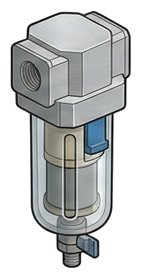 Coalescing Filter
 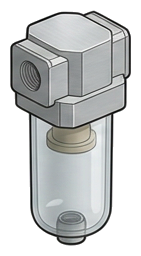 Particulate Filter
 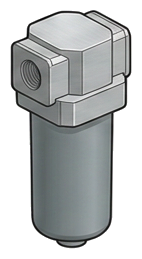 Activated Carbon Filter Medical Sterile Filter Intake Silencer Filter Silencer
 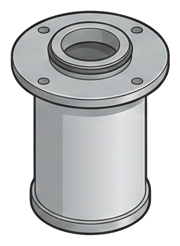 Air Oil Separator
 Tap any type to jump to its page. The Decision Guide further down asks three questions that funnel the spec to one of these.
Six filter types strip what's left — dry solids, liquid oil, gaseous vapor, medical bioburden — before the air ever reaches the application.
Each contaminant needs its own physics and its own stage. Skip one and you break every stage behind it.
Pre-filter catches solids; coalescing merges liquid oil and water mist; carbon adsorbs the vapor that only Class 0 needs. Sequence is the spec.
Air leaves the compressor hot, oily, and saturated — pipe that untreated to valves, sensors, and finished surfaces and the customer feels it everywhere.
Coalescing dying at 3 months instead of 12 means the particulate pre-filter is missing. Carbon has no DP warning — replace on the calendar.
The highest-cost, most-replaced consumable on every rotary screw — cross it by OEM make/model, anchor of the annual service kit.
Distributor-facing reading. The trade-off column is the one that closes the loop — every type buys something and gives something up. Knowing what each type costs you is how the right one gets on the quote without a callback.
Reading the brand bench column — the bar shows how many of SPC's tier slots (Industry Leader · Emerging · Economical · adjacent) carry an option at that product type. A deep bench means a price-driven and a spec-driven option both close cleanly; a narrow bench means the available brands map closely to the technical requirements and the comparison stops being a tier choice.
Draw a line from the customer's answer at the top to the type name at the bottom. This is the page distributors screenshot and send to a customer the day before a quote call — so the customer comes prepared with the answers, and the call is about the brand and the budget, not the basics.
Two universal rules behind the tree: coalescing always installs upstream of any desiccant dryer (oil carryover ruins desiccant media fast), and activated carbon always installs downstream of coalescing (liquid oil saturates carbon in days). The rotary-screw air-oil separator isn't a stage in the customer's filter train — it lives inside the compressor package and gets quoted on the service-parts cross, not as part of a downstream build.
Filtration isn't a filter — it's a stack. Sell the stack and the customer hits their audit. Sell one element and they fail it.
If the customer answers most of these at the first call, the second call is the quote. If they can't answer any, the filtration are rarely the only spec gap — flag it and push for a site walk.
Compressed air leaves the compressor hot, oily, and saturated with water vapor. Without the Treatment layer, that condition gets piped straight to every machine, valve, sensor, and finished surface downstream — and pneumatic equipment isn't built to tolerate it. Treatment is the four-stage conditioning train that turns plant air into the supply each piece of equipment was actually engineered for: pull the heat out, drop the bulk water, condition the dew point to the use-case spec, then polish out the remaining oil and particulate. Get this layer wrong and the customer feels it everywhere — rust in receivers, ice in winter lines, fouled instruments, ruined finish. Get it right once and it disappears.
Aftercoolers + water separators — the first stage of drying, drops the bulk water out of the air before it ever reaches the dryer.
→The core of air treatment — removes the water vapor that would otherwise corrode lines, foul tools, and ruin product.
→The final cleanup — strips oil, particulate and odor downstream so the air matches what the application can tolerate.
Handles the water the dryer and aftercooler pull out — timer drains, zero-loss drains, and oil-water separators.
→Tell us the end-use, the rough flow, and what climate the unit would sit in. We'll come back with a configured quote — the right type, the right tier, and the upstream gear the warranty assumes.
—. We reply within one business day with pricing, lead-time, and configured parts.