DISTRIBUTOR-FIRST SUPPLY PARTNER · SINCE 1999 Live · Compressed Air System
SPC Company
Compressed Air / Treatment / Air Dryers
System · Compressed Air Layer 2 · Treatment 5 product types

Air Dryers

Five dryer types, one decision. Which dew point does the end-use need, where does the air go after the dryer, and what does the install environment demand? This page walks the spec from "the customer says their air is wet" to the right product on the quote — comparison first, decision tree second, questions to ask third.

The Air Dryers family 5 types · Treatment

Tap any type to jump to its page. The Decision Guide further down asks three questions that funnel the spec to one of these.

01What this category is

A dryer takes moisture out of compressed air after the aftercooler has done all it can.

What it is
The core of air treatment

The dryer takes over where the aftercooler stops — pulling the pressure dew point down to whatever the end-use actually tolerates.

The decision
Dew point is the whole spec

Not horsepower, not airflow — the target dew point is what splits five types apart. A bottling line is happy at +38°F; laser optics aren't.

Rule of thumb
Default to refrigerated until something forces a step

Sub-+35°F spec, outdoor or freezer runs, a hazardous-area classification, or no electrical — each kicks the spec to desiccant, membrane, EP, or deliquescent.

Why it matters
Size to load and ambient, not the plate

Dryers rate at 100 PSIG / 100°F inlet — every 18°F over rating roughly halves capacity. Get the actual inlet condition, not the discharge plate.

Watch out
Desiccant dies on oil carryover

A coalescing filter ahead of every desiccant is non-negotiable; without it the warranty doesn't survive the first quarter.

02The 5 types · side-by-side

Best-for, key trade-off, capacity, price band, and how deep the brand bench runs.

Download PDF

Distributor-facing reading. The trade-off column is the one that closes the loop — every type buys something and gives something up. Knowing what each type costs you is how the right one gets on the quote without a callback.

Product type
Best for
Key trade-off
Typical capacity
Price band
Brands SPC carries
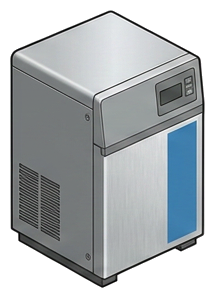
Refrigerated The default · dew point ~38°F
Most plants, most jobs. Standard plant air, assembly, packaging, paint shops with downstream filtration, anything inside a heated building with reliable electrical.
Floor at +38°F Cannot go below freezing dew point. If the air sees outdoor pipe runs in winter, or an end-use needs instrument-grade dryness, this type alone is not enough.
5 – 3,000+ CFM
non-cycling · cycling · digital
$ – $$
5 / 5 · deep
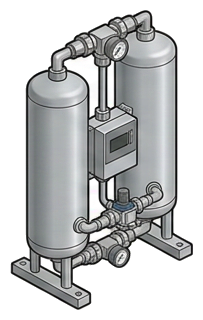
Desiccant · Regenerative Twin tower · dew point ‑40°F to ‑100°F
Instrument-grade dry air. Outdoor or freezer-line distribution, paint booths with electrostatic guns, laser optics, pharmaceutical, semiconductor, transit-applied compressed air on rolling stock.
Purge loss + footprint Heatless designs consume ~15% of dried-air capacity as purge to regenerate the off-line tower. Twin-tower footprint is double a refrigerated of the same flow. Desiccant media is a consumable on a 3–5 year cycle.
20 – 3,000+ CFM
heatless · heated · heated-blower purge
$$ – $$$
4 / 5 · solid
Deliquescent Single tower · dew point ~20–25°F below inlet
Portable, remote, no power. Pipeline operators, well-pad service, construction sites, contractors with diesel-driven portables. Anywhere the dryer has to follow the air, not the air follow the dryer.
Salt is a consumable Desiccant tablets dissolve as they work — refill is on a regular service interval. The dissolved brine drains as a corrosive byproduct that has to be handled. Dew-point performance is the shallowest of the five types.
Portable to ~600 CFM
no electrical required
$
1 / 5 · Van Air only
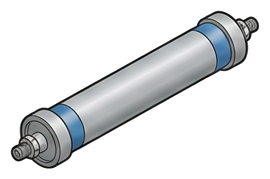
Membrane Point-of-use · dew point to ‑40°F
Small, dry, no power. Instrument enclosures, analytical loops, single-machine air-prep drops, hazardous-area instrumentation, dental / lab benches. Acts like a filter cartridge — bolts into a line and runs.
Tiny · expensive per-CFM Capacity tops out around 100 SCFM. Sweep-air loss is continuous (no regeneration). $/CFM is the highest of the five types, but the total dollars on a small line are small.
< 100 CFM typical
in-line cartridge form
$$
1 / 5 · Beko only
Explosion-Proof Desiccant Class I Div 2 / ATEX · same dew points as desiccant
Hazardous-location duty. Oil & gas refining, petrochemical, offshore, paint mixing rooms, anywhere a Class I Div 2 / Zone 2 (or stricter) area classification applies to the dryer's footprint.
Premium per certification Certified motors / heaters / controls add a meaningful premium over standard desiccant. Brand bench is narrow because few makers certify the full assembly — Van Air is SPC's lead here for that reason.
20 – 3,000+ CFM
heatless EP · heated EP
$$$
1 / 5 · Van Air only

Reading the brand bench column — the bar shows how many of SPC's tier slots (Industry Leader · Emerging · Economical · adjacent) carry an option at that product type. A deep bench means a price-driven and a spec-driven option both close cleanly; a narrow bench means the available brands map closely to the technical requirements and the comparison stops being a tier choice.

03Decision guide

3 questions “Funnel the Spec” to one product type.

Download PDF

Draw a line from the customer's answer at the top to the type name at the bottom. This is the page distributors screenshot and send to a customer the day before a quote call — so the customer comes prepared with the answers, and the call is about the brand and the budget, not the basics.

Use this Download the PDF above, print it, drop it in an email to the end customer, or screenshot the tree below. The questions and the type recommendations are designed to stand on their own without the rest of the page.
START AT THE TOP  ·  FOLLOW THE PATH DOWN  ·  END ON THE PRODUCT TYPE
Question 1
What dew point does the end-use actually need?
+38°F or warmer
Question 2a
Indoor install with reliable electrical?
If Yes
Recommend
Refrigerated Dryer
The default. Cheapest dew-point dollars in the catalog when conditions allow.
See product type →
If No · portable / no power
Recommend
Deliquescent Dryer
No electrical, no regen cycle — follows the compressor anywhere.
See product type →
0°F to ‑40°F
Question 2b
Is the dryer flow under ~100 CFM at one point of use?
If Yes · small POU
Recommend
Membrane Dryer
Bolt-in cartridge. No electrical, no moving parts, low maintenance.
See product type →
If No · plant-wide flow
Recommend
Desiccant Regenerative
Twin-tower the only option to hit ‑40°F at material plant CFM.
See product type →
‑40°F or drier
Question 2c
Is the dryer footprint in a hazardous-classified area (Class I Div 2, ATEX zone)?
If No
Recommend
Desiccant Regenerative
Heated or heated-blower variant for the deepest dew points and best purge economics.
See product type →
If Yes
Recommend
Explosion-Proof Desiccant
Certified motors, heaters, and controls. Van Air is SPC's lead here.
See product type →

If the customer doesn't know the answer to Question 1, work the use case backward: "What does your customer or process do with the air at the end of the line?" Sandblasting → +50°F is fine. Bottle-cap actuators → +38°F. Outdoor instrumentation in Minnesota in January → ‑40°F. Petrochemical analyzer in a hazardous zone → ‑40°F plus EP certification.

The decision is dew point first, install environment second. Everything after that is brand and budget.
SPC distributor playbook Air Dryers · how to quote in one call
04Questions to ask the customer · before you quote

8 inputs determine the right air dryer.

Download PDF

If the customer answers most of these at the first call, the second call is the quote. If they can't answer any, the air dryers are rarely the only spec gap — flag it and push for a site walk.

01
What dew point does the end-use actually need at the use point?
Spec sheets sometimes overshoot. Bottling and packaging are happy at +38°F. Painting, laser optics, electronics, and pharma typically need ‑40°F or drier. Outdoor or freezer-line distribution defaults to ‑40°F to avoid in-line condensation.
02
What's the dryer flow rate (SCFM) and the inlet pressure (PSIG)?
Dryer plates rate at 100 PSIG, 100°F inlet. Higher inlet temp derates capacity sharply — every 18°F over rating cuts capacity roughly in half. Get the actual inlet condition, not the compressor's discharge plate.
03
Indoor or outdoor install? What's the ambient temperature range at the install location?
Refrigerated dryers struggle below 50°F ambient and need shelter from direct sun. Desiccant towers tolerate a wider range. Outdoor exposure → NEMA 4 enclosure callout. If the answer is "in an unconditioned shed in Minnesota," the conversation changes.
04
Is the dryer's footprint in a hazardous-classified area?
Class I Div 2, ATEX Zone 1/2, IECEx — any of these flip the entire spec to explosion-proof construction. Confirm before quoting; substituting an EP unit at order time is a 6-8 week lead-time event, not a stocking item.
05
How much purge air can the system afford?
Heatless desiccant uses ~15% of dried capacity as purge. If the compressor was sized to flow, that's a ~15% capacity hit. If purge is a problem → heated or heated-blower desiccant cuts it to 4–7% but adds capex and an electrical heater. Refrigerated has zero purge.
06
Cleanliness class — is this air going somewhere with an ISO 8573-1 requirement?
Pharmaceutical, food contact, medical breathing, semiconductor — these jobs come with an ISO class spec for particulates, water, and oil. The dryer hits the water class; filtration before and after hits particulate and oil. If they cite a class, write it on the quote.
07
Continuous duty or intermittent? Shift-only or 24/7?
Refrigerated cycling and digital-scroll designs save energy on intermittent loads. Continuous heavy-duty plant air leans non-cycling. Desiccant always favors continuous duty — the regen cycle prefers steady flow.
08
Is there existing pre-filtration upstream of the dryer location?
Desiccant media gets ruined by oil carryover, fast. A coalescing filter ahead of every desiccant install is non-negotiable. If the line doesn't have one, the dryer quote needs to include it or the dryer warranty doesn't survive the first quarter.
05Where this category lives

Compressed air leaves the compressor hot, oily, and saturated with water vapor. Without the Treatment layer, that condition gets piped straight to every machine, valve, sensor, and finished surface downstream — and pneumatic equipment isn't built to tolerate it. Treatment is the four-stage conditioning train that turns plant air into the supply each piece of equipment was actually engineered for: pull the heat out, drop the bulk water, condition the dew point to the use-case spec, then polish out the remaining oil and particulate. Get this layer wrong and the customer feels it everywhere — rust in receivers, ice in winter lines, fouled instruments, ruined finish. Get it right once and it disappears.

Categories in this layer

Not sure which type? Send us the use case.

Tell us the end-use, the rough flow, and what climate the unit would sit in. We'll come back with a configured quote — the right type, the right tier, and the upstream gear the warranty assumes.