DISTRIBUTOR-FIRST SUPPLY PARTNER · SINCE 1999 Live · Pneumatic Automation System

SPC Company
Pneumatic Automation / Actuation / Cylinders / NFPA Tie-Rod Cylinder
Layer 04 · Actuation Industry Leader · SMC
01What it is

NFPA Tie-Rod Cylinder

An NFPA tie-rod cylinder (National Fluid Power Association — the North American imperial dimensional standard) is a heavy-construction pneumatic actuator with four threaded tie-rods clamping the end caps to the barrel. It is the cylinder family running nearly every legacy North American manufacturing line — automotive assembly, stamping presses, conveyors, lift platforms, drum dumpers. Two characteristics define it. First, it is field-rebuildable: any tech with a torque wrench can swap the seals and put it back in service. Second, it is dimensionally interchangeable across manufacturers — an NFPA cylinder from one brand drops into another brand's mount of the same bore, stroke, and mount style. It mounts to the machine via foot, flange, pivot/clevis, or trunnion (all to the NFPA standard) and is the right answer for installed-base maintenance and heavy-duty service above 100mm (4") bore.
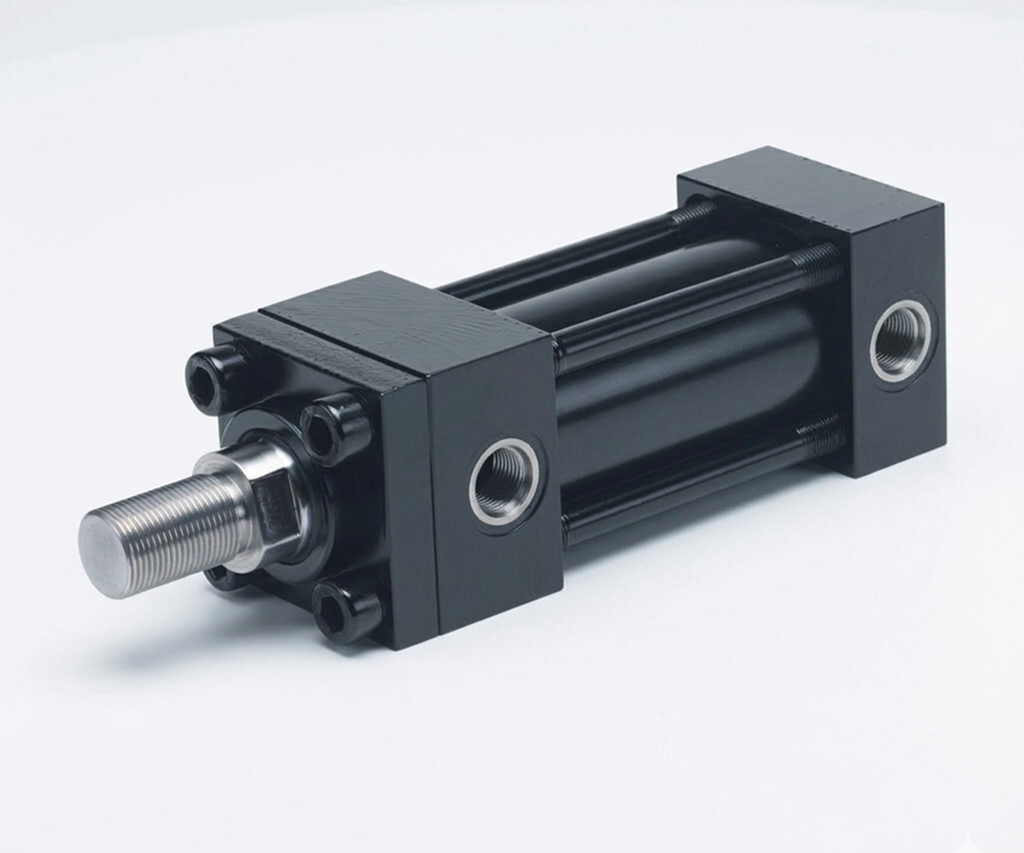
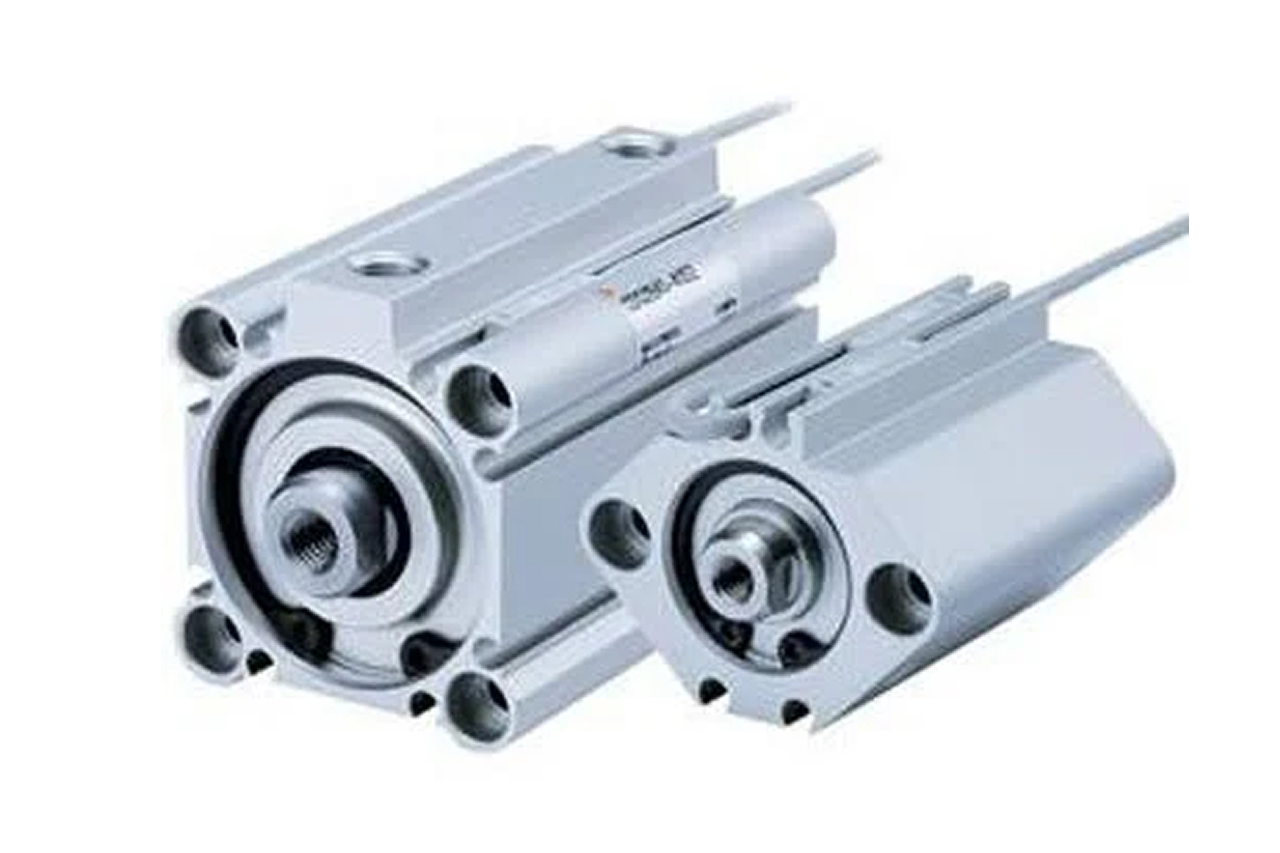
Real-world reference Representative nfpa tie-rod cylinder
NFPA Tie-Rod Cylinder — representative product photo
02Why it's needed

Why this matters.

Tips and pointers on when NFPA tie-rod is the right cylinder — and when to spec a different family. Scroll the strip →

01 · Key point
Field-rebuildable for 20-30 years.

Four threaded tie-rods (the long bolts clamping end caps to the barrel) loosen in a star pattern, end caps pull, seals swap, retorque — done. Body, bore, rod, and piston outlast multiple seal kits. Rebuild every 5-7 years on continuous duty; same cylinder runs decades.

02 · Key point
Drop-in across NFPA brands.

Bore, stroke, mount geometry, and rod-end thread are dimensionally fixed by the NFPA standard. Any compliant brand drops into the same mount — match the nameplate, quote the tier, ship this week instead of waiting 8 weeks on the original OEM.

03 · Key point
Heavy-duty above 4" bore.

Tie-rod construction handles forces ISO profile extrusion can't. Push at 80 PSI: 4" ≈ 1,000 lbs, 6" ≈ 2,260 lbs, 8" ≈ 4,020 lbs. Press cylinders, stamping actuators, drum dumpers, large-bore forming work — all NFPA territory above 100mm.

04 · Pro tip
Triage rebuild vs. replace first.

Seal leak with sound bore → rebuild kit ($40-200 + 30-60 minutes), not a new cylinder. Rod scoring → kit + rod. Bent rod, scored barrel, or 3+ prior rebuilds → new cylinder. Customers defaulting to "send a new one" pay 3-5× what they should.

05 · Where not to use
New metric OEM 32-100mm builds.

NFPA is heavier and lacks the integrated magnetic-switch slot modern PLCs need. → Switch to ISO 15552 on new OEM automation in the 32-100mm bore range — lighter, cleaner sensor integration, full cross-brand interchangeability.

06 · Where not to use
Foundry, abrasive, shock-load.

Standard NFPA in foundry heat (250-300°F), cement dust, or chronic shock loading fails at 1/4 to 1/2 expected service life. → Re-spec to heavy-duty cast with FKM seals + hard-chrome rod + rod boot when the environment drives the spec.

07 · Where not to use
Cheap value-tier imports.

Quality variance on low-tier NFPA imports is severe — bore concentricity, seal materials, tie-rod thread tolerance all suffer. → Stay Industry Leader or Emerging tier; skip the bargain-bin space on NFPA.

03Key selection criteria

What we need to spec it right.

From the machine spec sheet → to the part number. Answer what you know — leave the rest blank — and send.

01 · Input
Triage first — most customers default to "new cylinder" and pay 3-5× what they should. Sound body + leak = rebuild kit.
New install · Direct replacement · Rebuild kit only (seals) · Rebuild kit + rod
02 · Input
Pull from the load calculation. Add 25-50% safety factor general duty; 50-100% on press/forming/stamping — peak shock loads are 2-5× steady-state.
Push · Pull · Both (double-acting)
03 · Input
Confirm the regulator setting at the machine drop. Push force = pressure × piston area; spec at actual operating pressure, not rated max.
60 PSI · 80 PSI · 100 PSI · 120 PSI
04 · Input
Derived from required force ÷ operating pressure. At 80 PSI: 2" ≈ 250 lbs, 4" ≈ 1,000 lbs, 6" ≈ 2,260 lbs, 8" ≈ 4,020 lbs.
1-1/2" · 2" · 2-1/2" · 3-1/4" · 4" · 5" · 6" · 8" · 10" · 12" · 14"
05 · Input
Measure the application travel distance. Body length ≈ stroke + 4-8 in of dead length for end caps and rod gland.
1-12 in · 12-36 in · 36-72 in · >72 in (specify)
06 · Input
Match the installed bracket. Mount hole patterns are dimensionally fixed by NFPA — verify hole spacing against the NFPA chart before ordering.
Foot · Front / rear flange · Pivot / clevis · Trunnion
07 · Input
Pull from how the load attaches. NFPA rod-end threads are SAE imperial; verify before quoting.
Male thread · Female thread · Rod-end clevis · Rod-end eye
08 · Input
Photo the nameplate. NFPA enables drop-in dimensional swap across brands — any compliant cylinder matches the mount.
Brand · Model · Install date (if known)
09 · Input
Get the customer's cycle-time estimate. Heavy loads or high speeds exceed built-in cushion limits — need external shocks.
<500 mm/sec (cushion sufficient) · 500-1000 mm/sec (external shocks) · Press / shock service
10 · Input
NFPA uses external clamp-on band or rail-mount switches (different from ISO 15552's integrated slot). Quote 2 per cylinder.
None · Reed band · Solid-state band · Rail-mount
11 · Input
NBR seals fit clean indoor. Foundry/heat-treat needs FKM (fluorocarbon rubber); washdown needs stainless rod + FKM.
Clean indoor · Washdown (stainless + FKM) · Foundry / heat-treat (FKM) · ATEX hazardous
12 · Input
Drives the tier decision. 24/7 high-cycle needs premium (25M+ cycles); single-shift accepts mid-tier.
Single-shift light duty · Two-shift production · 24/7 continuous
13 · Input
Number of cylinders for this configuration. Need different bores or strokes? Add a separate quote line per variant.
1 cylinder · 2-4 (machine set) · 5+ (production fleet)

Need different sizes, colors, or quantities? Fill the form, add to quote, then fill again — each click is one quote line.

04Choose your solution tier  ·  core differentiator

Whatever your lever — spec, value, or price — SPC has the right brand.

Most distributors sell one brand per product type. SPC's 60-brand portfolio means every Product Type page surfaces three real options matched to how your customer is buying today. Pick the tier; the quote desk handles the cross-reference.

05How to sell this  ·  distributor talk track

The tier conversation closes the deal. The cross-reference catalog wins the next one.

NFPA is the rebuild-vs-replace decision. Customers who only buy new cylinders are paying 3-5x what they should be. Once you have the model and the failure mode, the right answer is often the seal kit, not the cylinder.
The SPC difference · how distributors actually buy

The 30-second positioning

NFPA quoting has three layers: rebuild-vs-replace triage, spec calc (bore, stroke, mount), and brand-tier. Most customers default to "send me a new cylinder"; most of the time the right answer is "send the rebuild kit."

Triage: Seal leak with sound bore → rebuild kit. Rod scoring → kit + rod replacement (premium lines stock rods). Bent rod or scored barrel → new cylinder. Three-plus prior rebuilds → new cylinder (barrel wears past seal tolerance). 25+ years old from a discontinued brand → often easier to replace with NFPA-compliant new than to source legacy seals.

Tier: Industry Leader tier — premium NFPA with 25M+ cycle life, full accessory ecosystems, ISO 9001 manufacturing. Emerging tier — typically 10-15M cycles, full NFPA dimensional compliance, materially lower price. Good for mid-life machines. Economical — value-tier imports exist but quality variance is significant; skip the value-tier import space on NFPA.

Recurring revenue is overwhelming. Every cylinder sold or rebuilt is a future rebuild kit (3-7 years out, then again across 20-30 year cylinder life), a future switch replacement (2-4 years on washdown), and an MRO line that compounds across the customer's installed fleet.

Customer cue → talk move

"Cylinder leaking at the rod"
Rebuild kit (most common). Quote new cylinder only if rod is scored or barrel damaged
"Cylinder leaking at the end cap"
Retorque tie-rod nuts first (free fix); if persists, full rebuild
"Need a replacement for an existing NFPA"
Photo the nameplate; match bore + stroke + mount + rod-end. Any compliant brand drops in
"Rebuilt 3-4 times and still leaks"
Barrel worn past seal tolerance — new cylinder + first rebuild kit at install
"Heavy press / forming / stamping"
NFPA heavy-duty grade with 50-100% safety factor; large-bore (6"+) is NFPA's exclusive territory
"Never rebuilt, always just replace"
Pitch the rebuild path. Customer's current spend is 3-5x what it should be
"New heavy industrial build"
Industry Leader tier; spec rebuild kit drop-shipped to MRO crib at install
"Food / washdown heavy-duty"
Stainless / nickel-plated NFPA with FKM seals; NSF for direct food contact
09Install · 6 critical steps

The things that matter on the first install.

Step 02
Capture nameplate data completely
Brand, model, bore, stroke, mount style, rod-end configuration, install date if known. NFPA enables cross-brand drop-in, but the model number resolves any ambiguity on cushion configuration and accessory mount holes.
Step 03
Calculate force-bore math when replacing
Required push force ÷ (operating pressure × piston area) = bore. Add 25-50% safety factor on general duty; 50-100% on press/forming/stamping. NFPA imperial bores: 1.5", 2", 2.5", 3.25", 4", 5", 6", 8", 10", 12", 14". Pull force is ~80% of push.
Step 04
Match mount style to the installed bracket
Foot, flange, pivot/clevis, trunnion — all to NFPA. Mount hole patterns are dimensionally fixed — verify hole spacing against the NFPA reference chart before ordering. Mount-style mismatch is the #1 returned-part cause on NFPA orders.
Step 05
Rebuild correctly when rebuilding
Loosen tie-rod nuts in a star pattern, remove end caps, remove piston and rod. Replace ALL seal-kit components in one service event — rod seal, piston seal, cushion seals, end-cap O-rings, rod wiper. Clean the bore with non-abrasive solvent and inspect for scoring. Lubricate seals with manufacturer's grease. Torque tie-rod nuts to OEM spec in star pattern.
Step 06
Install switches after stroke is verified
NFPA uses external clamp-on band or rail-mount switches (different from ISO 15552's integrated slot). Set with the cylinder cycling at operating speed; static positioning needs a final live-cycle adjustment.
Step 07
Document the install for rebuild-cycle planning
Record brand, model, bore, stroke, install date, mount style, rod-end config, rebuild-kit part number on the cylinder (durable tag) or in MRO. Project first rebuild 5-7 years out (continuous duty) or 8-12 years (light duty). Stock the rebuild kit on the customer's MRO shelf at install — finding the right kit from the cylinder model alone two years later is a real lookup project.
10Troubleshoot · top failures

Most returns trace to one of these causes.

Symptom
Most likely cause
Fix
Air leaking at the rod (visible at rod wiper)
Rod seal worn — the most common NFPA failure and the textbook rebuild-kit indication. 3-7 years on continuous duty. Less commonly: rod is scored or pitted (corrosion or side-load damage), or rod is slightly bent (impact damage).
Rebuild kit. Replace the full seal complement in one service event. If the rod is scored, replace rod with the rebuild — most premium NFPA lines stock rods as separate parts. If the rod is bent, new cylinder.
Air leaking at the end cap (visible at tie-rod boundary)
Tie-rod nuts loosened from years of cycling (most common — even NFPA cylinders need periodic retorque), end-cap O-ring worn (rebuild kit includes it), or end cap cracked from over-pressure / impact.
First, retorque tie-rod nuts in star pattern to OEM spec — often resolves the leak. If retorque doesn't fix, full rebuild with new end-cap O-rings. If end cap is visibly cracked, new cylinder.
Cylinder strokes but with reduced force
Three possibilities — supply pressure below spec (most common), piston seal bypassing internally (5-7 years on continuous duty), or cylinder undersized (RFQ used continuous force, not peak surge).
Check supply pressure under load first. Leak-test by pressurizing one chamber and listening at the opposite port for bypass. If both check out, resize.
Cylinder slams hard at end of stroke
Cushion screw set wide open, cushion seal worn (rebuild kit
), or load × velocity exceeds cushion rating. Fix: Close cushion screw progressively. If full-closed cushion doesn't help, rebuild kit. If a properly cushioned cylinder still hammers, the application needs an external shock absorber.
Cylinder will not extend fully
Cushion over-tightened to mechanical stop, debris in cushion chamber, mounting bracket shifted, or — on heavily rebuilt cylinders — piston hitting an internal step from prior wear.
Back out both cushion screws fully and test stroke. If full stroke returns, re-set cushions. If still short, disassemble. On rebuilt cylinders nearing end of life, internal wear shortens stroke — time for new cylinder.
Tie-rod nut working loose repeatedly
Insufficient torque at original assembly, missing/damaged lock washer, or high-vibration environment shaking nuts loose.
Retorque to OEM spec in star pattern. Add Loctite blue (removable) on the threads — standard practice on high-vibration installs. If the same nut works loose with Loctite, tie-rod or end-cap threads may be damaged — full inspection.

Get the right nfpa tie-rod cylinder on quote in 24 hours.

Send us the application — a specialist routes you to the correct tier with a configured part. Lead-times and pricing returned within one business day.

Request a quote