DISTRIBUTOR-FIRST SUPPLY PARTNER · SINCE 1999 Live · Pneumatic Automation System

SPC Company
Pneumatic Automation / Distribution & Conveyance / Push-to-Connect Fittings / Composite Push-to-Connect Fitting
Layer 02 · Distribution & Conveyance Emerging · Sang-A
01What it is

Composite Push-to-Connect Fitting

A composite push-to-connect (PTC) fitting is the workhorse pneumatic tube connector — a technopolymer or acetal body that joins tube-to-tube or tube-to-thread by pushing the tube in until it bottoms. It is the highest-volume fitting in any pneumatic plant: machine air drops, valve-to-cylinder runs, plant-air branches, MRO replacement. Sized by tube OD (outside diameter) in metric (4-16 mm) or inch (1/4"-1/2"), with thread ends in NPT (US tapered), BSPT (British tapered), BSPP (British parallel), or Metric. Installs at every cylinder port, valve port, FRL outlet, and tube junction. A complete catalog spans hundreds of SKUs once configuration, tube size, and thread type are crossed — which is why distributor stock depth is the structural play on this line.
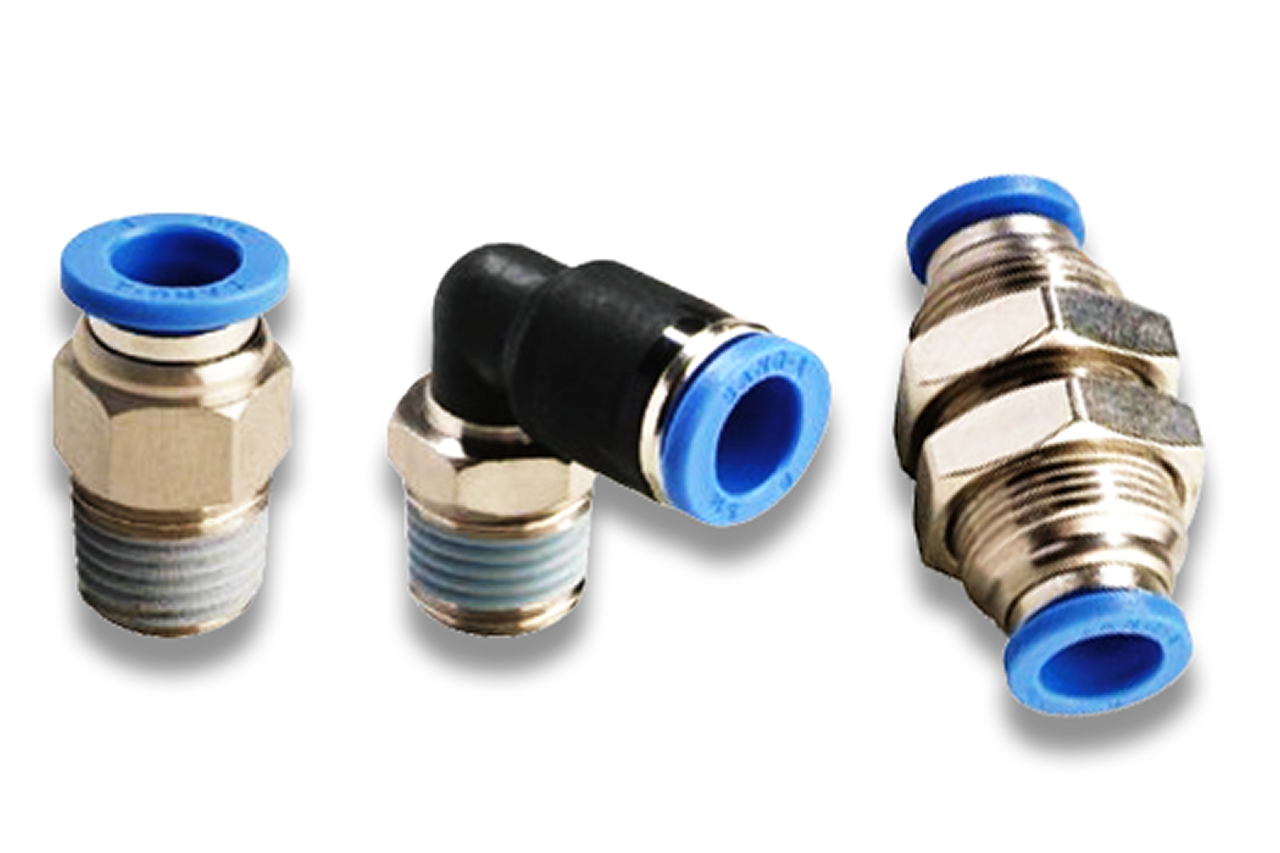
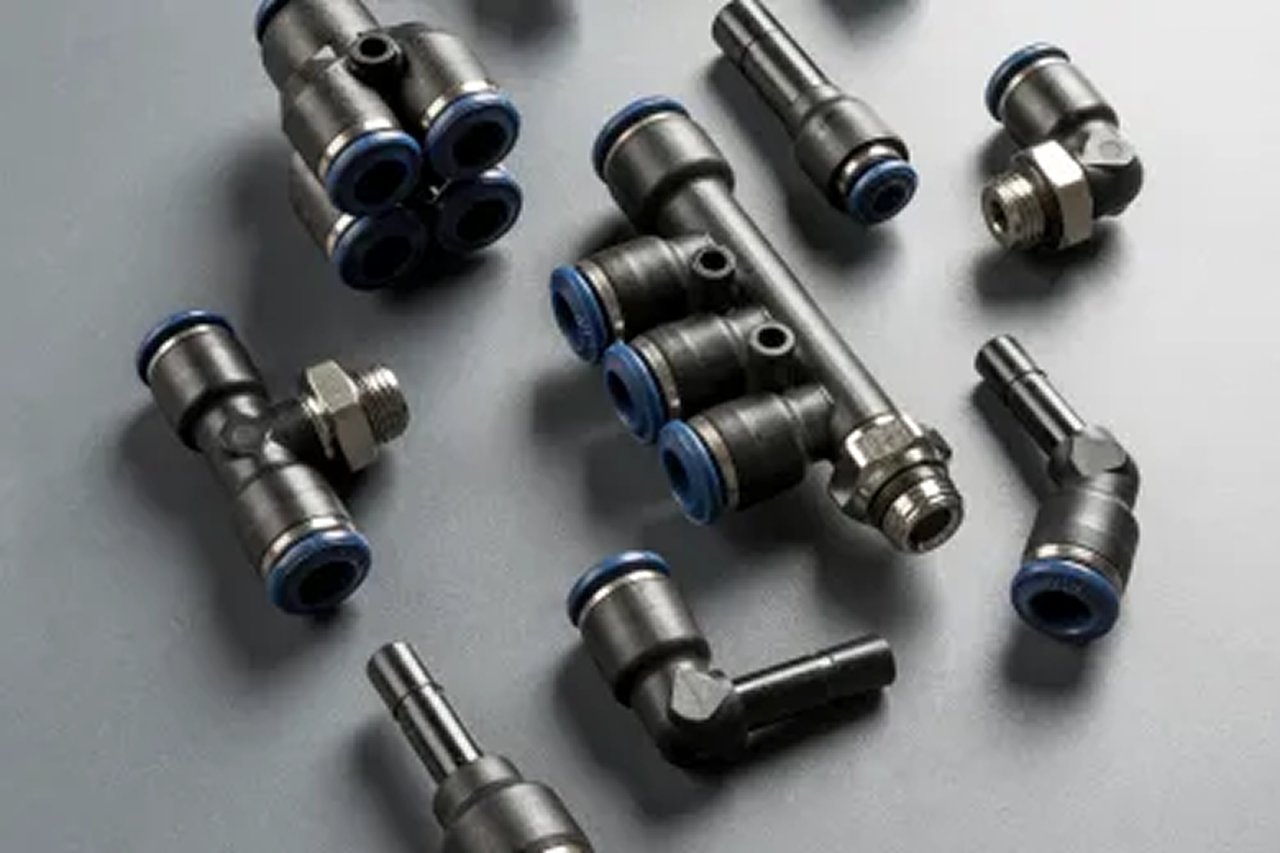
Real-world reference Representative composite push-to-connect fitting
Composite Push-to-Connect Fitting — representative product photo
02Why it's needed

Why this matters.

Tips and pointers on when composite PTC is the right call — and when to spec something else. Scroll the strip →

01 · Key point
The plant workhorse.

Highest-volume pneumatic fitting in any plant — every cylinder port, every valve outlet, every machine drop. A 25-50 HP plant runs hundreds of fittings; one packaging machine, 30-80.

02 · Key point
Stainless grab-ring inside.

The premium-line spec detail: a stainless-steel grab-ring (not plastic collet) bites the tube OD and resists creep under vibration for years. Generic-collet imports walk the tube out in 12-18 months.

03 · Key point
Full thread + configuration coverage.

NPT, BSPT, BSPP, Metric × straight, elbow, tee, Y, cross, reducer, bulkhead, banjo. Industry Leader tier''s deep US stock means a 1/4" elbow on the truck Tuesday — the structural play on this line.

04 · Pro tip
Upgrade the O-ring to chemistry.

NBR (nitrile) standard — general air. FKM for oil-mist or elevated temperature. EPDM for hot water or caustic. Wrong elastomer fails in months; right elastomer runs years.

05 · Where not to use
Above 150 PSI or 140°F sustained.

Composite body cracks at the thread root past envelope; O-ring seats deform. → Step up to metallic brass PTC for 230 PSI / 200°F industrial duty.

06 · Where not to use
Oil mist, coolant, hydraulic-adjacent.

Oil softens technopolymer until the fitting blows the tube off. → Step up to brass PTC for CNC coolant-mist zones, compressor-oil aerosol, hot-side compressor rooms.

07 · Where not to use
Food contact, washdown, CIP/SIP.

Composite is not NSF or stainless-certified; audit flags it on first walk-through. → Step over to NSF food-grade PTC for food-adjacent zones, stainless PTC for wet-contact and washdown.

03Key selection criteria

What we need to spec it right.

From the machine spec sheet → to the part number. Answer what you know — leave the rest blank — and send.

01 · Input
Measure the existing tube with a caliper — the fitting OD must match exactly. 6mm = 0.236" and 1/4" = 0.250"; the 0.014" gap leaks indefinitely. Metric and inch are not interchangeable.
Metric: 4mm · 6mm · 8mm · 10mm · 12mm · Inch: 1/4" · 3/8" · 1/2"
02 · Input
Confirms collet / seal compatibility. From the tubing supplier label.
PU (polyurethane — flex / general) · Nylon / PA (higher pressure / oil) · PE (utility / drains)
03 · Input
Read the component port spec sheet. NPT/BSPT seal on the threads (sealant required); BSPP seals on a bonded washer at the shoulder — no thread sealant.
NPT: 1/8" · 1/4" · 3/8" · 1/2" · BSPT / BSPP: G1/8 · G1/4 · G3/8 · Metric: M5 · M10 · M12
04 · Input
Pull from the connection geometry at the install point.
Straight · Male / female straight · Elbow (90°) · Tee · Y · Cross · Reducer · Bulkhead · Banjo
05 · Input
Confirm pressure stays at or below ~150 PSI for composite — above that, step up to metallic-brass. Oil / coolant / sustained heat above 140°F also rules out composite.
Standard indoor air ≤150 PSI · Clean general plant · Vibration / high-cycle (spec stainless grab-ring)
06 · Input
Number of pieces. Multiple sizes? Add separate quote lines per size variant. 25- and 50-count packs are the standard restock unit.
1-10 pcs · 25-100 pcs (counter stock) · 500+ pcs (volume tier)

Need different sizes, colors, or quantities? Fill the form, add to quote, then fill again — each click is one quote line.

04Choose your solution tier  ·  core differentiator

Whatever your lever — spec, value, or price — SPC has the right brand.

Most distributors sell one brand per product type. SPC's 60-brand portfolio means every Product Type page surfaces three real options matched to how your customer is buying today. Pick the tier; the quote desk handles the cross-reference.

05How to sell this  ·  distributor talk track

The tier conversation closes the deal. The cross-reference catalog wins the next one.

You don't win composite PTC on per-piece price. You win on stock depth, lead time, the matched bundle, and the grab-ring inside the fitting.
The SPC difference · how distributors actually buy

The 30-second positioning

Industry Leader tier is the SPC flagship on this line — stainless grab-ring as standard construction, full thread + configuration coverage, US-market stock depth. Quote it as the default; quote European premium (Emerging tier) only when the customer's OEM spec demands a specific brand.
Bundle the tube on every quote. PU (polyurethane) tubing for ≤145 PSI clean plant air; nylon (PA) for oil/coolant or higher pressure; PE (polyethylene) for utility drains. Quoting fittings without tube creates a two-step purchase the customer routes around you.
Tier: Industry Leader tier (value default, stainless grab-ring), Emerging tier (Premium — OEM-spec only), Generic / Import (avoid — plastic collet, 12-18 month failure).

Customer cue → talk move

"Bag of 1/4" elbows for MRO restock"
Industry Leader tier in 25- or 50-count pack. Confirm NPT (US-spec) + tube material. Attach matched PU tube.
"Fittings keep leaking"
Diagnose: pressure >150 PSI = brass territory; oil-mist = brass; otherwise generic-collet issue. Upgrade to Industry Leader tier.
"Can I get cheaper imports?"
Generic at $0.75 replaces yearly; Industry Leader tier at $1.50 runs 5+ years. Generic costs 2.5x over the cycle plus labor on every swap.
"Building a machine, need 50 mixed"
Industry Leader tier machine-build kit. Get the BOM, bundle with matched tube + PTFE tape + deburring tool.
"Vibration-heavy install"
Industry Leader tier stainless grab-ring spec (standard on the mainline series). Add tube clips 2-3" back from each fitting.
"Consolidating from 3 vendors"
Industry Leader tier cross-references most multi-vendor composite stocking. Quote a pilot-quarter standing order.
06Where it's used

Industries served.

Each industry below uses this product across the listed areas. Open an industry to see how it fits the rest of its system.

Also applies to Machine actuation and pneumatic cylinder plumbing · Robot end-of-arm tooling and integrated automation · MRO replacement and service-call install · Pneumatic test stands, calibration rigs, engineering benches · OEM machine-build connection layer (non-engineered-system OEMs) · Vacuum-application pneumatic plumbing

09Install · 6 critical steps

The things that matter on the first install.

Step 01
Confirm tube OD, material, and pressure rating match the fitting
Metric and inch are NOT interchangeable — 6mm = 0.236", 1/4" = 0.250", enough for a slow leak. Caliper-confirm. PU tubes to ~145 PSI; nylon to ~230 PSI.
Step 02
Cut the tube square and deburr the OD
Use a tube cutter (rotary or shear), not side cutters or a hacksaw. An angled cut prevents the O-ring from sealing against the tube OD. Deburr to remove the flash that tears the O-ring on insertion.
Step 03
Insert the tube straight to full insertion depth
Push straight (no rotation, no rocking) until it bottoms — typically 14-20mm. Tug-test to verify grab-ring engagement; a tube that pulls back is not seated and will blow off under pressure.
Step 04
Apply correct thread sealant on the port end
NPT/BSPT (tapered): 2-3 wraps PTFE tape in the direction of engagement, OR an air-rated thread paste. Never both. BSPP (parallel) seals on an O-ring at the face — no thread sealant.
Step 05
Torque carefully — composite cracks under over-torque
Typical 8-15 ft-lb depending on size. Stop the moment the wrench resists; composite cracks before brass does, without warning.
Step 06
Pressurize gradually and soap-test
Stage up (50 / 100 / operating PSI). Brush soap on every fitting, every thread. Zero bubbles at the collet, zero at the thread.
10Troubleshoot · top failures

Most returns trace to one of these causes.

Symptom
Most likely cause
Fix
Slow leak at the collet on a new install.
Angled or burred tube cut, wrong tube OD (metric/inch confusion), tube not bottomed, or grit on the OD damaged the O-ring on insertion.
Depressurize, push the release sleeve forward, pull the tube. Inspect the cut — square + deburr. Caliper-confirm OD. Re-insert and tug-test.
Tube creeping out under vibration over weeks.
Plastic collet (generic/import construction) — doesn't hold under vibration cycling.
Replace with Industry Leader tier or equivalent stainless-grab-ring construction. Add tube clips 2-3" back from each fitting to immobilize against the vibration source.
Tube blows off under pressure.
Tube not fully seated past the grab-ring, tube pressure rating below operating pressure (PU on a >145 PSI line), or wrong tube OD (undersized — 6mm in a 1/4" fitting).
Confirm tube rating vs. operating pressure. Re-seat tube fully. Caliper-confirm OD.
Composite body cracked at the thread root.
Over-torque at install — composite cracks before it groans. Or cross-threading (NPT into BSPT port).
Replace. Re-install to manufacturer torque spec (8-15 ft-lb typical). Confirm thread-type match — NPT and BSPT are NOT interchangeable.
O-ring swelling or hardening within months.
Wrong elastomer for the chemistry — standard NBR in oil-mist fails within months; needs FKM. EPDM for hot water or caustic.
Upgrade to FKM or EPDM O-ring on the Industry Leader tier line. If chemistry is past food-grade FKM envelope, step up to stainless PTC.
Slow leak at the threaded port (not the collet).
Insufficient or wrong thread sealant (tape on a paste-spec, or vice versa), under-torque, or sealant applied to a BSPP parallel thread (which seals on the bonded washer, not the thread).
Depressurize, back out, re-apply correct sealant per thread type. Don't over-torque to "stop" a thread leak — that cracks the composite body.

Get the right composite push-to-connect fitting on quote in 24 hours.

Send us the application — a specialist routes you to the correct tier with a configured part. Lead-times and pricing returned within one business day.

Request a quote