DISTRIBUTOR-FIRST SUPPLY PARTNER · SINCE 1999 Live · Pneumatic Automation System

SPC Company
Pneumatic Automation / Motion Control / Shock Absorbers / Pneumatic Shock Absorber — Adjustable
Layer 05 · Motion Control Emerging · KOBA
01What it is

Pneumatic Shock Absorber — Adjustable

An adjustable pneumatic shock absorber is a field-tunable end-of-stroke decelerator that mounts at the impact point of a moving pneumatic load and brings it smoothly to rest. An external screw — the tuning knob, typically indexed through 8-12 detented positions — sets the damping rate, so one unit covers a range of load weights and approach speeds instead of being locked to a single rating. It threads into the machine frame on a standard mounting thread (M14, M20, M27, M33, M42 covering most industrial sizes) and is installed wherever a cylinder, gantry, or rotary actuator would otherwise hit a hard stop. The trade-off for that flexibility is that the unit only tunes correctly while the load stays inside its rated effective weight range, and the setting must be re-checked whenever the application changes. This is the variant to specify when the load or speed is variable, not yet finalized, or expected to evolve over the machine's service life.
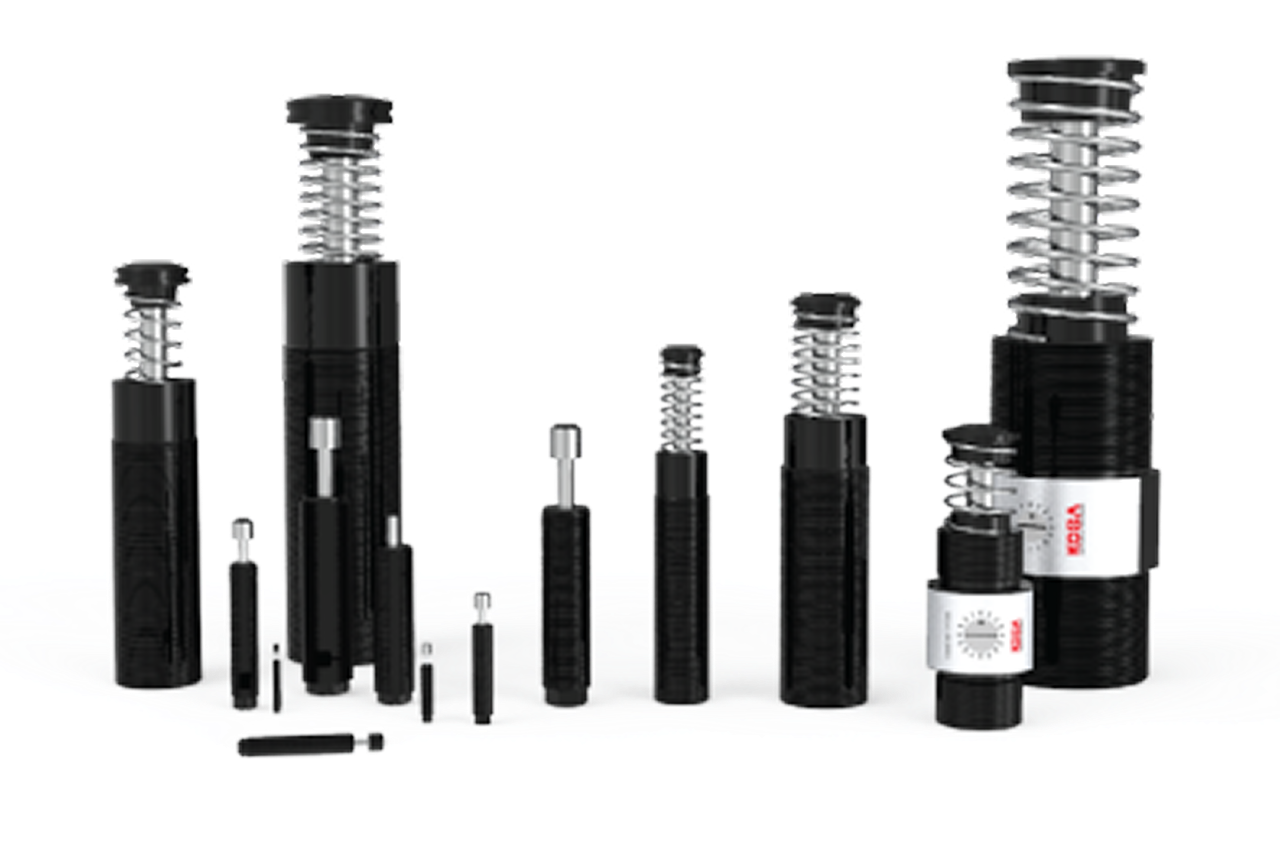
Real-world reference Representative pneumatic shock absorber — adjustable
Pneumatic Shock Absorber — Adjustable — representative product photo
02Why it's needed

Why this matters.

Tips and pointers on when an adjustable absorber is the right call — and when self-comp or a heavy-duty series is the better spec. Scroll the strip →

01 · Key point
It protects the cylinder.

Hydraulic energy absorption per cycle converts KE = ½mv² impact to heat instead of bent rods, blown end-caps, scored bores. A sized absorber multiplies cylinder service life 5-10x — the "cylinder replacement every 6 months" pattern is almost always a missing absorber.

02 · Key point
One unit, a range of loads.

External screw indexes through 8-12 detented positions across a 4:1 effective-weight ratio — one part number covers changeover lines, mixed-product packaging, and integrators shipping to multiple end-customers without re-sourcing per install.

03 · Key point
Field-tunable at startup.

Retrofits and rebuilds rarely have clean load data. Adjustable lets the install crew tune at commissioning, document the setting, and lock the collar — no recompute from incomplete specs, no second trip when the load is wrong.

04 · Pro tip
Get four numbers before quoting.

Total moving load (rod + tooling + fixture + workpiece), approach velocity at contact, cycles per minute, and mounting thread. KE = W × V² / (2 × 386), add 20-30% safety factor, verify inside the effective-weight band. Skip these and the unit is back in 90 days.

05 · Where not to use
Stable OEM-designed machinery.

If load and velocity are characterized at design time and won't change, the adjustment screw is a wear point and a drift risk. → Re-spec to self-compensating for set-and-forget OEM builds and high-cycle production lines.

06 · Where not to use
Load outside effective-weight band.

Below minimum, the softest setting sees no damping; above maximum, max setting slams through. The screw cannot tune outside the rated 4:1 ratio. → Cross-check load against the series chart and step up to the heavy-duty / high-energy series above ~500 in-lb/cycle.

07 · Where not to use
Side-loaded or angled impact.

Off-square contact destroys seals fast — the most common premature-failure mode. → Spec a self-aligning pivot mount or flat contact pad any time geometry creates angle; for emergency-stop duty where a fault can dump 2-5x normal energy, the heavy-duty / high-energy series is mandatory.

03Key selection criteria

What we need to spec it right.

From the machine spec sheet → to the part number. Answer what you know — leave the rest blank — and send.

01 · Input
Sum every mass that moves — rod, tooling, fixture, workpiece — not just the part being moved. Under-stating the load is the #1 sizing miss; energy scales linearly with weight.
Under 10 lb · 10-100 lb · 100-500 lb · 500+ lb (heavy-duty series)
02 · Input
The cylinder's actual speed at impact, not nameplate. Pull from a speed measurement or stroke ÷ travel time. Velocity drives kinetic energy as the square — a 2x velocity error is a 4x energy error.
Under 20 in/sec · 20-60 in/sec · 60-120 in/sec · 120+ in/sec
03 · Input
How many hits per minute. Verifies the unit's thermal duty rating — heat the body can shed before damping degrades. Pull from production rate or PLC cycle counter.
Under 10/min · 10-30/min · 30-60/min · 60+/min (high-cycle)
04 · Input
Confirm load/speed varies, it's a changeover line, or future modifications are realistic. If anything is uncertain, adjustable is the safe call; if everything is genuinely fixed, self-compensating is cleaner long-term.
Changeover / mixed-product · Retrofit / rebuild · Prototype / R&D · Stable (re-quote self-comp)
05 · Input
Pull from the machine's mounting-point spec on the print or measure with a thread gauge. NPT and metric are not interchangeable — verify the thread standard, not just the diameter.
M6-M12 (light-duty) · M14 · M20 · M27 · M33 · M42 (heavy-duty)
06 · Input
Cross-check load against the series effective-weight band (typically 4:1) — outside it the screw cannot tune at any setting. Above ~500 in-lb/cycle or for emergency-stop duty, step up to heavy-duty.
Standard adjustable · Heavy-duty / high-energy · Emergency-stop rated
07 · Input
If a shock-absorber series is already specified on the original print, match it for consistency — the OEM characterized the application at design time. Check before quoting a substitute.
OEM-spec match · Cross-reference equivalent · No print / new build
08 · Input
Number of shock absorbers for this configuration. Matched pairs or sets per axis? Add separate quote lines if specs differ between positions.
1 unit · 2-4 (machine axis set) · 5+ (OEM build lot)

Need different sizes, colors, or quantities? Fill the form, add to quote, then fill again — each click is one quote line.

04Choose your solution tier  ·  core differentiator

Whatever your lever — spec, value, or price — SPC has the right brand.

Most distributors sell one brand per product type. SPC's 60-brand portfolio means every Product Type page surfaces three real options matched to how your customer is buying today. Pick the tier; the quote desk handles the cross-reference.

05How to sell this  ·  distributor talk track

The tier conversation closes the deal. The cross-reference catalog wins the next one.

Shock absorbers are the cylinder-protection sale. Customers who replace cylinders every six months don't have a cylinder problem — they have a missing or undersized absorber.
The SPC difference · how distributors actually buy

The 30-second positioning

This is an engineered sale, not a count-the-valves sale. Each install needs four numbers: total moving load (rod + tooling + fixture + workpiece), approach velocity at contact (actual, not cylinder nameplate), cycles per minute (drives thermal rating), and mounting thread. Get those four and any catalog gives the answer in two minutes; skip them and the unit is either undersized (fails fast, breaks cylinders) or oversized (won't tune).

Adjustable vs. self-comp is the first qualifying question. Adjustable wins on changeover lines, retrofits, custom builds, prototype work. Self-comp wins on stable OEM machinery and high-cycle set-and-forget lines. Default to adjustable when the answer to "is the load constant?" includes any uncertainty.

The energy math. KE = W × V² / (2 × 386) gives in-lb/cycle. Add 20-30% safety factor. Verify the load falls inside the unit's effective-weight range (typically 4:1) — outside it the screw can't tune at any setting.

Tier: Industry Leader tier for emergency-stop and large-actuator duty — full standard thread range plus heavy-duty / high-energy series. Emerging tier covers the same mounting-thread range at a lower price point for light-to-medium industrial stops.

Recurring revenue lives in two places. Replacement on cycle-life intervals (10-25M typical) — track count, replace on calendar. And re-tuning service visits when products, fixtures, or cylinders change.

Customer cue → talk move

""Cylinder keeps failing — every six months""
Almost always missing or undersized absorber. Site-walk: bent rod, blown end-cap, scored bore = impact damage. Customer is paying $300 twice a year because they're missing a $100 absorber.
""Building a new machine""
Adjustable for anything still in development. Re-quote to self-comp once loads stabilize.
""Line runs different products on the same machine""
Adjustable with documented per-product settings. Lock collar prevents drift.
""Load varies but we don't know how much""
Adjustable, sized to heaviest load with effective-weight range covering lightest. Heavy-duty adjustable series cover ~4:1 ratio — verify the swing fits.
""Loud bang at end of stroke""
Under-damped. Bang at very end = no absorber or not engaged; soft crunch through stroke = too soft for the load.
""Emergency-stop application""
Heavy-duty / high-energy series only. Fault events can dump 2-5x normal energy. Standard series can fail catastrophically on a single E-stop.
""Absorber is leaking oil""
End of service life. Sealed, non-rebuildable. Quote the replacement.
06Where it's used

Industries served.

Each industry below uses this product across the listed areas. Open an industry to see how it fits the rest of its system.
Also applies to Custom machine builders and integrators · Retrofit and machine-rebuild projects · Prototype, R&D, and pilot lines · Heavy-duty actuator and emergency-stop service · 2-5x normal energy · Rotary actuators and high-energy rotational stops · Test benches and durability fixtures

09Install · 6 critical steps

The things that matter on the first install.

Step 01
Calculate energy per cycle before quoting
KE = W × V² / (2 × 386) gives in-lb/cycle (W in lbs, V in in/sec). Add 20-30% safety factor. Verify the result is inside the absorber's rated range — under-rated fails fast, over-rated won't tune. Above ~500 in-lb/cycle warrants engineering review and the heavy-duty series.
Step 02
Verify the load is inside the effective weight range
Every adjustable absorber has a rated band (typically 4:1 ratio). A load below the minimum sees no damping at the softest setting; above the maximum it slams through regardless. Cross-check load against the series chart before ordering — this is the most common at-quote miss.
Step 03
Mount perpendicular to load travel and torque to spec
The nose must contact the load square-on. Side loading destroys seals fast — the most common premature-failure cause. If geometry creates any angle, use a self-aligning pivot mount or flat contact pad. Over-torque distorts the housing and binds the rod.
Step 04
Set the adjustment screw to mid-range for the first cycle
Don't start at max (cylinder stalls) or min (no protection). Cycle at normal speed and observe: too soft = bang at end; too hard = cylinder labors and won't reach end.
Step 05
Fine-tune in single-step increments, then lock
Most adjustable absorbers have 8-12 detented positions. Increase damping one step at a time, cycle 5-10 times to let the body heat-soak, observe. The right setting decelerates smoothly across the full stroke, ending in a soft touch-down. Engage the lock collar and mark final position with a paint pen. For changeover lines, document per-product settings on a laminated chart at the machine.
Step 06
Set cycle-life tracking and re-check cadence
Service life is 10-25M cycles. On high-volume installs, document the cycle count and plan replacement on calendar before failure. On lower volumes, plan an annual re-check of the tuning — screws drift, applications change, seals age.
10Troubleshoot · top failures

Most returns trace to one of these causes.

Symptom
Most likely cause
Fix
Loud bang at end of stroke despite absorber installed.
Set too soft, undersized for energy, load not square-on the nose, return spring failing, or hard stop hit before absorber engages.
Watch the absorber during a cycle. If only partially engaging, reposition so the load contacts the nose at the start of deceleration. If fully engaging but still banging, increase damping one step at a time. If max setting still bangs, the unit is undersized — recompute energy and quote the next-larger size.
Cylinder stalls or labors before reaching end of stroke.
Set too hard, oversized (load below effective-weight minimum), cylinder pressure inadequate, or absorber engaging too early.
Back off the screw one step at a time. If still labors at softest, the absorber is oversized — verify load is inside the effective-weight range; if not, swap smaller. Don't fight under-sized cylinders at the absorber — raise supply pressure or upsize the cylinder.
Oil weeping or seeping from the absorber body.
End of service life — seals have aged. Sealed, non-rebuildable units; once oil seeps, damping is already degraded.
Replace the absorber. Don't attempt to service — refilled-unit damping is unpredictable. Document failure date and cycle count to refine the PM interval.
Mounting bracket cracking or fatiguing.
Absorber undersized (energy reaches the bracket), missing, or the bracket itself undersized for the impact load.
Verify sizing — if the absorber is absorbing the energy, the bracket sees only static reaction force. If sizing is correct and the bracket still fatigues, the bracket is the problem — structurally reinforce. Don't over-damp to "stiffen" the system; that moves the failure.
Performance has drifted over weeks or months.
Screw worked loose (vibration drift), application has changed since tuning, or seal aging.
Re-tune from scratch — back to mid-range, cycle, fine-tune. If the original setting is restored and performance returns, the screw drifted (lock harder). If the original setting now gives different damping, the unit's internal performance has changed — replacement is approaching.
Absorber running hot to the touch.
Cycle rate exceeding thermal rating, energy near rated max, or elevated ambient.
Verify cycles/min against the thermal chart. If exceeding, upsize to a heavy-duty series or improve ventilation. Hot absorbers run with degraded damping and shortened life — don't accept it as normal.

Get the right pneumatic shock absorber — adjustable on quote in 24 hours.

Send us the application — a specialist routes you to the correct tier with a configured part. Lead-times and pricing returned within one business day.

Request a quote