DISTRIBUTOR-FIRST SUPPLY PARTNER · SINCE 1999 Live · Pneumatic Automation System

SPC Company
Pneumatic Automation / Actuation / Rotary & Electric Actuators / Rotary Actuator
Layer 04 · Actuation Industry Leader · SMC
01What it is

Rotary Actuator

A rotary actuator converts compressed air into rotary motion — a partial rotation of an output shaft, rather than the linear push and pull of a cylinder. It produces a set-angle turn, commonly 90, 180, or 270 degrees, through one of two mechanisms: a vane design, where air pressure acts on a vane inside a chamber, or a rack-and-pinion design, where a piston-driven rack turns a pinion gear. Vane actuators are compact and direct; rack-and-pinion actuators generally deliver higher torque and more accurate, repeatable end positions. Rotary actuators drive indexing tables, gate and part swinging, rotational gripping, and any motion that turns a load through a defined angle. The governing sizing parameter is output torque against the rotation angle, with allowance made for the inertial energy that must be absorbed at the end of each rotation.
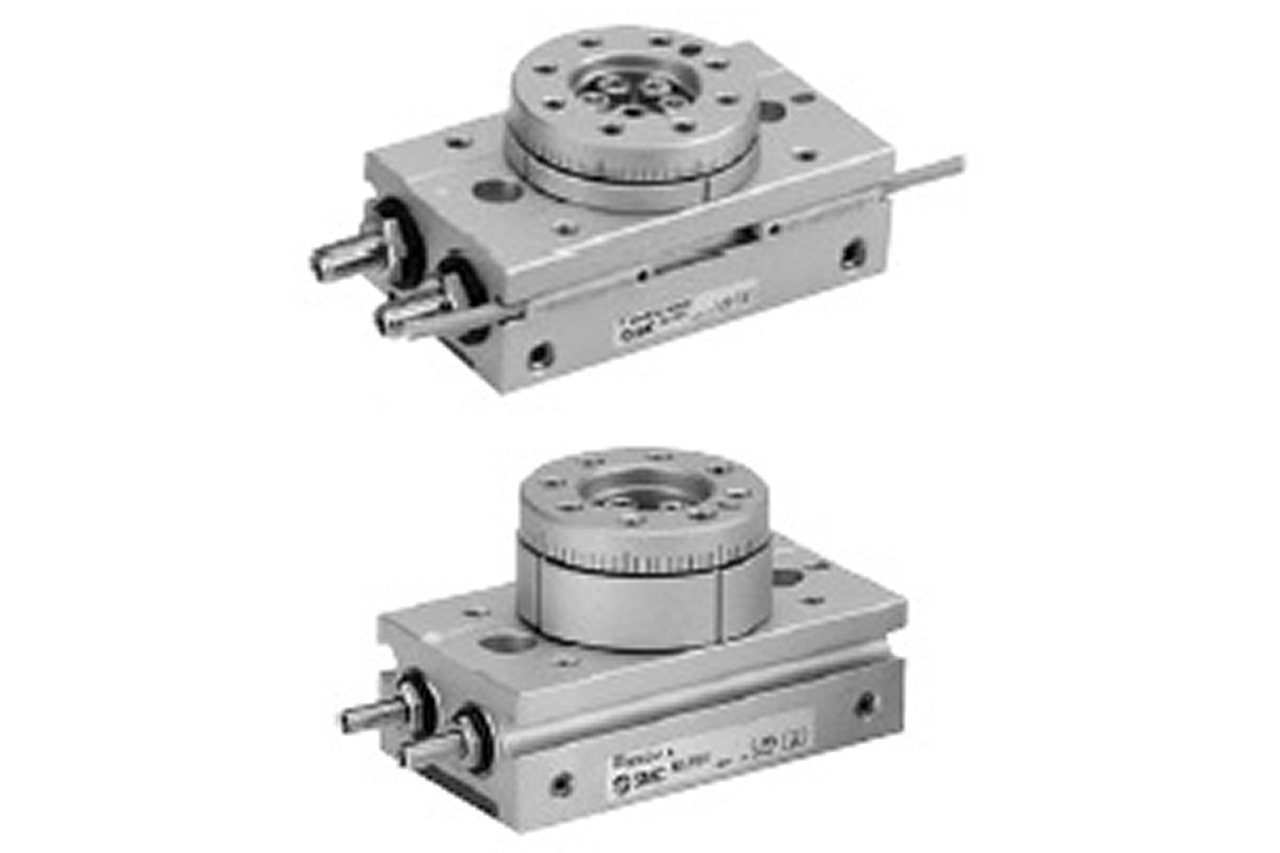
Real-world reference Representative rotary actuator
Rotary Actuator — representative product photo
02Why it's needed

Why this matters.

Tips and pointers on when a pneumatic rotary is the right call — and when to spec something else. Scroll the strip →

01 · Key point
It rotates directly, no linkage.

Fixed-angle turn — 90°, 180°, 270° — straight off the output shaft. A linear cylinder driving a rack or crank can fake it, but adds backlash, wear points, and footprint the direct rotary avoids.

02 · Key point
Two mechanisms, two jobs.

Vane — compact, fast, fixed-angle, ±0.5°-1° accuracy. Rack-and-pinion — higher torque, ±0.05° accuracy, handles inertia. Pick the right one at quote time, not at install.

03 · Key point
Cylinder ecosystem, drop-in.

Industry Leader tier rotary actuators share auto-switch geometry, speed controllers, and 5/2 solenoid valves with the same brand's linear cylinder line. Position feedback to the PLC mounts in the body — no extra sensing required.

04 · Pro tip
Size on torque AND end-of-rotation KE.

Torque (load × radius + 25-50% safety) is half the calc. Compute ½ × I × ω² at end-of-rotation; if it exceeds the built-in cushion rating, pair with external shock stops. Most rotary failures are over-inertia events the sizing calc didn't catch.

05 · Where not to use
Programmable multi-position rotation.

Pneumatic rotary stops reliably at the fixed end angles — nothing in between. → Switch to an electric rotary table actuator for variable angle, stored positions, or precise position feedback.

06 · Where not to use
Non-standard angle on a fixed-angle unit.

Trying to limit a 90° vane with external stops destroys the cushion within weeks. → Spec the adjustable-angle variant, or size up to the next standard angle.

07 · Where not to use
Motion that's actually linear.

If a rack or crank linkage is being used to fake linear-from-rotary, the spec is wrong. → Drop the linkage and switch to a standard linear cylinder — simpler, cheaper, fewer wear points.

03Key selection criteria

What we need to spec it right.

From the machine spec sheet → to the part number. Answer what you know — leave the rest blank — and send.

01 · Input
Pull from the rotational load calc (twisting force × radius from shaft centerline) against friction, gravity, and process torque, then add 25-50% safety factor. Undersize is the #1 reason rotary actuators fail early.
Low (≤1 N·m) · Medium (1-10 N·m) · High (10-100 N·m) · Heavy (100+ N·m)
02 · Input
Read off the application motion. Don't try to limit a fixed-angle actuator with external stops — destroys the cushion within weeks. For non-standard angles, spec the adjustable-angle variant.
90° · 180° · 270° · Adjustable-angle variant
03 · Input
Vane for compact/fast/moderate-torque; rack-and-pinion for high torque, precision end-of-rotation, and inertial loading. Precision indexing = rack-and-pinion mandatory.
Vane (±0.5°-1°, compact) · Rack-and-pinion (±0.05°, high torque)
04 · Input
Confirm from the regulator setting on the machine drop. Published torque ratings assume a specific pressure (typically 87 PSI / 6 bar) — verify actual line pressure before sizing.
60 PSI · 87 PSI (6 bar) · 100 PSI · 120 PSI · 145 PSI
05 · Input
Pull from the machine design. The mounting interface absorbs full reaction torque every cycle — under-mounting causes vibration and bolt loosening. Use the matched series mount hardware kit.
Foot · Flange · Body-mount · Axial
06 · Input
Match to the load-attachment method already on the machine. Through-shaft only when load couples on both ends for symmetric drive.
Keyed shaft · Splined shaft · Table-mount · Through-shaft
07 · Input
Get cycle rate (rotations per minute) and load mass × attachment radius (moment of inertia). High inertia at production rate creates end-of-rotation KE that destroys cushions — pair with external shock stops sized to the energy budget.
Low cycle (≤10 rpm) · Medium (10-30 rpm) · High (30+ rpm) · High-inertia load (add shock stops)
08 · Input
Confirm from the PLC/control design. Auto-switches mount in the actuator body geometry — quote minimum start + end switches on every PLC-controlled rotary install; multi-station indexers need one per stop.
None (manual) · Start + end switches · Switch per stop position
09 · Input
Pull from plant context — sets IP rating, seal compound, and any food-grade or ATEX (explosion-proof) certification. Wet, dusty, or hazardous environments narrow the variant list significantly.
Indoor general · Washdown (high IP) · Food-grade · Hazardous (ATEX)
10 · Input
Number of units for this configuration. Need a different angle, mechanism, or mount? Add a separate quote line per variant.
1 unit · 2-5 units · 6+ units (volume tier)

Need different sizes, colors, or quantities? Fill the form, add to quote, then fill again — each click is one quote line.

04Choose your solution tier  ·  core differentiator

Whatever your lever — spec, value, or price — SPC has the right brand.

Most distributors sell one brand per product type. SPC's 60-brand portfolio means every Product Type page surfaces three real options matched to how your customer is buying today. Pick the tier; the quote desk handles the cross-reference.

05How to sell this  ·  distributor talk track

The tier conversation closes the deal. The cross-reference catalog wins the next one.

Rotary actuator is the rotation equivalent of a cylinder — but sized on torque AND end-of-rotation energy, not just torque. Most rotary failures are over-inertia events the customer's sizing calc didn't catch.
The SPC difference · how distributors actually buy

The 30-second positioning

The sizing conversation. Capture angle + output shaft load (mass × attachment radius defines inertia) + cycle rate. Compute torque + 25-50% safety. Compute end-of-rotation KE = ½ × I × ω²; compare to cushion rating. If KE exceeds rating, pair with external shock stops. Choose vane (compact/fixed-angle/moderate-torque, ±0.5-1°) or rack-and-pinion (high-torque/precision ±0.05°/high-inertia).

Tier: Industry Leader tier for production indexing and reliability-critical rotary — full vane and rack-and-pinion families, switch and accessory ecosystem that matches the same brand's linear-cylinder lines. Light-duty or prototype work = value tier acceptable.

Recurring revenue: rotary actuators have shorter service life than linear cylinders — vane seals load faster, rack-and-pinion gears wear. Typical replacement at 5-10M cycles. The fleet generates a steady line on actuator + position switches + external shock stops.

Customer cue → talk move

"Index a workpiece 90° between stations"
Classic rotary. Vane for compact, rack-and-pinion for heavier loads or precision end positions.
"High-cycle indexer, multiple stations"
Rack-and-pinion. Pair with external shock stops if end-of-rotation KE exceeds cushion rating.
"Swing a gate 180°"
Vane (compact, gate loads usually moderate). Verify torque against gate weight + any wind/friction load.
"Pneumatic gripper rotating the workpiece"
Compact vane actuator (small-bore EOAT sizes). Workpiece mass × attachment radius usually within vane cushion rating.
"Vane seals leaking"
Service life. Check if load has changed — heavier workpiece, faster cycle — and if so, recompute and upsize.
"High-inertia heavy table"
Pair with external shock stops sized for rotational KE. Built-in cushions have hard rated limits; exceeded = vane seal blows, rack teeth strip.
"Need precise end-of-rotation position"
Rack-and-pinion mandatory. ±0.05° vs vane ±0.5-1°.
"Adjustable rotation angle"
Adjustable-angle variant with mechanical stop adjusters.
"Electric servo vs pneumatic rotary?"
Pneumatic for fixed-angle indexing at predictable cycle rate. Electric rotary table for programmable multi-position, variable-angle, or feedback-rich applications.
06Where it's used

Industries served.

Each industry below uses this product across the listed areas. Open an industry to see how it fits the rest of its system.
Also applies to Indexing tables and rotary fixtures · Pneumatic-actuated gates, doors, and dampers · Rotational pneumatic grippers · Quarter-turn valve actuators · Test stands and inspection fixtures with rotary positioning

09Install · 6 critical steps

The things that matter on the first install.

Step 01
Calculate required torque AND end-of-rotation KE before quoting
Both matter. Torque = friction + gravity + process loads + safety factor. End-of-rotation kinetic energy = ½ × moment of inertia × angular velocity² at end of rotation. Verify both within the actuator's ratings. If KE exceeds cushion rating, pair with external shock stops sized to the energy budget.
Step 02
Choose mechanism (vane vs rack-and-pinion)
Vane = compact installs, fixed angle, moderate torque, ±0.5°-1° end-position accuracy. Rack-and-pinion = higher torque, precision end-of-rotation (±0.05°), higher inertial loading. Get the trade-off right at quote time rather than discovering it at install.
Step 03
Match rotation angle to the application
Standard angles: 90°, 180°, 270°. Adjustable-angle variants available on some Industry Leader tier series. For non-standard angles, the adjustable variant or a custom setup is the answer — do not try to limit rotation with external stops on a fixed-angle vane actuator. The cushion will not survive.
Step 04
Mount rigidly to handle reaction torque, and specify the output shaft
The mounting interface takes full reaction torque every cycle; under-mounting causes vibration, fatigue, and bolt loosening. Use the series-matched mount hardware torqued to spec. For high-cycle / high-torque installs, add blue (removable) Loctite on mount bolts. Match output shaft (keyed, splined, table-mount, or through-shaft) to the load-attachment method.
Step 05
Install end-of-rotation cushioning and shock stops live
Adjust built-in cushions under the actual load at production cycle rate; static positioning misses the right setting. External shock stops mount to the machine frame at the load's impact point, NOT on the actuator. Verify end-of-rotation behavior at production speed — cushions that look right at half-speed bang or bounce at production cycle.
Step 06
Install position switches live and document the install
Set auto-switches at production cycle rate; static setup needs final live-cycle adjustment. Stock spare switches at install. Record actuator model, mechanism, rotation angle, torque rating, mount style, shaft configuration, switch quantity, and external shock stop part numbers. Project service life at 5-10M cycles for vane (sooner on high-inertia), 10-20M for rack-and-pinion.
10Troubleshoot · top failures

Most returns trace to one of these causes.

Symptom
Most likely cause
Fix
Rotates but doesn't reach full angle.
Supply pressure inadequate (most common); vane seal leak (air bypasses, audible at opposite port); cushion screw set too tight; end-stop wrong on adjustable variants.
Check supply pressure first. Listen at opposite port for internal bypass. Vane seal replacement on rebuildable lines; full swap on sealed designs. Back off over-tightened cushion. Re-set end stops.
End-of-rotation slam or bang on a high-inertia load.
End-of-rotation KE exceeds cushion rating. The cushion is working but application energy is over-spec.
Install external shock stops sized for actual rotational KE. Do not over-tighten the cushion — destroys the cushion seal. For chronic over-energy, upsize the actuator AND add shock stops.
Vane seal failing repeatedly at short intervals.
Torque or inertial energy exceeds rating; air-supply contamination attacking the seal; or — most common — end-of-rotation impact from inadequate cushion / no shock stops.
Recompute requirements; upsize if exceeded. Address upstream filtration if contaminated. Install external shock stops as primary fix on impact failures. Replacing seals without root cause = same failure within months.
Rack-and-pinion teeth wearing or stripping.
Application torque significantly exceeds rating (shock loading at end of rotation transmitted through the gears); debris in the gear chamber.
Replace actuator. For chronic stripping, upsize. Gear stripping usually means the customer underestimated load by 2-5x.
End-of-rotation position drift or repeatability degradation.
Vane seal wear on vane type; mechanical end-stop wear on adjustable variants; gear backlash on rack-and-pinion from years of cycling.
Replacement on vane wear. Re-set or replace stops on adjustable. For rack-and-pinion backlash, Industry Leader tier lines hold repeatability over millions of cycles — if backlash is increasing, plan replacement.
Air leaking around the output shaft seal.
Shaft seal worn (cycling, side-load from misaligned coupling, contamination); shaft mechanically damaged (impact, over-torque on coupling).
Replace actuator on sealed designs; replace the shaft seal on rebuildable types. Verify load coupling alignment — misalignment transmits side load through the seal and accelerates wear.

Get the right rotary actuator on quote in 24 hours.

Send us the application — a specialist routes you to the correct tier with a configured part. Lead-times and pricing returned within one business day.

Request a quote