DISTRIBUTOR-FIRST SUPPLY PARTNER · SINCE 1999 Live · Pneumatic Automation System

SPC Company
Pneumatic Automation / Control & Valving / Directional Control Valves / Solenoid Valve
Layer 03 · Control & Valving Industry Leader · SMC Emerging · AIGNEP Economical · STC
01What it is

Solenoid Valve

A solenoid valve is a directional control valve (DCV) shifted by an electric coil instead of a hand or foot. Energize the coil from a PLC (Programmable Logic Controller — the machine's electronic brain), push button, or sensor and the valve routes compressed air to a cylinder's ports; de-energize it and the valve returns or holds its last command. It is the universal bridge between the electrical control system and every pneumatic actuator on the machine — the single highest-unit-count active pneumatic component on any modern automated line, mounted inline at a single station or bolted to a shared sub-base manifold across 8 to 24 valves on one machine.
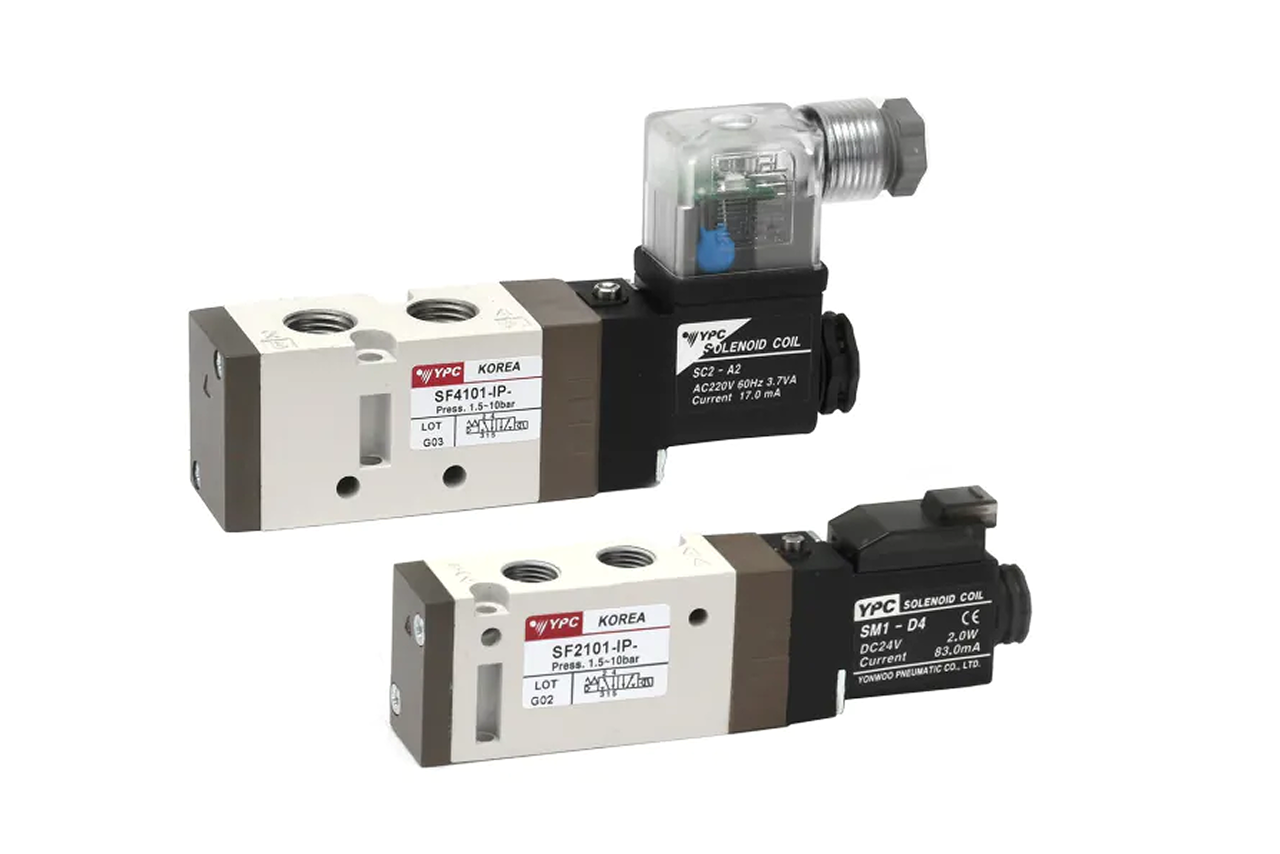
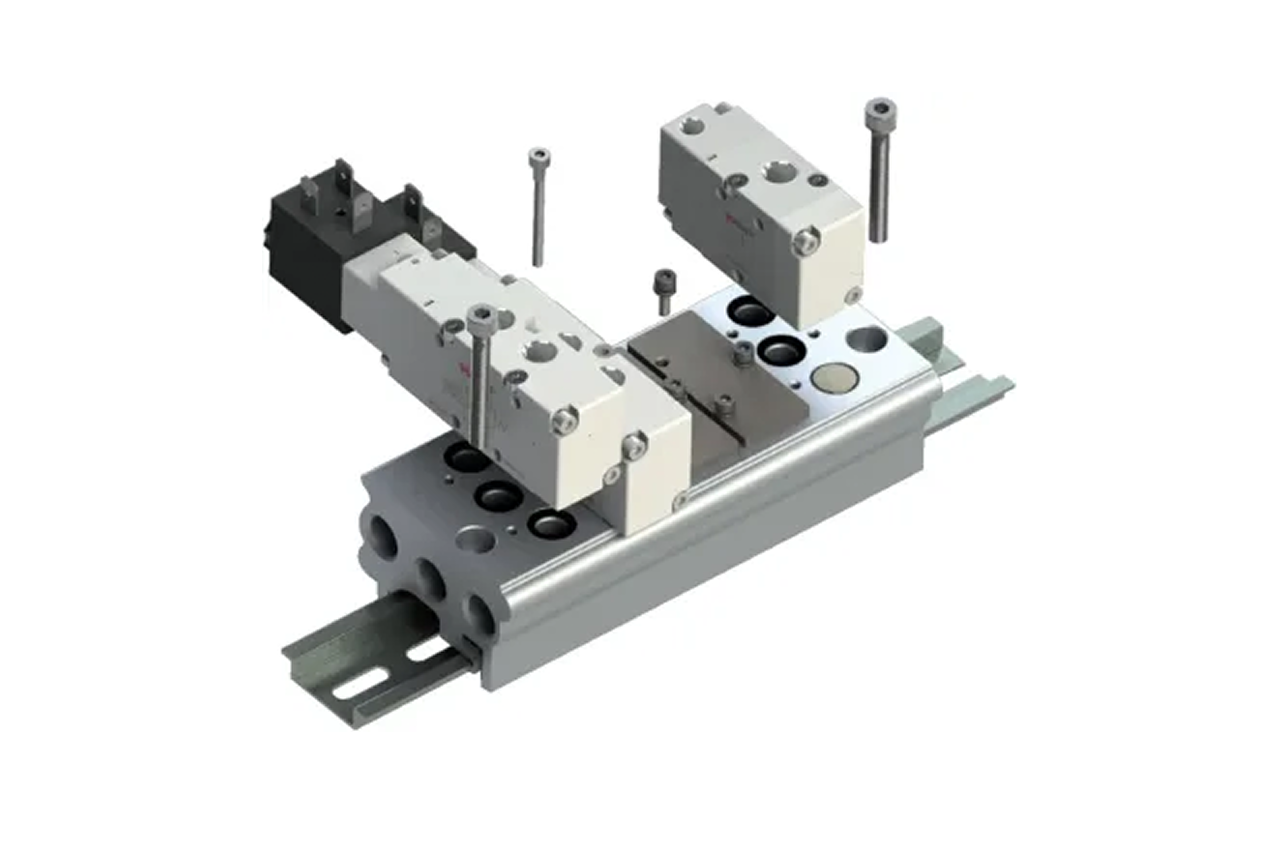
Real-world reference Representative solenoid valve
Solenoid Valve — representative product photo
02Why it's needed

Why this matters.

Tips and pointers on when the solenoid is the right DCV — and when to spec something else. Scroll the strip →

01 · Key point
PLC fires it directly.

A 1.5–5 W coil at 24 VDC drives a tiny pilot; the pilot uses the inlet air to shift the main spool. Thirty solenoids run off PLC outputs with no power amplifiers — the universal electrical-to-pneumatic bridge.

02 · Key point
One family, four behaviors.

5/2 single springs to safe on power loss. 5/2 double holds last position (memory). 5/3 centers closed/open/pressure for hold or hand-move. 3/2 for single-acting or vacuum. One base series, four cylinder behaviors.

03 · Key point
Manifolds and ISO bases scale.

Industry Leader tier valves drop onto ISO 5599 / 15407 sub-bases — cross-brand swap on the same manifold, 50M+ cycle life on the Industry Leader tier for 24/7 packaging duty.

04 · Pro tip
Match coil voltage to the PLC.

24 VDC is the modern default. 110/120 VAC is legacy US; 220/240 VAC is legacy European; 12 VDC is mobile. A 24 VDC coil on 110 VAC burns in seconds — confirm the PLC output spec before quoting, every time.

05 · Where not to use
Classified hazardous areas.

Coil arcs on switching; surface heats on duty. Either ignites a flammable gas or dust. → Re-spec to ATEX solenoid any time the location carries a Class/Division or ATEX zone classification.

06 · Where not to use
Below ~25 PSI pilot minimum.

Pilot-operated valves silently won't shift below their pilot minimum — customer reports "cylinder not moving" with no other symptom. → Switch to a direct-acting variant for low-pressure or vacuum service (operates to 0 PSI, lower flow).

07 · Where not to use
8+ valves on one machine.

Loose inline valves stop scaling at the 8th station — fittings, wiring, and cabinet space dominate the build. → Switch to manifold sub-base, or step up to IO-Link valve terminal if the customer has an IIoT initiative or wants per-valve diagnostics.

03Key selection criteria

What we need to spec it right.

From the machine spec sheet → to the part number. Answer what you know — leave the rest blank — and send.

01 · Input
Pull from the controlled cylinder's acting type and power-loss behavior. Wrong function on a single-acting cylinder can damage the spring chamber.
5/2 single (spring-return-to-safe) · 5/2 double (memory — holds last position) · 5/3 closed-center (hold mid-stroke) · 5/3 open/exhaust-center (rod hand-moveable) · 3/2 (single-acting / vacuum / air motor)
02 · Input
Sizes valve Cv against cylinder air demand at peak flow. Mismatch is the #1 cause of "valve fires but cylinder is slow" service calls.
Bore: 20mm · 32mm · 50mm · 80mm · 100mm+ · Approx Cv target: 0.3 · 0.5 · 1.5 · 3 · 4+
03 · Input
Port size sets Cv ceiling; thread standard must match the manifold or fitting line — NPT and G are not interchangeable.
1/8" NPT · 1/4" NPT · 3/8" NPT · 1/2" NPT · 1" NPT · G1/8 · G1/4 · G3/8 · G1/2
04 · Input
Confirm from the PLC output spec. A 24 VDC coil wired to 110 VAC burns instantly; a 110 VAC coil on 24 VDC will not actuate at all. The single most common spec error on a valve quote.
24 VDC (modern PLC default) · 12 VDC (mobile) · 110/120 VAC 60Hz (legacy US) · 220/240 VAC 50/60Hz (legacy European)
05 · Input
Pull from production rate and shift pattern. 24/7 at 1 cycle/sec = 30M cycles/year — spec a 50M+ valve. Single-shift at 1 cycle/min runs a 10M economy valve for a decade.
Light duty (single-shift, <1M/yr — 10M-rated OK) · Standard duty (1–10M/yr — 30M-rated) · Heavy 24/7 (30M+/yr — Industry Leader tier, 50M+ rated)
06 · Input
3+ valves on one machine usually pivots to a manifold. Single inline stations stay here.
Inline (1–2 valves) · Sub-base manifold (3–24 stations) · IO-Link valve terminal (8+ with IIoT)
07 · Input
Confirm from the regulator setting. Pilot-operated valves silently fail to shift below ~25 PSI — switch to direct-acting for low-pressure or vacuum service.
Vacuum to 25 PSI (direct-acting required) · 40–80 PSI · 80–125 PSI (typical plant) · 125–145 PSI
08 · Input
Sets IP rating, body material, coil cladding. Water ingress through the coil cable gland is the most common washdown failure.
IP65 standard (protected cabinet) · IP67 washdown (stainless-clad coil) · Food-contact (FDA elastomers) · Outdoor (UV-stable housing)
09 · Input
Enables like-for-like cross-reference and confirms manifold compatibility — ISO 5599 / 15407 bases let SMC and AIGNEP swap on the same manifold.
SMC SY / VQ · AIGNEP 01V / 03V · STC / YPC legacy · ISO 5599 standard base
10 · Input
Most modern coils integrate surge suppressors; older designs need them added externally. Indicator lights pay back on every service call.
Manual override (momentary) · Manual override (detented) · LED indicator · Integral surge suppressor · External RC snubber (AC)
11 · Input
Number of valves at this configuration. Mixed function codes or different port sizes on the same machine? Add separate quote lines per variant so pricing stays clean.
1–5 pcs · 10–25 pcs (machine build) · 50+ pcs (production lot / OEM)

Need different sizes, colors, or quantities? Fill the form, add to quote, then fill again — each click is one quote line.

04Choose your solution tier  ·  core differentiator

Whatever your lever — spec, value, or price — SPC has the right brand.

Most distributors sell one brand per product type. SPC's 60-brand portfolio means every Product Type page surfaces three real options matched to how your customer is buying today. Pick the tier; the quote desk handles the cross-reference.

05How to sell this  ·  distributor talk track

The tier conversation closes the deal. The cross-reference catalog wins the next one.

The cylinder is the line item the customer asks for. The solenoid valve is the line item that stays on the quote every time and turns one cylinder sale into a full circuit sale.
The SPC difference · how distributors actually buy

The 30-second positioning

Start with the function code. 5/2 single for default safe-state-on-power-loss. 5/2 double for memory (cylinder holds last position). 5/3 for hand-moveable or hold-mid-stroke. 3/2 for single-acting / vacuum / air motor. Get the function from the cylinder's required behavior — never quote a valve without the cylinder context.

Tier: Industry Leader tier for new OEM builds (highest-density manifold platforms on the market and the integrator default) and 24/7 lines needing 50M+ cycle life. Emerging tier for value-tier replacement against spec'd machines — ISO 5599/15407 interchangeable on the same manifold, 10–25M cycle life, drops in without re-engineering. Economical tier for low-cycle MRO drop-ins on legacy machines, cycle counts under 5M.

Coil voltage is the spec error that burns coils. 24 VDC is the modern PLC default. 110/120 VAC is legacy US industrial; 220/240 VAC is legacy European; 12 VDC is mobile. Always confirm the PLC output before quoting.

The recurring lever: every valve is a future seal-kit + coil-replacement line. A clean upstream FRL doubles or triples valve life — the FRL attach is not optional on a valve quote. Set up the standing seal-kit reorder at the time of valve sale.

Customer cue → talk move

""Need a valve for a specific brand cylinder""
Quote the matching Industry Leader tier valve as line 1; offer an ISO-interchangeable value alternative on the same sub-base. Mention seal-kit availability — that locks in the MRO line.
""Cylinder must hold position on power loss""
5/2 double solenoid (memory), not 5/2 single. Double-sol holds without spring force; single-sol springs to rest when power drops.
""Push the rod by hand during setup""
5/3 open-center. Both cylinder ports vent to atmosphere when centered; rod moves freely.
""Cylinder must hold mid-stroke under load""
5/3 closed-center. Both ports blocked traps air on both sides and locks the rod.
""Replacing a 110 VAC valve on a 40-year-old machine""
Check whether the PLC retrofit uses 24 VDC outputs. If yes, change the coil voltage on the order, not just the valve.
""Hazardous-area machine""
Stop quoting standard. Switch to ATEX Solenoid Valve and verify the area classification (Class/Division/Group or ATEX zone/gas group/T-class).
""Wiring 16 valves on one machine""
Pivot to IO-Link Valve Terminal or manifold sub-base with multi-pin connector. Wiring labor savings alone justify the upgrade before diagnostics value is counted.
""Single-acting cylinder with spring return""
3/2 valve, not 5/2. Five-port to a single-acting cylinder will not actuate correctly and can damage the spring chamber.
""Valve sticking or shifting slow""
Almost always upstream air quality. Check the FRL coalescing filter first; replace the valve seal kit second; replace the valve last.
""Recurring valve failures every 6 months""
Coil failure (voltage match, ambient temp, duty cycle) or seal contamination. Quote seal kits AND the upstream coalescing-filter upgrade together.
06Where it's used

Industries served.

Each industry below uses this product across the listed areas. Open an industry to see how it fits the rest of its system.

Also applies to OEM automation — the universal directional control element. · Retrofit and machine modernization. · Single-station manual work cells. · Mobile and off-highway equipment. · Vacuum and air-motor control.

09Install · 6 critical steps

The things that matter on the first install.

Step 01
Match coil voltage to PLC output before opening the box
24 VDC coil on 110 VAC burns instantly. 110 VAC coil on 24 VDC will not actuate. Coil voltage is embossed on the coil body and called out in the part number — verify both against the wiring schematic before installation.
Step 02
Confirm minimum inlet pressure for pilot-operated valves
Most production solenoids are pilot-operated and need ~25 PSI minimum for the pilot to shift the main spool. For low-pressure or vacuum service, specify a direct-acting variant that works to 0 PSI — slower, lower-flow, but actually operational. Pilot-operated valves below their minimum silently fail to shift, and the customer reports the cylinder as "not moving" with no other symptom.
Step 03
Plumb exhaust ports to mufflers, sized to total flow
5/2 and 5/3 have two exhausts; 3/2 has one. Never leave exhausts open in a dusty or wet environment. If piped to a common exhaust manifold, size the line to total simultaneous flow or stations back-pressure each other and cylinders move erratically. Sintered bronze for standard environments; filtered exhaust mufflers for clean-room or food-contact.
Step 04
Wire surge suppression on DC coils driving inductive loads
When a 24 VDC coil de-energizes, the collapsing magnetic field generates a back-EMF spike that can exceed 1000 V and destroy the PLC output transistor over time. A diode (DC) or RC snubber (AC) installed across the coil terminals clamps the spike. Most modern coils include integral suppression — verify on the datasheet.
Step 05
Release manual overrides during commissioning
Most solenoids include a manual override that lets a tech shift the valve without electrical signal. Some are momentary, some are detented (turn-to-lock). A detented override left engaged means the valve will not respond to PLC commands — confusing "valve dead" failure with the coil testing fine. Verify all overrides are released before leaving the install.
Step 06
Pair every valve with speed controllers + upstream FRL
The valve sets direction. The speed controller sets cylinder speed. The FRL sets pressure and conditions the air. Quoting the valve alone leaves the customer to source two adjacent products from a competitor and creates the air-quality conditions that shorten seal life.
10Troubleshoot · top failures

Most returns trace to one of these causes.

Symptom
Most likely cause
Fix
Coil energizes (clicks, gets warm) but valve does not shift
Inlet pressure below pilot minimum (most common — pilot-operated valve under ~25 PSI), or manual override engaged in detented position, or spool jammed by contamination, or external pilot port not connected.
Check inlet pressure first; if low, fix the supply or switch to direct-acting. Verify the manual override is released. Cycle the valve manually with the override — if it shifts on override but not on coil signal, the pilot is blocked; if it does not shift on override either, the spool is jammed. Disassemble and clean, or replace the spool kit.
Continuous audible hiss from valve body or exhaust ports at rest
Internal spool or seat seal damaged and leaking across the spool (most common after years of contamination), or manual override leaking past its seat, or cracked body from over-torqued fittings.
Isolate the leak source — listen at exhaust ports vs. body. Leak at an exhaust port at rest = supply-to-exhaust seal failed; install the seal kit. Leak at the body or fitting threads = replace the valve. Fleet-wide leaks point at upstream contamination — check the FRL coalescing filter.
Valve shifts but cylinder moves slowly or erratically
Valve Cv undersized for cylinder air demand, or downstream speed controller misadjusted, or kinked/undersized hose, or exhaust muffler clogged with oil from upstream lubricator overuse.
Open the speed controllers fully and observe. If the cylinder runs fast with controls open, the speed controls were misadjusted. If still slow, the bottleneck is upstream — check mufflers, then hose ID, then valve Cv vs. cylinder demand.
Coil burns out repeatedly on the same station
Voltage mismatch (rare to be missed twice but happens on retrofits), or ambient temperature exceeds coil rating (coils derate above ~50°C — engine compartments, hot enclosures), or duty cycle exceeds rating, or stuck spool causes the coil to overheat trying to shift.
Verify voltage against the PLC. Check ambient at the coil — switch to a high-temp variant or relocate if above rating. Check duty cycle against spec. If voltage/temp/duty are in spec, the spool is sticking — clean or replace.
5/3 valve drifts off center over time
Spool seals leaking past the center position (closed-center traps air at both ports; a worn seal equalizes and lets the cylinder creep), or internal pilot bleed plugged.
For a creeping 5/3 center, the seal kit is the answer — no field workaround. For mission-critical hold-position, consider a 5/2 double solenoid plus pilot-operated check valves at the cylinder ports — a more positive hold than a 5/3 closed-center delivers long-term.
Valve fires but PLC reports no position feedback
This is a position-sensor problem, not a valve problem. The cylinder position sensor is misaligned, failed, or wired wrong.
Verify the magnetic switch position against actual end-of-stroke. Cycle slowly and watch the switch LED. Re-clamp or replace as needed. Do not replace the valve for this symptom.

Get the right solenoid valve on quote in 24 hours.

Send us the application — a specialist routes you to the correct tier with a configured part. Lead-times and pricing returned within one business day.

Request a quote