DISTRIBUTOR-FIRST SUPPLY PARTNER · SINCE 1999 Live · Pneumatic Automation System

SPC Company
Pneumatic Automation / Motion Control / Speed & Flow Controls / Speed Controller
01What it is

Speed Controller

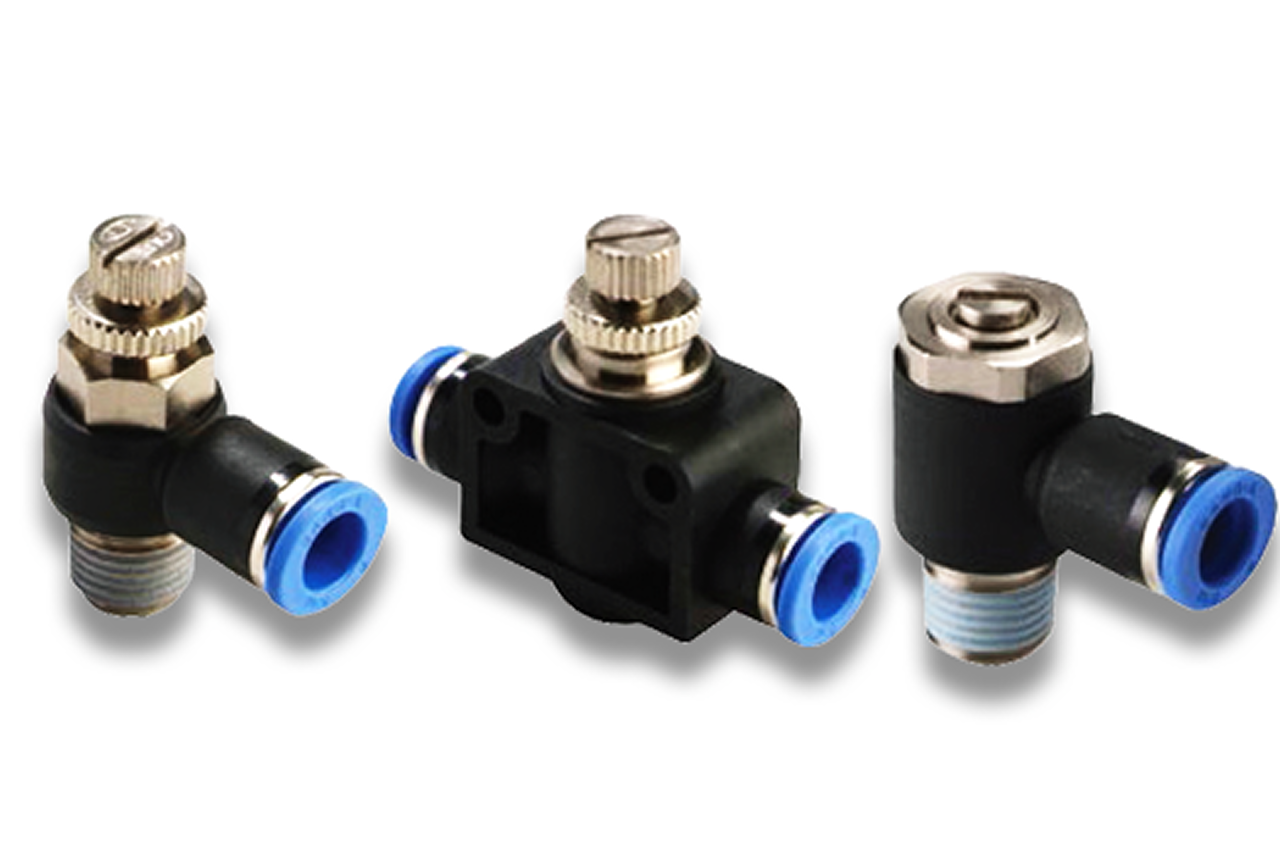
A speed controller is an inline functional fitting that threads directly into a cylinder port and sets how fast that cylinder extends or retracts. It combines two elements in one body: an adjustable metering needle and a check valve. Air is throttled through the needle in one direction and flows freely past the check valve in the other — so the controller restricts the cylinder's motion on one stroke and lets it move at full speed on the return. It is the standard, purpose-built way to control pneumatic cylinder speed, and the second sale on every cylinder: a cylinder without speed control slams its end-of-stroke and cannot be tuned to the line's cycle time. The controller is sized to the same tube OD as the push-to-connect fittings on the machine and installs at the cylinder port, between the directional valve and the actuator.
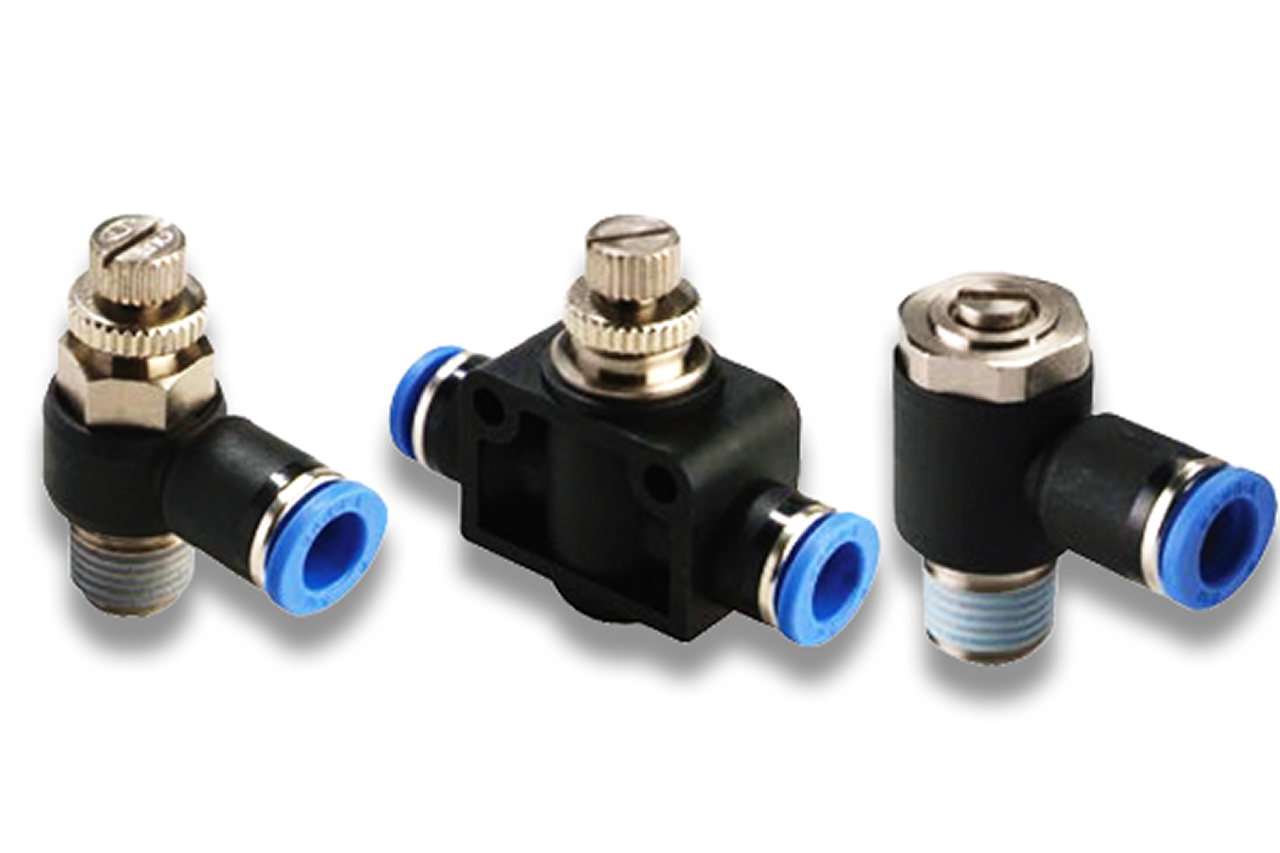
Real-world reference Representative speed controller
Speed Controller — representative product photo
02Why it's needed

Why this matters.

Tips and pointers on when the speed controller is the right call — and when to spec something else. Scroll the strip →

01 · Key point
Two valves in one body.

A needle valve throttles flow in one direction, an integral check lets flow pass freely the other way. No regulator and no plain flow-control can do this — meter the exhaust on the working stroke, free flow on the return.

02 · Key point
Meter-out keeps motion load-stable.

Throttling the exhaust (suffix O) keeps a column of pressurized air on the back side of the piston — motion stays smooth across changing loads. Default for any double-acting cylinder; meter-in is the exception (spring-return single-acting only).

03 · Key point
Two per cylinder, on every quote.

Two per double-acting, one per single-acting. A 16-cylinder machine needs 30+ controllers; stock in 25- or 50-count cases. Miss them at quote time and the customer either calls back angry or sources from a competitor.

04 · Pro tip
Verify meter-in vs. meter-out.

Part-number suffix O = meter-out, I = meter-in. Double-acting = meter-out, almost always. Wrong direction creates jerky load-dependent lurching that worsens at lighter loads — 5-minute fix, but only if the suffix is verified at order.

05 · Where not to use
Line-level bidirectional metering.

The integral check forces one-direction throttling — wrong for line balancing or pilot signal timing where both directions need to meter equally. → Re-spec to flow control valve when the throttle lives in the line, not at the cylinder port.

06 · Where not to use
Load holding on power loss.

A speed controller's check unseats on pilot reversal — it cannot trap the cylinder chamber against a directional valve venting on power loss. → Re-spec to pilot-operated check valve at each cylinder port for load-holding service.

07 · Where not to use
Manual isolation for service.

A speed controller is always partly open — it can't be locked off for OSHA lockout-tagout. → Re-spec to quarter-turn shutoff valve upstream of the FRL when the job is deliberate manual isolation, not cylinder-port speed tuning.

03Key selection criteria

What we need to spec it right.

From the machine spec sheet → to the part number. Answer what you know — leave the rest blank — and send.

01 · Input
Pull from the cylinder spec sheet — the speed controller threads directly into the cylinder's port. Mismatched threads will not seal.
Thread types: NPT · BSPT · BSPP / G · Metric · Common sizes: 1/8" · 1/4" · 3/8" · M5 · M7
02 · Input
Caliper-measure at the existing machine tubing. The PTC end must match the machine's tube OD exactly — mixing metric and inch is the most common at-install miss.
Metric: 4mm · 6mm · 8mm · 10mm · 12mm · 16mm · Inch: 1/4" · 3/8" · 1/2"
03 · Input
Set by the cylinder's load behavior. Wrong direction creates jerky load-dependent lurching — 5-minute fix, but only if verified at order.
Meter-out (suffix O — default for double-acting, load-stable) · Meter-in (suffix I — single-acting / spring-return only)
04 · Input
Set by connection geometry at the cylinder port and where the operator adjusts the throttle. Panel-mount is a different SKU.
Male straight connector (most common) · Male elbow (tight spaces) · Straight union · Bushing · Panel-mount (behind-panel adjustment)
05 · Input
The controller's flow capacity (Cv) must match the cylinder bore — undersize prevents full speed even fully open; oversize gives too coarse an adjustment.
Small: Ø20-40mm · Mid: Ø50-100mm · Large: Ø125mm+
06 · Input
Confirm from the regulator setting on the machine drop. Controller has a max-pressure rating — verify the system runs within it before quoting.
Typical: 60 PSI · 90 PSI · 120 PSI · Verify max rating on quote
07 · Input
Count the cylinders on the build. Typically 2 per cylinder (meter-out × 2 ports); multi-axis machines have higher counts. A 16-cylinder machine lands at 30+ controllers.
2 per double-acting cylinder · 1 per single-acting · 25/50-count case (production-line MRO)

Need different sizes, colors, or quantities? Fill the form, add to quote, then fill again — each click is one quote line.

05How to sell this  ·  distributor talk track

The tier conversation closes the deal. The cross-reference catalog wins the next one.

Every cylinder sale is two speed-controller sales. Miss them at quote time and the customer either calls back angry or sources them from a competitor.
The SPC difference · how distributors actually buy

The 30-second positioning

Quote one with every cylinder. Two per double-acting (one each port), one or two per single-acting. Match the cylinder's port thread + the machine's tube OD.

Tier: Economical tier is the value default with full size + thread coverage. Industry Leader tier for matched-vendor builds.

The consultative move — meter-in vs meter-out. Meter-out (suffix O) for any double-acting cylinder. Meter-in (suffix I) only for single-acting with spring return, or rare constant-load double-acting cases. Verify the suffix before quoting — a wrong-direction swap creates jerky motion.

Body form: male straight connector is most common; elbow for tight spaces; panel-mount for behind-the-panel adjustment.

Stocking pattern: a 16-cylinder machine needs 30+ controllers, so 25- or 50-count cases are the standard re-order on production lines.

Customer cue → talk move

"Cylinder slams the end of stroke"
Both ports, meter-out, tune the throttle. Most common service call.
"Cylinder is weak / stalls under load"
Customer is throttling pressure. Restore full pressure, install meter-out controllers.
"Motion is jerky and uneven"
Meter-in installed where meter-out is needed. Swap to meter-out.
"Speed varies with load weight"
Same fix — swap to meter-out.
"Adding a new cylinder to a machine"
Quote two controllers (matched thread + tube OD) on the same line. Don't make this the call-back.
"Replacing on a 10-yr-old machine"
Verify the existing meter-in/meter-out spec before ordering — wrong direction changes cylinder behavior.
06Where it's used

Industries served.

Each industry below uses this product across the listed areas. Open an industry to see how it fits the rest of its system.

Also applies to Every double-acting cylinder install · Single-acting / spring-return cylinders · Air motors + rotary air tools · Air-operated diaphragm pumps (AODD) · Bench-mounted pneumatic presses + clamping fixtures · Vacuum pick-and-place · Cylinder retrofits on legacy machines

09Install · 6 critical steps

The things that matter on the first install.

Step 01
Verify meter-in vs meter-out
Part-number suffix O = meter-out, I = meter-in. Double-acting = meter-out, almost always. Wrong direction creates jerky motion that worsens at lighter loads.
Step 02
Thread directly into the cylinder port
— not the supply hose. Mounting it in the hose still throttles flow but adds tubing volume that hurts response time and creates pressure-spike chambers between the throttle and the cylinder.
Step 03
Orient the knob for service access
Rotate the body within the port thread (within sealant limits) so the adjustment knob is reachable with the cylinder installed in the machine. On elbow-body controllers, the elbow orientation also affects access.
Step 04
Thread sealant by thread type
NPT = 2-3 wraps of PTFE tape in the direction of engagement. BSPP/G = O-ring at the face, no thread sealant on the threads. Mixing methods causes either thread leaks or face leaks.
Step 05
Open fully, then close in small increments
Cycle once with both controllers full-open to verify the cylinder runs at full speed in both directions (catches undersized controllers). Then close each throttle gradually until motion is smooth and end-of-stroke is acceptable without slamming.
Step 06
Lock the throttle
Engage the lock nut or set screw on each controller after tuning. Mark the final position with a paint pen so drift or unintended adjustment is visible. Unlocked controllers drift over time from vibration or get casually re-tuned during service, undoing the original setup.
10Troubleshoot · top failures

Most returns trace to one of these causes.

Symptom
Most likely cause
Fix
Cylinder slams the end-of-stroke on one direction
That stroke's speed controller is full-open, bypassed, or failed-open.
Find the controller for the slamming stroke (in meter-out, it's at the OPPOSITE port from the stroke direction). Close incrementally. If full-closed doesn't slow it, it's bypassed or failed.
Motion is jerky and lurches under load
Meter-in installed where meter-out is needed (double-acting cylinder).
Verify the part-number suffix. Swap to meter-out (O suffix). 5-minute fix.
Speed varies with load weight
Same root cause — meter-in on a double-acting cylinder. Meter-out is load-stable.
Swap to meter-out.
Cylinder won't move, controllers fully open
Failed closed (rare), OR a different downstream restriction (kinked hose, plugged muffler).
Remove the controller, replace with a straight union. If cylinder moves, the controller failed; if not, the restriction is elsewhere.
Speeds drift over time even with locked controllers
Particulate from a degraded upstream coalescing filter is fouling the needle/seat.
Service the upstream coalescing filter. Replace contaminated controllers with the filter service.
Extend and retract speeds are unequal but should match
One controller more throttled than the other, OR mismatched Cv (mixed brands/sizes).
Open both fully and observe. If equal at full open, the bottleneck is upstream. If unequal, the controllers are mismatched.

Get the right speed controller on quote in 24 hours.

Send us the application — a specialist routes you to the correct tier with a configured part. Lead-times and pricing returned within one business day.

Request a quote