DISTRIBUTOR-FIRST SUPPLY PARTNER · SINCE 1999 Live · Pneumatic Automation System

SPC Company
Pneumatic Automation / Motion Control / Shock Absorbers / Pneumatic Shock Absorber — Self-Compensating
Layer 05 · Motion Control Industry Leader · SMC Emerging · KOBA
01What it is

Pneumatic Shock Absorber — Self-Compensating

A self-compensating pneumatic shock absorber is a fixed-rating end-of-stroke decelerator that brings a moving pneumatic load smoothly to rest without any external adjustment. Internal metering — a profiled set of orifices engineered into the body — automatically adapts the damping force to the incoming energy across the unit's rated range, so one unit handles a span of load-and-velocity combinations as built. It threads into the machine frame on a standard mounting thread (M6, M8, M10, M14, M20, M27 covering most ranges) and is installed wherever a cylinder, gantry, or EOAT would otherwise hit a hard stop. The trade-off for that simplicity is fixed behavior: if the application's load or speed later changes outside the rated range, the unit cannot be re-tuned and must be re-selected. This is the OEM-designed-in default — the variant to specify when load and velocity are stable, characterized at design time, and will not change over the machine's service life.
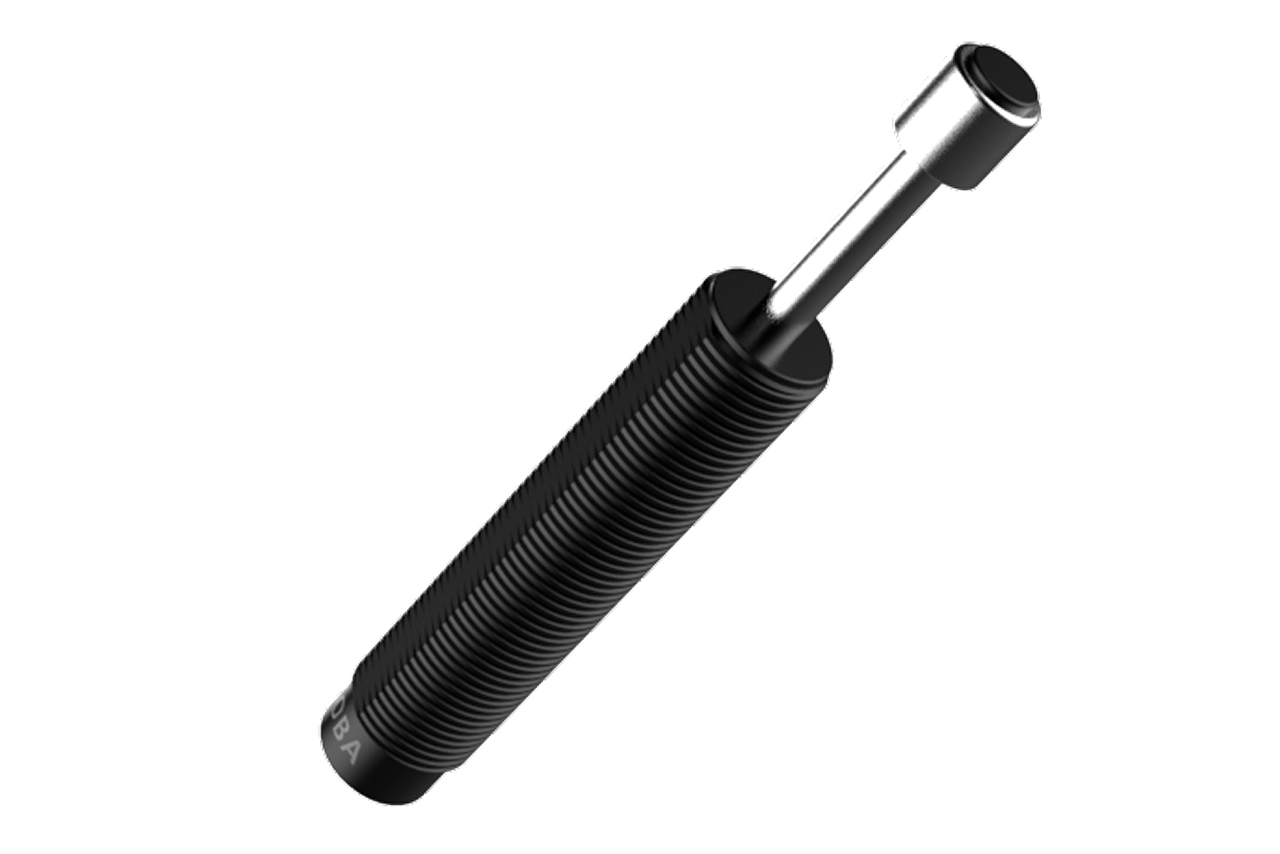
Real-world reference Representative pneumatic shock absorber — self-compensating
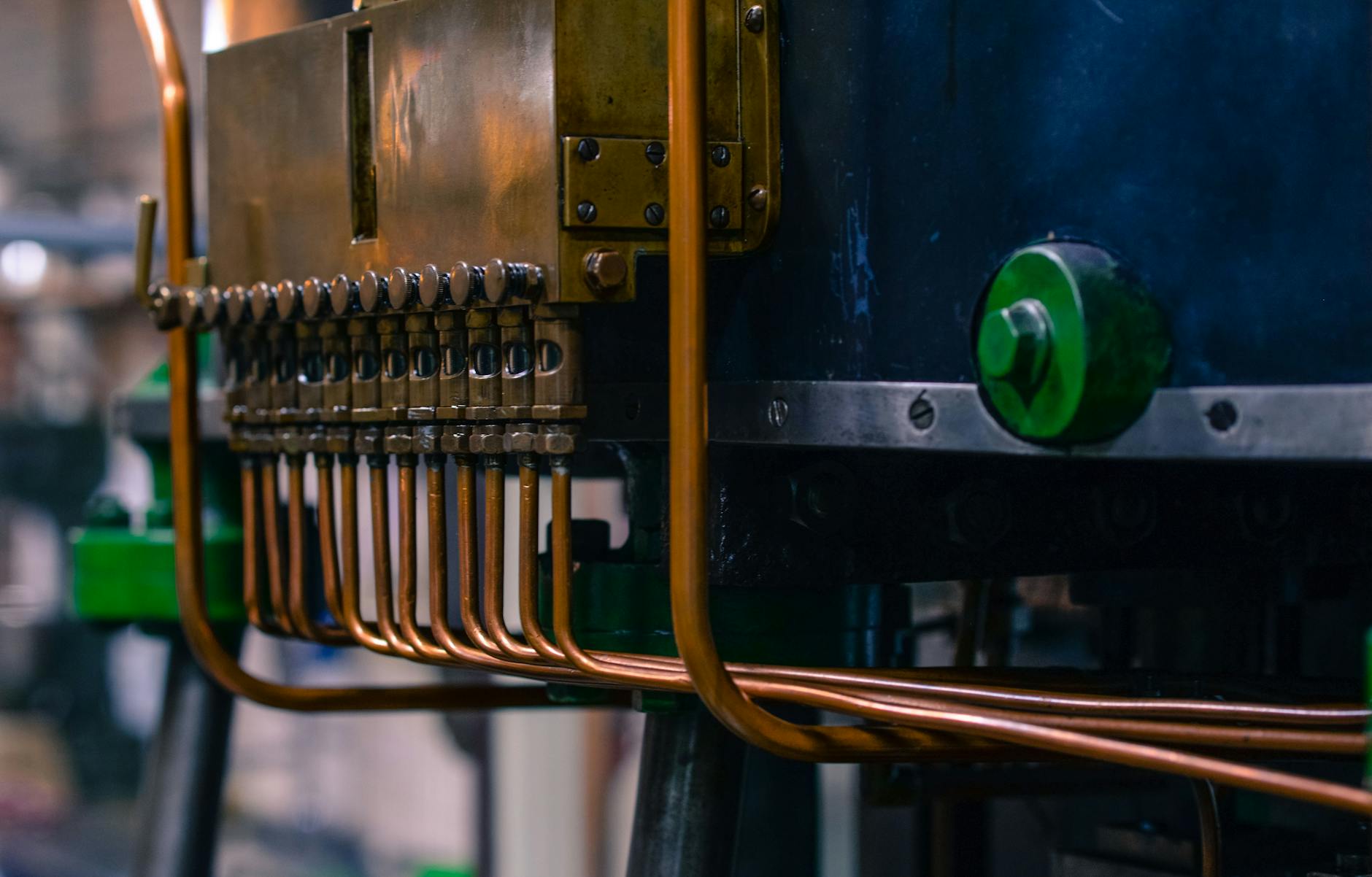
Pneumatic Shock Absorber — Self-Compensating — representative product photo
02Why it's needed

Why this matters.

Tips and pointers on when self-compensating is the cleaner spec — and when adjustable or a heavy-duty series belongs on the quote instead. Scroll the strip →

01 · Key point
Set-and-forget install.

No adjustment screw means no drift under vibration, no per-product tuning, no service-tech callbacks. A profiled orifice set self-adapts the damping curve across the rated window — the OEM-designed-in default for SMC, Festo, Norgren, Bimba machinery.

02 · Key point
Longer cycle life.

10-20 million cycles typical service life — longer than the adjustable equivalent because the simpler internal design has no adjustable-orifice mechanism to wear. The only viable choice on high-cycle production lines seeing tens of millions of cycles per absorber.

03 · Key point
One unit, a 5:1 load spread.

Profiled metering handles a 5:1 spread of load weights and a similar spread of velocities within the rated window — uniform deceleration ending in a soft touch-down without any field adjustment. Wider operating range than the adjustable variant's 4:1 ratio.

04 · Pro tip
Match the velocity class.

Self-comp ships in velocity-class options — typically a lower-speed and a higher-speed orifice profile per series. Compare actual approach velocity to the chart and pick the matching class. A mismatch delivers off-curve damping: bangs at high speed in the low-class, stalls at low speed in the high-class.

05 · Where not to use
Variable loads or changeover lines.

Self-comp cannot be field-tuned. Mixed-product packaging, retrofits, prototype work, or any application where load or velocity will evolve sits outside its operating model. → Re-spec to adjustable for variable loads and document settings per product on a laminated chart at the machine.

06 · Where not to use
Energy outside rated window.

Above max, even the heavy-duty curve slams through; below min, the unit over-damps a light load into a stall. → Compute KE = W × V² / (2 × 386), add 20-30% safety factor, verify inside the series window. Move to the heavy-duty self-comp series for high-energy stops; move to the soft / low-energy variant for delicate workpieces and light loads.

07 · Where not to use
Side-loaded or angled impact.

Off-square contact destroys seals fast — the dominant premature-failure mode. → Spec a self-aligning pivot mount or flat contact pad on rotary actuators, swinging loads, or any non-linear geometry. For delicate or finished-surface contact, add the cap / urethane bumper variant at the nose.

03Key selection criteria

What we need to spec it right.

From the machine spec sheet → to the part number. Answer what you know — leave the rest blank — and send.

01 · Input
Sum every mass that moves — rod, tooling, fixture, workpiece — not just the part being moved. Under-stating the load is the #1 sizing miss; energy scales linearly with weight.
Under 5 lb (EOAT) · 5-50 lb · 50-200 lb · 200+ lb (heavy-duty series)
02 · Input
The cylinder's actual speed at impact, not nameplate. Pull from a speed measurement or stroke ÷ travel time. Velocity drives kinetic energy as the square — a 2x velocity error is a 4x energy error.
Under 20 in/sec (low-speed class) · 20-60 in/sec · 60-120 in/sec (high-speed class) · 120+ in/sec
03 · Input
Self-comp absorbers ship in velocity-class options — typically a lower-speed and higher-speed orifice profile per series. A mismatch delivers off-curve damping: bangs at high speed in the low-class, stalls at low speed in the high-class.
Low-speed profile · Standard profile · High-speed profile
04 · Input
How many hits per minute. Verifies thermal rating and plans cycle-life replacement — self-comp has a defined 10-20M cycle life that becomes calendar-equivalent at this rate.
Under 10/min · 10-30/min · 30-60/min · 60+/min (high-cycle production)
05 · Input
Self-comp is right only when the operating point is fixed for the machine's service life. If load, speed, changeover, or future mods are uncertain, quote adjustable instead.
OEM-designed-in (fixed) · High-cycle production (no changeover) · EOAT (fixed payload) · Any uncertainty → adjustable
06 · Input
Pull from the machine's mounting-point spec on the print or measure with a thread gauge. NPT and metric are not interchangeable — verify the thread standard, not just the diameter.
M6-M10 (EOAT / compact) · M14 · M20 · M27 (heavy-duty)
07 · Input
Compute KE = W × V² / (2 × 386) + 20-30% safety; verify inside the rated window (typically 5:1 spread). Soft variant for delicate light loads; cap/bumper for finished-surface contact.
Standard self-comp · Heavy-duty / high-energy · Soft / low-energy · Cap / urethane bumper
08 · Input
If a self-comp series is already on the original print (SMC RB-Series is the most common spec), match for consistency — the OEM characterized the load at design time. Check before quoting a substitute.
SMC RB-Series match · KOBA equivalent cross · No print / new build
09 · Input
Number of shock absorbers for this configuration. Matched pairs or sets per axis? Add separate quote lines if specs differ between positions.
1 unit · 2-4 (machine axis set) · 5+ (OEM build lot)

Need different sizes, colors, or quantities? Fill the form, add to quote, then fill again — each click is one quote line.

04Choose your solution tier  ·  core differentiator

Whatever your lever — spec, value, or price — SPC has the right brand.

Most distributors sell one brand per product type. SPC's 60-brand portfolio means every Product Type page surfaces three real options matched to how your customer is buying today. Pick the tier; the quote desk handles the cross-reference.

05How to sell this  ·  distributor talk track

The tier conversation closes the deal. The cross-reference catalog wins the next one.

Self-compensating is the OEM-designed-in absorber — no adjustment screw, no service drift, longer cycle life. If the customer's load and velocity will never change, this is the cleaner install. If anything is uncertain, quote adjustable instead.
The SPC difference · how distributors actually buy

The 30-second positioning

This is the engineering-sale anchor of OEM machinery. Most brand-name pneumatic OEM machines (SMC, Festo, Norgren, Bimba, Numatics) ship with self-comp absorbers built into the original design — the OEM characterized the loads and selected for the operating point. SPC's play is twofold: spec self-comp into new machine builds where the customer's engineering team has characterized the load, and supply same-spec replacement units when OEM-spec absorbers reach end of cycle life on installed equipment.

The structural conversation has five pieces. First, get the load, velocity, and cycle-rate numbers — total moving load (rod + tooling + fixture + workpiece), approach velocity at contact, cycles per minute. Second, verify the application is stable — load and velocity won't change, no product changeovers, no retooling planned. If any uncertainty exists, switch to adjustable. Third, compute energy per cycle with KE = W × V² / (2 × 386) and confirm it falls inside the series' rated window (most cover a 5:1 spread). Fourth, match velocity class — self-comp absorbers ship in velocity-class options; a mismatch delivers off-curve damping. Fifth, match the mounting thread.

Tier: Industry Leader tier for OEM-designed-in machinery where a specific brand is called out on the print — match it for consistency. Emerging tier covers the same energy and velocity-class ranges at a lower price point; viable for same-spec replacement when lead time or price are the constraint. The category does not have a meaningful economical tier worth quoting — unbranded and import self-comp absorbers are common but damping-curve quality is inconsistent and cycle-life claims are unverified. Lead with Industry Leader tier and stay there.

Recurring revenue is in the replacement cadence. Self-comp absorbers have longer cycle lives than adjustable equivalents (10-20M cycles typical for standard service) but they are still planned consumables on high-cycle production lines. Track cycle count, replace before performance visibly degrades, document the install date so the next replacement is on calendar. A 50-machine plant with 4 absorbers per machine on a 5-year cycle-life is 40 absorbers per year of recurring replacement.

Customer cue → talk move

""We're building OEM machinery and need shock absorbers""
Self-comp is the default. Get load and velocity, size from the Industry Leader tier catalog, spec into the machine print. No adjustment screw means no field-tuning step for the customer — what OEM customers want.
""Replacing an SMC RB-series absorber on an installed machine""
SMC same-part-number replacement is the cleanest call. If lead time is long, an Industry Leader tier equivalent in the same energy/velocity class is a viable cross — verify the customer is comfortable with it.
""High-cycle production line — robotic, automated assembly, pick-and-place""
Self-comp is mandatory. Adjustable variants wear the adjustment mechanism on high-cycle service and drift; self-comp has no adjustment to wear. Match velocity class carefully — high-cycle robotics typically run higher approach velocities than general industrial.
""Our load is stable but we want to be able to tune later if needed""
Push back gently. If the load is genuinely stable, self-comp is the cleaner install. If they insist on field-tuning, quote adjustable but note the shorter cycle life on high-cycle service.
""Delicate workpiece, light load, gentle deceleration""
Soft / low-energy self-comp variant. Standard series over-damps very light loads; the soft variant is profiled for gentle deceleration of fragile or low-mass loads.
""Our 8-year-old machine's absorber feels different lately""
End of service life. Self-comp absorbers wear gradually rather than failing suddenly — performance drift is the warning. Quote the equivalent unit and recommend replacement before output is affected.
""Robotic end-of-arm tooling with a fixed payload""
Self-comp in compact threads (M6-M14). EOAT loads are characterized at integration time and don't change. Use the cap/bumper variant if the contact point hits a finished surface.
""Our load varies by 3x across products""
Self-comp absorbers cover a ~5:1 spread, so 3x is inside most series' window — verify by computing energy at lightest and heaviest. If borderline, quote adjustable for field-tuning capability.
06Where it's used

Industries served.

Each industry below uses this product across the listed areas. Open an industry to see how it fits the rest of its system.
Also applies to OEM-designed-in machinery (SMC, Festo, Norgren, Bimba spec) · The largest install volume for self-compensating across SPC's territory. · High-cycle production lines (robotic, automated assembly, pick-and-place) · only viable choice · Robotic end-of-arm tooling (EOAT) · Indexing tables and rotary fixtures with stable operating points · high cycle counts reliably · Pneumatic-driven testing and inspection equipment · Replacement service across multi-machine fleets · steady annual replacement quantity that compounds over years

09Install · 6 critical steps

The things that matter on the first install.

Step 01
Verify the application is stable before specifying self-comp
Load and velocity must not change over the machine's service life. Changeover lines, retrofits, prototype work, and any planned modifications should use the adjustable variant instead. Self-comp is the right call only when the operating point is characterized and fixed.
Step 02
Calculate energy per cycle and verify it's inside the series operating window
KE = W × V² / (2 × 386) gives in-lb/cycle (W in lbs, V in in/sec). Add 20-30% safety factor. The result must fall inside the rated range — most series cover a 5:1 spread, but absolute limits still apply at both ends. If outside, move to the heavy-duty / high-energy self-comp series.
Step 03
Match the velocity class to actual approach velocity
Self-comp absorbers ship in velocity-class options (typically labeled by velocity range — lower-speed vs. higher-speed orifice profiles). Compare the customer's velocity at contact to the series chart and pick the matching profile. A mismatched velocity class delivers off-curve damping — under-damped at high speed (bangs), over-damped at low speed (stalls).
Step 04
Mount perpendicular to load travel and torque to spec
The absorber nose must contact the load square-on, not at an angle. Side loading destroys seals fast and is the most common premature-failure cause. For non-linear geometry (rotary actuators, swinging loads), use a self-aligning pivot mount or a flat contact pad. Torque the mounting nut to the manufacturer's spec — over-torque distorts the housing.
Step 05
Specify cap or bumper for delicate contact applications
The cap/bumper variant adds a urethane or rubber pad at the nose, protecting both the absorber and the load from direct metal-to-metal impact. Standard install for delicate workpiece handling, food-grade contact, and any application impacting a finished surface.
Step 06
Document the install at commissioning, then set the planned-replacement cadence
Record the full part number (series + model + velocity class + mounting thread), the calculated energy per cycle, the rated cycle life, the install date, and the cycle-counter starting value. Compute the calendar-equivalent of cycle life at the line's cycle rate — a 10M-cycle absorber at 30 cycles/min, 8 hr/day, 5 day/week reaches end of life in roughly 1.4 years. Plan replacement on calendar with 10-15% buffer. For service-route customers, fold the replacement into the same PM visit as other consumables.
10Troubleshoot · top failures

Most returns trace to one of these causes.

Symptom
Most likely cause
Fix
Loud bang at end of stroke despite self-comp absorber installed.
Undersized for actual energy (calculation underestimated load or velocity), wrong velocity class (high-speed class on a low-speed application or vice versa), load not contacting nose square-on, return spring failed, or absorber installed at the wrong stroke position.
Re-measure load and velocity, recompute energy, verify against the series chart. If energy exceeds rated, upsize to the heavy-duty series. If velocity class is wrong, switch class. Verify square contact by checking the impact mark on the nose — angled impact leaves an off-center wear pattern.
Cylinder labors or stalls before reaching end of stroke.
Oversized for actual load (below the series minimum), wrong velocity class (low-speed class engaging too aggressively), cylinder pressure inadequate, or absorber installed at the wrong stroke position (engaging too early).
Verify calculated energy is inside the operating window. Self-compensating absorbers cannot be field-adjusted — if sizing or velocity class doesn't match, the unit must be replaced with the correct one. For light loads outside the standard range, switch to the soft / low-energy variant.
Oil weeping or seeping from the absorber body.
End of service life — seals have aged. Self-comp absorbers are sealed, non-rebuildable units; once oil seeps, the damping curve is already degrading.
Replace the absorber. Don't attempt to top up or service — they aren't rebuildable and a refilled unit's damping is unpredictable. Document failure date and cycle count to refine PM intervals across the customer's fleet.
Damping performance has degraded gradually over years.
Approaching end of rated cycle life — the multi-orifice metering profile loses sharpness as internal seals and orifice edges wear gradually over millions of cycles. This is the expected end-of-life signature for self-comp absorbers (different from the adjustable variant's screw-drift signature).
Replace the absorber. Before quoting same-spec replacement, verify the operating point hasn't changed — if load or velocity has crept, recompute and re-spec; if not, same-spec is the call.
Absorber running hot to the touch.
Cycle rate exceeding thermal duty rating, energy/cycle near or exceeding rated max, elevated ambient temperature, or the unit being used outside its rated operating window in a way that forces maximum damping every cycle.
Verify cycles per minute and energy/cycle against the series thermal chart. If exceeding, upsize to a heavy-duty series or add forced cooling. Self-comp absorbers should run within 10-15°F of ambient on a properly sized install — "warm" is not normal.
Mounting bracket cracking or fatiguing despite absorber installed.
Undersized (energy reaches the bracket through end-of-stroke contact instead of being absorbed), installed at the wrong stroke position (load contacts the bracket before the absorber), or the bracket itself undersized for the static reaction force.
Verify the absorber engages through its full stroke — the load should contact the nose with the absorber fully extended and decelerate across the entire stroke length, not just bottom against it. If sizing is correct and the bracket still fatigues, structurally reinforce. Don't over-spec the absorber to compensate for a weak bracket — the failure just moves.

Get the right pneumatic shock absorber — self-compensating on quote in 24 hours.

Send us the application — a specialist routes you to the correct tier with a configured part. Lead-times and pricing returned within one business day.

Request a quote