DISTRIBUTOR-FIRST SUPPLY PARTNER · SINCE 1999 Live · Compressed Air System

SPC Company
Compressed Air / Monitoring / Air Quality / Ultrasonic Leak Detector
Layer 07 · Monitoring Emerging · CS Instruments
01What it is

Ultrasonic Leak Detector

A handheld audit instrument that finds compressed air leaks by listening for them. Operated by a technician walking the plant, it sits in the monitoring layer as the audit entry point — not an installed sensor, but the tool that produces the leak report from which every downstream repair quote is built. Modern units estimate each leak's rate in SCFM (Standard Cubic Feet per Minute), convert it to a dollars-per-year figure using the customer's electric rate, and log location + photo, so the deliverable is a quantified worklist rather than a vague hiss. Camera-equipped variants overlay leak location on a visible-light image — essential for overhead piping documentation.
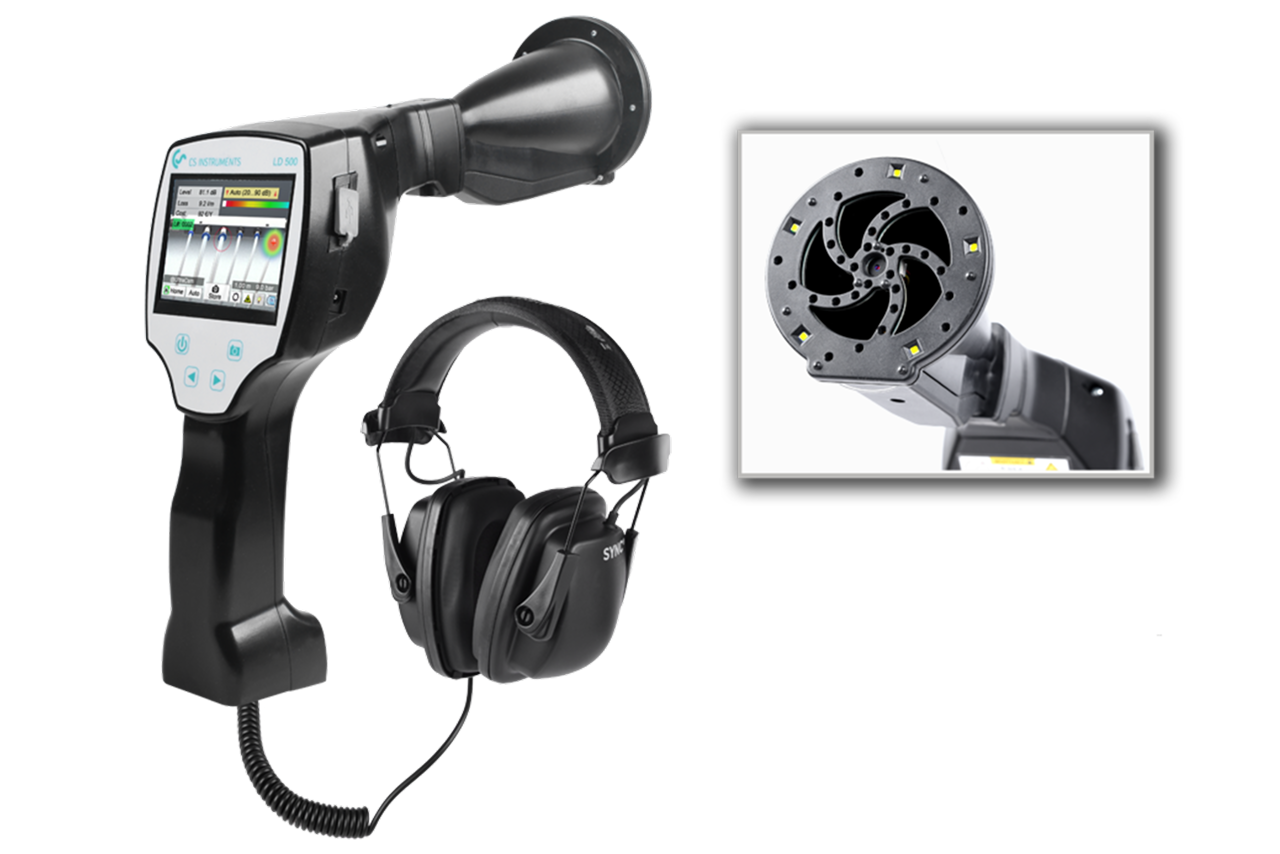
Real-world reference Representative ultrasonic leak detector
Ultrasonic Leak Detector — representative product photo
02Why it's needed

Why this matters.

Tips and pointers on when an ultrasonic leak detector is the right call — and when to spec something else. Scroll the strip →

01 · Key point
It hears what ears can't.

Leaks emit ultrasonic energy around 40 kHz — silent to people, loud to the detector. Catches the 80% of leakage that walking-by-ear surveys miss entirely.

02 · Key point
It produces dollar figures.

Each leak logged with SCFM rate + $/year using the customer's electric rate. 20-30% leak loss is industry norm; the deliverable is a numbered worklist with dollar costs no one can argue with.

03 · Key point
First 30 minutes pays the audit.

A 100 HP rotary-screw at 4,000 hrs/yr leaking burns ~80,000 kWh — $8,000+/year per compressor. Typical walk surfaces enough leakage to justify the audit fee before the first hour is done.

04 · Pro tip
Calibrate to the electric rate first.

Get $/kWh from the utility bill before walking. Without the rate configured, the report has SCFM figures but no dollar number — and the dollar number is what funds the repair quote.

05 · Where not to use
Overhead piping with basic unit.

An audio-only handheld can locate at 30+ feet but can't document for the maintenance team. → Re-spec to an acoustic-imaging camera unit for photo evidence the lift crew can find again.

06 · Where not to use
High-ultrasonic-noise environments.

Steam vents, electrical arcing, certain pumps swamp the 40 kHz signal. → Use a parabolic focusing accessory and reduce sensitivity, or schedule the survey off-shift when the ambient sources are down.

07 · Where not to use
Depressurized or idle systems.

Leaks only sound when air is escaping — the system must be at working pressure with the compressor running. → Verify line pressure on a gauge during the survey; no flow, no findings.

03Key selection criteria

What we need to spec it right.

From the machine spec sheet → to the part number. Answer what you know — leave the rest blank — and send.

01 · Input
Does the customer want SPC to walk the plant and deliver the report, or own the detector and run their own surveys? Sets the quote shape — service engagement vs. instrument + training.
SPC audit service (single visit, report deliverable) · Customer-owned tool (instrument + half-day training) · Hybrid (first audit by SPC, customer takes over)
02 · Input
Camera units are essential for overhead piping at 20+ feet where maintenance needs to find the leak again. Multi-parameter variants capture dew point/flow/pressure on the same walk-through.
Basic handheld (audio + numerical rate estimate) · Acoustic-imaging camera unit (photo evidence, overhead documentation) · Multi-parameter (adds dew point / flow / pressure inputs)
03 · Input
Total square footage + number of compressor rooms / production cells. Sets walk-through time and report scope — half-day for small plants, multi-day for large.
Under 100,000 sq ft (half-day) · 100k-500k sq ft (1-2 days) · 500k+ sq ft / multi-building (full week)
04 · Input
Industrial electric rate from the utility bill, or regional estimate. This multiplier converts each leak's SCFM into $/year — without it the report has leakage figures but no dollar number to fund repairs.
Provided by customer (utility bill) · Regional average (US industrial ~$0.08-0.12/kWh) · Estimate at install
05 · Input
Most audit teams need 1 detector. Larger multi-site audit consultancies or corporate accounts running parallel surveys may stock additional units + spare batteries.
1 unit (single audit team) · 2-3 units (multi-site consultancy) · 4+ units (corporate program / regional rollout)

Need different sizes, colors, or quantities? Fill the form, add to quote, then fill again — each click is one quote line.

04Choose your solution tier  ·  core differentiator

Whatever your lever — spec, value, or price — SPC has the right brand.

Most distributors sell one brand per product type. SPC's 60-brand portfolio means every Product Type page surfaces three real options matched to how your customer is buying today. Pick the tier; the quote desk handles the cross-reference.

05How to sell this  ·  distributor talk track

The tier conversation closes the deal. The cross-reference catalog wins the next one.

The leak detector is the dollar-figure machine. It turns invisible waste into a quote the customer cannot argue with — and the quote it produces is for everything else SPC sells.
The SPC difference · how distributors actually buy

The 30-second positioning

Two-route sale. Route 1 — audit service: SPC owns the detector, an SPC tech walks the plant, produces the leak report, and the report sells the downstream repair work (fittings, couplers, hose, FRLs). Route 2 — tool sale: the customer buys the detector outright for their own maintenance team.
Tier: The SPC audit handheld is an Industry Leader tier unit with audio output and numerical rate estimate; acoustic-imaging camera variants add overhead photo-documentation capability.

Customer cue → talk move

""Our electric bill is too high""
Leak audit. Walk with the audit handheld, log every leak with location and SCFM, convert to $/year. Typical first-pass finds enough leakage to justify the audit fee and repair quote in the first 30 minutes of walking.
""We've done audits before but nothing changed""
Two issues: vague audit report, or repair never funded. Re-do with an acoustic-imaging camera unit — photo evidence makes the repair decision much harder to defer.
""Overhead piping at 30+ feet, we can't reach it""
Acoustic-imaging camera unit. Locates and photo-documents from the floor — no lift required for the survey.
""We want to run surveys ourselves""
Tool-sale. Quote an audit handheld + half-day training. Customer owns the program; SPC owns the consumable resupply (fittings, couplers, FRL kits) as repairs happen.
""How much will the audit save us?""
Industry average is 20-30% leak loss; typical audit recovers 10-20% of compressor electric if repairs actually happen. Anchor the audit fee to that recoverable amount.
""Our last audit was 3 years ago""
Time for a repeat. Systems regenerate leaks continuously — every new fitting, every disconnect creates new points. Annual cadence keeps total leakage under 10%; irregular drifts back to 25-30% within 2-3 years.
06Where it's used

Industries served.

Each industry below uses this product across the listed areas. Open an industry to see how it fits the rest of its system.

Also applies to Standalone compressed-air leak audit (any plant, any compressor brand) · Energy / ESG reporting and sustainability programs · Pre-compressor-purchase load verification · Defers the new compressor purchase by years. · Multi-site corporate accounts with structured leak programs · Continuous-duty plants where every percent of compressor savings matters · Highest-value audit-service engagements. · Overhead / high-ceiling plants requiring acoustic-imaging documentation · Post-repair verification engagements · This is where SPC's audit-service model compounds — repair revenue is one event, the verification re-audit starts the next cycle.

09Install · 6 critical steps

The things that matter on the first install.

Step 01
Calibrate the detector against the customer's electric rate
Get $/kWh from the utility bill. Configure the cost-conversion so each logged leak is auto-tagged with annualized dollar cost. Without this step, the report has SCFM figures but no dollar number — and the dollar number is what drives the repair decision.
Step 02
Pressurize the system and run during the survey
Leaks only sound when air is escaping; the system must be at working pressure and the compressor running. Off-shift surveys produce cleaner distribution-leak data; on-shift surveys catch the operational leaks (active quick-couplers, connected hoses). Pick by the audit goal.
Step 03
Plan the walk-through route to cover the full distribution system
Start at the compressor room and walk outward: discharge, receiver, dryer, main header, branch lines, point-of-use FRLs (Filter-Regulator-Lubricator units), quick-couplers, hoses, pneumatic tools. Cover overhead piping, mezzanines, and out-of-the-way runs — the worst leaks are often where nobody looks.
Step 04
Adjust sensitivity per area, sweep slowly
Plug in the noise-isolating headphones. High sensitivity in quiet areas; lower sensitivity in noisy stamping/machining areas to filter background noise. Sweep across each fitting, joint, valve stem, and coupler — pause where the tone rises and home in.
Step 05
Log each leak: location, rate estimate, photo
For each leak: location (use a building map or photo-tag), leak-rate estimate from the detector, dollar-per-year (auto-calculated), and — on camera units — acoustic-image photo. Tag the physical leak with a numbered sticker or zip-tie so the maintenance team finds it later.
Step 06
Export the report; recommend top 20% for immediate repair
Connect to PC and export to the detector's report software. The export produces PDF + spreadsheet listing every leak with location, rate, dollar cost, and photo. Sort by dollar cost; the top 20% of leaks typically represent 60-80% of total leakage — recommend those for immediate repair and quote the components alongside.
10Troubleshoot · top failures

Most returns trace to one of these causes.

Symptom
Most likely cause
Fix
Picks up loud signals everywhere — every fitting sounds like a leak.
Sensitivity set too high for the background noise environment, or ambient ultrasonic noise sources nearby (steam vents, electrical arcing, certain motors and pumps produce ultrasonic noise).
Reduce sensitivity until clean fittings read as quiet baseline tone. Move away from steam vents and electrical panels during the survey. Use the detector's focusing accessory (parabolic dish or rubber focusing tip) to narrow the pickup angle and reject ambient noise.
Finds no leaks in a plant that obviously has them.
Sensitivity set too low, headphone volume too low, system not at full working pressure, or operator missing the high-leak areas (overhead piping, behind equipment).
Open a quick-coupler briefly as a test reference and tune sensitivity until that known leak reads clearly. Verify system pressure on a gauge during the survey. Re-plan the route to cover overhead and out-of-the-way runs.
Leakage-rate estimates seem unreasonably high or low.
Configured pipe pressure does not match actual system pressure; or distance from the leak during the rate-estimate measurement was wrong (the rate depends on holding the detector at a consistent calibration distance).
Verify configured pressure matches the line gauge. Hold the detector at the OEM's specified measurement distance (typically 10-20 cm) for the rate-estimate function.
Acoustic camera shows leak offset from the visible piping.
Camera not at the working distance, parallax between the acoustic array and the visible-light camera, or operator interpreting the heat-map too literally (the brightest pixel is the loudest source, not the exact leak point).
Use the camera at the OEM's recommended working distance. For close-range leaks, audio + standard handheld is more precise than camera imaging; use the camera for overhead/standoff documentation. The overlay is a documentation tool, not a millimeter-precision pointer.
Battery dies partway through a facility walk-through.
Battery old or degraded, cold ambient (lithium-ion drops in cold), or detector left on between leaks rather than standby.
Carry a spare charged battery for any survey over 2-3 hours. Use the standby/auto-off function between leaks. Replace the battery if out of warranty.
Report export fails or produces incomplete data.
SD card full, USB connection unstable, OEM report software not updated, or detector firmware out of date.
Clear onboard memory before each survey. Use the OEM-supplied USB cable. Update report software and firmware. For high-volume audit-service teams, train a backup operator on the export workflow.

Get the right ultrasonic leak detector on quote in 24 hours.

Send us the application — a specialist routes you to the correct tier with a configured part. Lead-times and pricing returned within one business day.

Request a quote