What it is
The functional exhaust on every valve
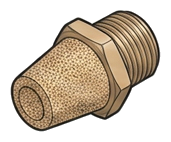
It threads into the exhaust port and breaks one loud jet into thousands of low-velocity streams — part of the valve's circuit, not an accessory.

Two silencer types, one decision. Where does the exhaust go, what's the environment, and how many valves are on the machine? This page walks the spec from "the customer is buying a valve" to the right silencer on the same line of the quote — comparison first, decision tree second, questions to ask third.
Tap any type to jump to its page. The Decision Guide further down asks three questions that funnel the spec to one of these.
It threads into the exhaust port and breaks one loud jet into thousands of low-velocity streams — part of the valve's circuit, not an accessory.
A 5/2 dumping 80 PSI hits 90-100 dBA — past OSHA's 85 dBA action level — and pulls shop debris back into the valve.
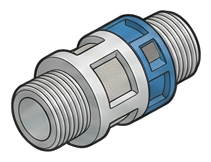
Sintered bronze handles heat, abuse, and oil mist for years. Switch to plastic only for washdown, weight-sensitive moving parts, or prototypes.
Porosity loads on dust and oil, back-pressure climbs, the valve acts sluggish. Check the silencer first — a 5-minute swap, not a teardown.
One per exhaust port × valve count — a 50-valve cell is 50+ silencers. Quote the full set, put it on the 6-12 month PM. Adsens anchors both styles.
Distributor-facing reading. The trade-off column is the one that closes the loop — every type buys something and gives something up. Knowing what each type costs you is how the right one gets on the quote without a callback.
Reading the brand bench column — the bar shows how many of SPC's tier slots (Industry Leader · Emerging · Economical · adjacent) carry an option at that product type. Silencers run a single-brand bench across both body styles by design — Adsens is SPC's anchor for the full thread range in both sintered bronze and plastic, and consolidating to one vendor across the entire silencer line IS the value to the customer's MRO procurement.
Draw a line from the customer's answer at the top to the type name at the bottom. This is the page distributors screenshot and send to a customer the day before a quote call — so the customer comes prepared with the answers, and the call is about the brand and the budget, not the basics.
Two things to keep in mind on every silencer quote. First — silencers are an attach sale, not a primary spec. The conversation starts after the valve count is known: one silencer per valve exhaust port × number of valves on the machine. A 20-valve machine is a 20-silencer line at install and a 20-silencer reorder line every 6-12 months at PM. Single-piece reactive quotes are the failure mode; full-set PM bundles are the recurring-revenue mechanic. Second — default to bronze unless a specific reason pushes to plastic. The named-reason list is short and clear (washdown / food / marine / corrosive / weight-sensitive / short-life prototype). Outside those conditions, bronze wins on durability, temperature range, and mechanical resilience — and Adsens carries both body styles, so the brand decision is already made.
Silencers aren't a tier-card sale — they're a count-the-valves sale. Quote the full set at install, put the reorder on PM, and the line runs itself.
If the customer answers most of these at the first call, the second call is the quote. If they can't answer any, the silencers are rarely the only spec gap — flag it and push for a site walk.
At the machine level, Control & Valving is the layer that decides where the air goes and how it gets there — and the silencer is the functional exhaust component that finishes the valve's discharge path. Every directional control valve dumps its exhaust somewhere, and an unmuffled dump is both loud and dirty: it spikes past OSHA's action level and pulls shop debris back into the valve. On a pneumatic machine the recurring story is volume, not value: a typical 50-valve manufacturing cell carries 50+ silencers, every one of them threaded into a valve exhaust port and sized to that port thread, and every one of them a functional part of the valve's exhaust circuit — not an afterthought consumable. The silencer's porosity also loads on dust and oil mist over months of cycling and silently raises back-pressure until the connected valve starts to act sluggish. Spec the silencer wrong and the customer blames the valves — "the line got loud, the cylinders are slow" — and starts pricing replacement automation. Spec it right and the silencer line attaches to every valve quote at install, sized to the port and chosen for the install environment, and reorders as a full-set PM swap on the 6-12 month cadence.
The functional exhaust component on every directional control valve — one silencer per valve exhaust port, consolidated onto every valve quote at install, reordered as a full set on the 6-12 month PM cadence. The attach-sale line that turns a one-time valve order into a recurring MRO relationship.
The valves the silencers attach to — every solenoid, ATEX, mechanical, and manifold valve has at least one exhaust port, and every port needs a silencer sized to its thread. Count the valves, quote the silencer set.
→The hand-operated isolation on the same machine — a quarter-turn shutoff locks out the supply so the valves and their silencers can be serviced without bleeding the branch.
→The smart, high-density manifold end of the same Control layer — IO-Link terminals still exhaust through silenced ports; a dense terminal is a dense silencer set on the same PM cadence.
→Filter, regulator, lubricator at the machine inlet. The lubricator's oil eventually loads the silencer from the exhaust side; over-oiling is the most common driver of accelerated silencer clogging.
→The end-use actuators the valves drive. Cylinder-speed tuning routes back to the speed-control silencer variant; sluggish cylinders are usually a clogged-silencer symptom, not a cylinder problem — check the silencer before the actuator teardown.
→Tell us the end-use, the rough flow, and what climate the unit would sit in. We'll come back with a configured quote — the right type, the right tier, and the upstream gear the warranty assumes.
—. We reply within one business day with pricing, lead-time, and configured parts.