What it is
The manifold that talks back
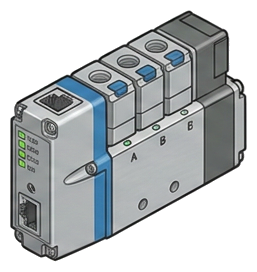
An IO-Link valve terminal turns a passive base into a fieldbus node — plus electronic regulation that holds an exact, commanded pressure.

Valve terminals and regulators are the smart, electronic end of the Control layer — where the manifold stops being a passive base and becomes a fieldbus node that talks back. An IO-Link valve terminal replaces a 32-conductor wire bundle with one fieldbus cable and streams per-val…
Tap any type to jump to its page. The Decision Guide further down asks three questions that funnel the spec to one of these.
An IO-Link valve terminal turns a passive base into a fieldbus node — plus electronic regulation that holds an exact, commanded pressure.
When the customer says predictive maintenance, smart-factory, or MES integration, the valve answer is an IO-Link terminal — and the sensors follow.
One fieldbus cable replaces a 32-conductor bundle and streams per-valve cycle counts, coil currents, and pressure feedback back to the PLC.
Firmware-locked to one fieldbus — a PROFINET unit can't become EtherNet/IP in the field. Get the protocol in writing, don't infer it.
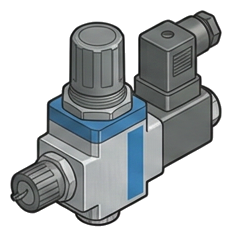
Reach for the proportional regulator when the process needs a commanded, closed-loop pressure for force or tension — not a mechanical setpoint.
Not there yet? Sell the standardized ISO sub-base manifold today; the IO-Link gateway is a swap-the-module future option on the same valves.
Distributor-facing reading. The trade-off column is the one that closes the loop — every type buys something and gives something up. Knowing what each type costs you is how the right one gets on the quote without a callback.
Reading the brand bench column — the bar shows how many of SPC's tier slots (Industry Leader · Emerging · Economical · adjacent) carry an option at that product type. SMC is the integrator default for the IO-Link gateway (EX600), a narrow bench where the technical requirement maps to a single anchor brand. The proportional pressure regulator is listed as a Product Type in this category without a curated comparison row yet.
Draw a line from the customer's answer at the top to the type name at the bottom. This is the page distributors screenshot and send to a customer the day before a quote call — so the customer comes prepared with the answers, and the call is about the brand and the budget, not the basics.
IO-Link is the pivot question on every modern machine quote. If the customer is moving toward predictive maintenance, MES integration, or smart-factory diagnostics, the directional-control answer is an IO-Link terminal — and that single choice cascades the rest of the spec. The terminal hosts IO-Link pressure switches, vacuum switches, and position sensors on the same gateway, so the manifold conversation expands into a sensor conversation. If the customer isn't there yet, quote the standardized sub-base manifold today (SMC SY or AIGNEP 01V on ISO 5599 / 15407) and the IO-Link upgrade path as a swap-the-gateway-module future option — same physical valves, same base, same mounting. Most customers buy the standard manifold first on wiring-savings alone, then upgrade to IO-Link 1-3 years later when the smart-factory budget lands.
If the customer answers most of these at the first call, the second call is the quote. If they can't answer any, the valve terminals & regulators are rarely the only spec gap — flag it and push for a site walk.
The Control & Valving layer is where compressed air stops being a utility and starts being motion. Upstream, the air-preparation and distribution components have delivered clean, dry air to the machine; downstream, cylinders, grippers and vacuum cups will do the physical work. Control is the layer in between — the directing-and-regulating job that decides which port of which actuator gets pressurized, in what order, on which signal, and what happens to that actuator on power loss. Most of it is electrical: a 24 VDC PLC output energizes a solenoid coil, the coil shifts a spool, the spool routes air to the cylinder, the cylinder moves. Some of it is mechanical (operator-actuated palm buttons and foot pedals; safety interlocks where geometry beats software). Some of it is hazardous-area-certified (ATEX zones where a standard electrical valve is a non-starter). And the modern layer carries diagnostics as well as commands — IO-Link valve terminals stream cycle counts, coil currents, and pressure feedback back to the PLC, turning the control layer into the IIoT pivot point for the whole machine. Get this layer wrong and the machine doesn't move, or moves wrong, or stops moving without warning. Get it right and the entire automated factory operates at the cost and density it operates at today.
IO-Link valve terminals that collapse the wiring and stream per-valve diagnostics, plus electronic / proportional pressure regulation — the smart, fieldbus-connected end of the Control layer and the IIoT pivot point on a modern machine.
The standardized sub-base manifold that the IO-Link terminal upgrades from — same ISO 5599 / 15407 valves, same base. Quote the manifold today, the terminal as the swap-the-gateway future option.
→The hand-operated isolation ahead of the terminal — a quarter-turn shutoff locks out the supply so the smart manifold and its gateway can be serviced without bleeding the branch.
→The functional exhaust component on the terminal's valves — one silencer per valve exhaust port, sized to the port thread, on the same high-density manifold the terminal commands.
→The end-use actuators the terminal commands. The same IO-Link gateway hosts the position and pressure sensors that close the loop on those actuators.
→Tell us the end-use, the rough flow, and what climate the unit would sit in. We'll come back with a configured quote — the right type, the right tier, and the upstream gear the warranty assumes.
—. We reply within one business day with pricing, lead-time, and configured parts.