What it is
The hand-operated, no-coil isolation
A human turns it, not a PLC. Quarter-turn shutoffs, ball valves, and hand valves that take a branch on, off, or out of service.

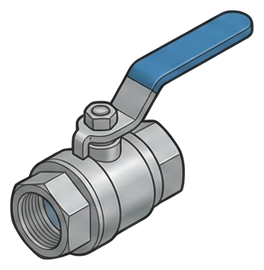
Manual and shutoff valves are the hand-operated, no-coil end of the Control layer — the human turns them, not a PLC. The workhorse is the quarter-turn shutoff: a point-of-use ball valve upstream of every FRL and at every branch take-off, so a filter bowl, regulator, or tool chang…
Tap any type to jump to its page. The Decision Guide further down asks three questions that funnel the spec to one of these.
A human turns it, not a PLC. Quarter-turn shutoffs, ball valves, and hand valves that take a branch on, off, or out of service.
Put one upstream of every FRL and branch take-off so a bowl, regulator, or tool change is serviced without bleeding the whole branch.
Lockout is what separates a shutoff from a plain valve. Padlock-through- lever = the OSHA quarter-turn; no lockout = a ball or hand valve.
Brass for general air, bronze for higher pressure, stainless for washdown / food / pharma / outdoor — brass in washdown corrodes within 6-12 months.
The shutoff is forgotten on the first quote. A walk-through audit surfaces 10-50 missing drops — count them and the audit becomes the sale.
Distributor-facing reading. The trade-off column is the one that closes the loop — every type buys something and gives something up. Knowing what each type costs you is how the right one gets on the quote without a callback.
Reading the brand bench column — the bar shows how many of SPC's tier slots (Industry Leader · Emerging · Economical · adjacent) carry an option at that product type. The shutoff bench is three (Kingston + STC + AIGNEP) by the brand list, though no brand-offering YAMLs exist yet, so the row is labelled "catalog pending." Ball valves and hand valves are new Product Types in this category without a curated comparison row yet — spec by material (brass / bronze / stainless) against the install environment until brand offerings are added.
Draw a line from the customer's answer at the top to the type name at the bottom. This is the page distributors screenshot and send to a customer the day before a quote call — so the customer comes prepared with the answers, and the call is about the brand and the budget, not the basics.
If the customer answers most of these at the first call, the second call is the quote. If they can't answer any, the manual & shutoff valves are rarely the only spec gap — flag it and push for a site walk.
The Control & Valving layer is where compressed air stops being a utility and starts being motion. Upstream, the air-preparation and distribution components have delivered clean, dry air to the machine; downstream, cylinders, grippers and vacuum cups will do the physical work. Control is the layer in between — the directing-and-regulating job that decides which port of which actuator gets pressurized, in what order, on which signal, and what happens to that actuator on power loss. Most of it is electrical: a 24 VDC PLC output energizes a solenoid coil, the coil shifts a spool, the spool routes air to the cylinder, the cylinder moves. Some of it is mechanical (operator-actuated palm buttons and foot pedals; safety interlocks where geometry beats software). Some of it is hazardous-area-certified (ATEX zones where a standard electrical valve is a non-starter). And the modern layer carries diagnostics as well as commands — IO-Link valve terminals stream cycle counts, coil currents, and pressure feedback back to the PLC, turning the control layer into the IIoT pivot point for the whole machine. Get this layer wrong and the machine doesn't move, or moves wrong, or stops moving without warning. Get it right and the entire automated factory operates at the cost and density it operates at today.
Quarter-turn shutoffs, ball valves, and hand valves — the hand-operated isolation and lockout points that take a branch offline for service. Material (brass / bronze / stainless) is the spec that follows the install environment.
The PLC-driven solenoid, ATEX, mechanical, and manifold valves downstream of the shutoff that actually drive the cylinders. A shutoff isolates the supply; the directional valve directs it.
→The smart, fieldbus-connected end of the same machine — IO-Link valve terminals and electronic pressure regulation. A shutoff still isolates the supply ahead of the terminal for service.
→The functional exhaust component on the directional valves the shutoff feeds — one silencer per valve exhaust port, sized to the port thread, on the same machine the shutoff isolates.
→The tubing and fittings a shutoff isolates. The shutoff sits at the boundary between the distribution run and the machine — close it and the FRL, regulator, and tooling downstream can be serviced without bleeding the branch.
→Tell us the end-use, the rough flow, and what climate the unit would sit in. We'll come back with a configured quote — the right type, the right tier, and the upstream gear the warranty assumes.
—. We reply within one business day with pricing, lead-time, and configured parts.