DISTRIBUTOR-FIRST SUPPLY PARTNER · SINCE 1999 Live · Compressed Air System

SPC Company
Compressed Air / Distribution / High-Purity Tubing & Fittings / Instrumentation Stainless Tube Fitting
Layer 04 · Distribution Industry Leader · DK-LOK
01What it is

Instrumentation Stainless Tube Fitting

An instrumentation stainless tube fitting is a double-ferrule compression fitting for leak-tight connections on small-diameter stainless tubing in high-purity, instrumentation, and analytical service — instrument-air headers, sample lines, gauge and transmitter connections. Instead of threading or flaring the tube, it uses a front-ferrule / back-ferrule design: as the nut is tightened, the back ferrule drives forward and the front ferrule grips and seals against the tube OD. The result holds high pressure, takes vibration, and remakes through ten or more cycles without seal degradation. This is a different family from push-to-connect — the two are not interchangeable, and tube fittings are the right choice wherever PTC is not acceptable: high purity, instrumentation, oil and gas, semiconductor, hydrogen, power generation. Because the design follows a widely adopted geometry, fittings from different makers are often dimensionally compatible — Industry Leader tier drops into existing Swagelok / Parker A-LOK / CPI systems without redesign. 316 stainless steel is the standard grade.
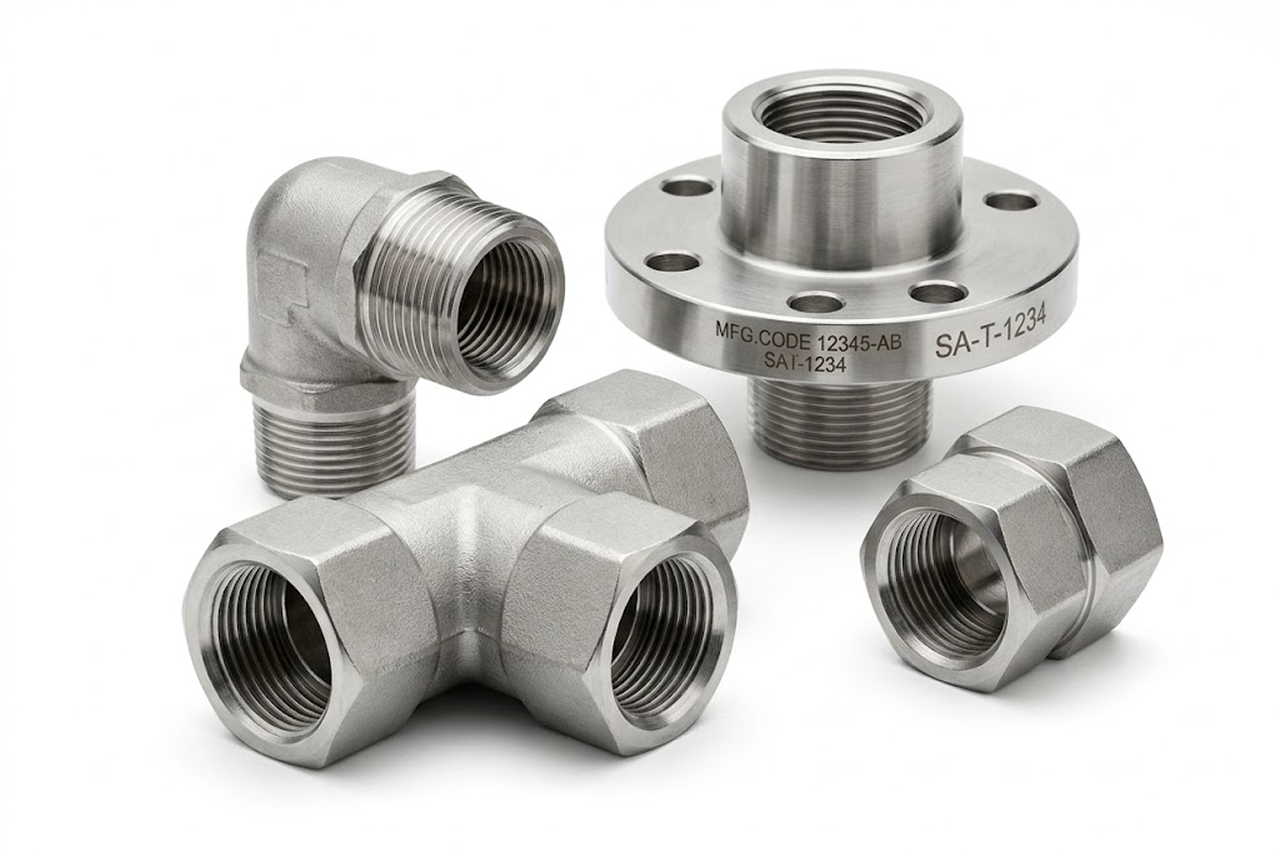
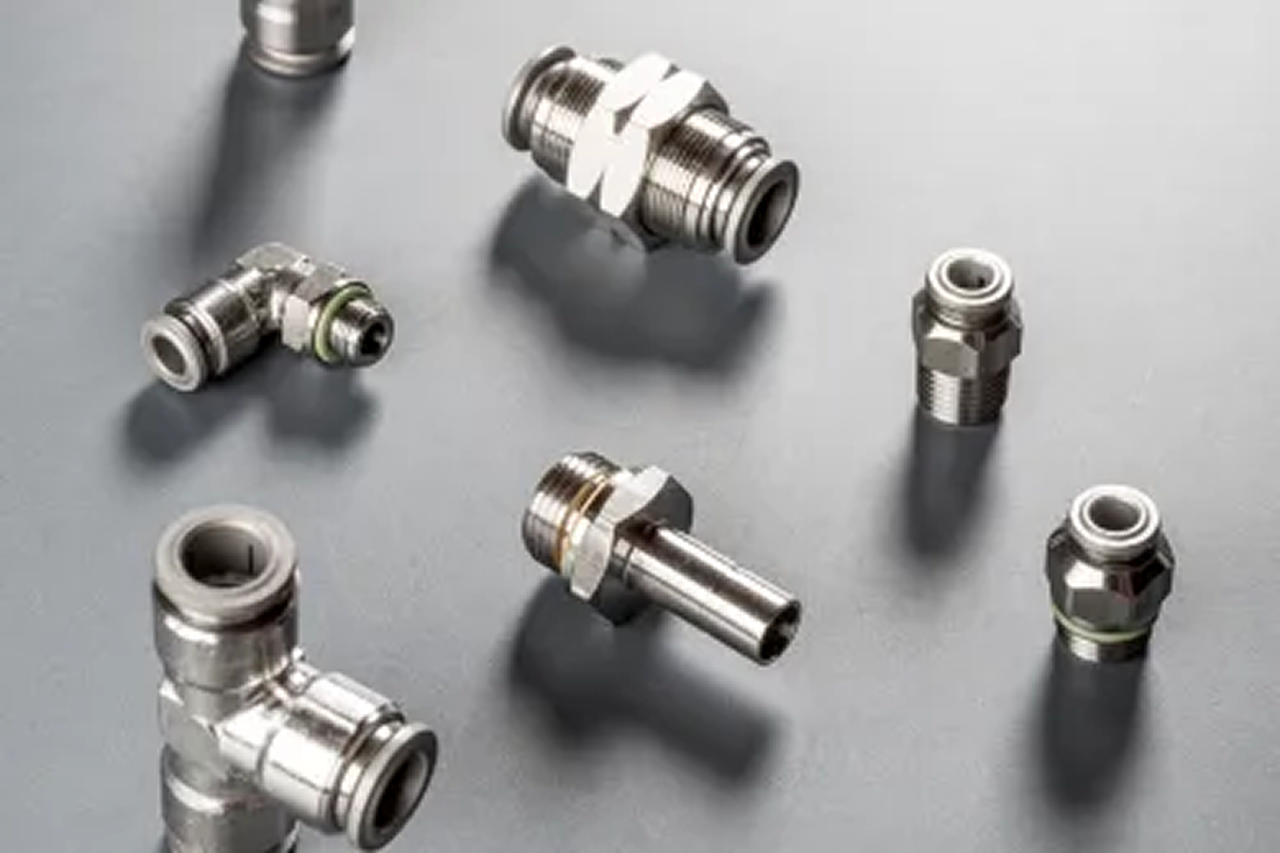
Real-world reference Representative instrumentation stainless tube fitting
Instrumentation Stainless Tube Fitting — representative product photo
02Why it's needed

Why this matters.

Tips and pointers on when double-ferrule compression is the right call — and when to spec something else. Scroll the strip →

01 · Key point
Engineered for remake cycles.

Two-ferrule design: back ferrule grips mechanically, front ferrule seals against tube OD, gap-inspection gauge confirms geometry. Properly made on annealed 316 SS, remakes 10× or more without seal degradation.

02 · Key point
ASME B31.3 / B31.1 governed.

Pressure rated per process-piping and power-piping codes — multi-thousand-PSI on small OD high-wall tube. The standard for oil & gas, refinery, power generation, hydrogen service.

03 · Key point
Drop-in Swagelok / Parker equivalent.

Industry Leader tier two-ferrule geometry is dimensionally compatible with Swagelok and Parker A-LOK/CPI — drops into existing systems without redesign at 30-40% below Swagelok list.

04 · Pro tip
Bundle the mill certs.

B31.3, B31.1, offshore, hydrogen, semi all require 3.1 mill test reports (MTRs) traceable to heat lot on fittings, ferrules, and tube. Quote the cert package upfront — auditors check at install, not retroactively.

05 · Where not to use
Soft pneumatic tubing (PU, PA).

Ferrules deform and cut soft polymer; double-ferrule is for hard tube. → Use stainless-steel PTC for soft pneumatic tube in pharma, semi, and food applications.

06 · Where not to use
General shop-air pneumatics.

Different family entirely — gap-inspection install too slow and over-spec for plant air. → Use composite PTC or brass PTC for general shop pneumatics. Quoted only where customer is over-spec''ing.

07 · Where not to use
Hard-drawn or work-hardened tube.

Back ferrule can''t bite work-hardened tube; pull-out under pressure is the failure mode. → Use fully annealed seamless 316 SS to ASTM A269/A213 exclusively — never substitute hard-drawn.

03Key selection criteria

What we need to spec it right.

From the machine spec sheet → to the part number. Answer what you know — leave the rest blank — and send.

01 · Input
Measure the tube — both set the fitting size and the correct ferrule. Wall thickness drives the ASME B31.3 pressure calculation. Metric and imperial are not interchangeable.
Imperial OD: 1/8" · 1/4" · 3/8" · 1/2" · 3/4" · 1" · Metric OD: 6mm · 8mm · 10mm · 12mm · 16mm · Wall: 0.028" · 0.035" · 0.049" · 0.065"
02 · Input
Set by media and corrosion environment. 316/316L is the instrumentation default; 304 only where the chemistry is benign.
316 / 316L SS (high-purity / corrosion / pharma default) · 304 SS (less demanding) · Brass (low-purity general utility)
03 · Input
Pull from the mating component. Tube-to-tube uses double-ferrule both ends; thread or face-seal sides match the instrument or valve port.
Tube-to-tube (double-ferrule) · NPT male / female · Face seal (VCR · VCO) · Weld
04 · Input
Read the system data and verify against the fitting rating for the material grade and tube OD/wall per ASME B31.3 / B31.1 — rating is governed by the tube, not the fitting.
Pressure: ≤1500 PSI · 1500-5000 PSI · 5000-10000 PSI · Temp: ambient · 200°F · 400°F · 800°F+
05 · Input
Confirms 316 SS suitability — different media may need different grades or seal options.
Instrument air · Sample gas · Hydrogen / fuel gas · Process chemistry · Steam / hot condensate
06 · Input
Ask for the installed part number so the dimensionally compatible Industry Leader tier equivalent can be matched on the same tube system.
Swagelok · Parker A-LOK / CPI · Hoke / Gyrolok · None — new install
07 · Input
Number of pieces. Multiple sizes? Add separate quote lines per size variant. Large-count instrumentation projects are where the Industry Leader tier cost gap vs. Swagelok is material.
1-10 pcs · 25-100 pcs (project stock) · 500+ pcs (skid / system build)

Need different sizes, colors, or quantities? Fill the form, add to quote, then fill again — each click is one quote line.

04Choose your solution tier  ·  core differentiator

Whatever your lever — spec, value, or price — SPC has the right brand.

Most distributors sell one brand per product type. SPC's 60-brand portfolio means every Product Type page surfaces three real options matched to how your customer is buying today. Pick the tier; the quote desk handles the cross-reference.

05How to sell this  ·  distributor talk track

The tier conversation closes the deal. The cross-reference catalog wins the next one.

Instrumentation tube fittings are a specification-driven sale. The customer's engineer wrote 'Swagelok or equivalent' on the drawing — your job is to be the equivalent that costs 30-40% less, holds the same spec, and drops into the same tubing without redesign.
The SPC difference · how distributors actually buy

The 30-second positioning

This sale runs on a different rhythm than commodity pneumatic fittings. Customers are project engineers specifying skid builds, instrumentation contractors wiring analyzer cabinets, fab shops building sample-conditioning panels, MRO buyers at refineries replacing fittings on B31.3 lines. Every one is reading a drawing that says "316 SS double-ferrule compression, dimensionally compatible with Swagelok" or simply "Swagelok SS-600-1-6" on a line item. The opening is when the customer asks the question that follows the spec: "does anyone make this for less?"
Tier: Industry Leader tier — manufactured to ASME B31.3 / B31.1 with full material certs, dimensional compatibility with leading Swagelok and Parker geometries, 316 SS default with 304 SS and brass available. Cross-reference catalog is comprehensive and spec data is published. Avoid Emerging/Economical — import-tier double-ferrule lacks reliable documentation, material traceability, and dimensional consistency. Selling a no-cert fitting into a B31.3 line is a liability transfer to SPC.

Customer cue → talk move

"Engineer specced Swagelok on the drawing"
Industry Leader tier cross-reference. Get the Swagelok part number, return Industry Leader tier equivalent with dimensional + pressure-rating equivalence documented. Submit as "engineering-approved substitution" on the project.
"How is this different from a PTC fitting?"
Different family entirely. PTC = shop-air pneumatics; double-ferrule = instrumentation, sample gas, high-pressure process, hazardous media. Not interchangeable.
"Fittings for hydrogen / process-gas / cal-gas"
316 SS double-ferrule. Confirm tube wall thickness against working pressure (B31.3 calculation), confirm material certs required, confirm ferrule-cleanliness for high-purity.
"System is half Swagelok / half Parker — can we mix?"
Yes — Industry Leader tier is dimensionally compatible with both. Customer can install into existing Swagelok ferrules on re-make (with gap-inspection caution). Don't mix ferrules from different manufacturers within a single connection — at the system level, the geometries cross.
"Leak at a fitting re-made multiple times"
Diagnose first. Check ferrule wear (back ferrule shoulder, front ferrule sealing surface), tube OD scoring, that connection was tightened ⅛-turn past finger-tight per Swagelok-style remake spec. Sell fresh ferrule kit; don't sell new fitting body unless body itself is damaged.
"Full ferrule and nut kit on the shelf"
Yes. Quote ferrule kit (front + back) + replacement nut for each tube size in 316 SS. MRO stocking program — customer draws on it every time a sensor swaps.
"Project pricing on 200-fitting analyzer cabinet"
Bid full BOM at Industry Leader tier net pricing against Swagelok list. Savings is the buying motion. Bring material certs + B31.3 documentation in the quote package.
06Where it's used

Industries served.

Each industry below uses this product across the listed areas. Open an industry to see how it fits the rest of its system.

Also applies to Gas chromatograph and analyzer sample-conditioning panels · 316 SS double-ferrule is the universal standard. · Process instrumentation impulse lines (pressure, level, flow transmitters) · ASME B31.3 / B31.1 governed. · Calibration gas distribution and gas-panel manifolds · Material traceability required. · Extreme cleanliness specs · Hydrogen fueling, hydrogen distribution, and fuel-cell test stands · 350-700 bar · B31.1 power-piping service. · Sanitary-grade variants

09Install · 8 critical steps

The things that matter on the first install.

Step 01
Cut and prep the tube square
Use a tube cutter, not a hacksaw. Cut perpendicular within 0.5° — an angled cut will not seal in the ferrule. Deburr inside and outside; any burr inside creates turbulence, any outside scores the ferrule sealing surface. Inspect tube OD for scratches, gouges, or oval distortion. Use fully annealed seamless 316 SS tube to ASTM A269 / A213; never substitute hard-drawn or work-hardened tube.
Step 02
Insert the tube fully into the fitting body against the shoulder
With nut and ferrules loose, push the tube into the body until it bottoms against the internal shoulder. The tube must be fully seated before tightening — a tube stopping short leaves dead volume and the ferrules won't bite at correct geometry.
Step 03
Verify ferrule orientation
Back ferrule tapered end points toward the front ferrule. Front ferrule tapered end points into the body shoulder. Reversed ferrules will not seal and will damage the tube OD when tightened.
Step 04
Tighten finger-tight, then ⅛-turn (1¼ flats) past finger-tight per Swagelok-style instruction
Wrench on the nut + back-up wrench on the fitting body (to prevent rotating the body and stressing downstream tubing). ⅛-turn past finger-tight for fractional sizes ½" and smaller; ¾-turn for larger sizes and metric equivalents per manufacturer spec. Do not over-tighten — past the specified turn, the ferrule deforms the tube OD and weakens the connection.
Step 05
Verify with the gap-inspection gauge
A properly made-up double-ferrule connection has a specific gap between the nut and the fitting body shoulder. Insert the no-go gauge: it should NOT fit. If it fits, the connection is under-tightened and must be re-tightened. Use the gauge on every fitting — don't rely on torque or feel.
Step 06
Pressure test the system before commissioning
Isolate from downstream service, pressurize to working (or 1.5× working per B31.3/B31.1 test spec), hold 10+ minutes. Soap-test every fitting; for hazardous or expensive media, use helium mass spectrometer leak detection.
Step 07
Remake spec
Bring the same nut back to the same body with the same ferrules. Finger-tighten until the ferrules contact the original shoulder marks on the tube. Tighten the nut just past finger-tight (~⅛ turn). Verify with gap gauge. A properly-made fitting on annealed tube remakes ten times or more; if remake doesn't pass the gauge, replace ferrules from a fresh kit.
Step 08
Document and stock spare ferrule kits
Record fitting part numbers, tube spec (ASTM A269/A213, OD, wall thickness, heat lot), assembly date, pressure-test results. For B31.3 and B31.1, material certs and traceability go in the project file. Stock spare ferrule + nut kit for each tube size in the customer's MRO crib.
10Troubleshoot · top failures

Most returns trace to one of these causes.

Symptom
Most likely cause
Fix
Connection leaks immediately after assembly.
Tube not fully seated against the body shoulder before tightening (ferrules bit at wrong axial position), ferrules oriented backward, tube OD scored or out-of-round at the sealing zone, tube was hard-drawn instead of annealed, or under-tightened.
Disassemble, inspect tube OD; if scored, cut back and re-prep. Verify ferrule orientation. Verify tube fully seated. Re-tighten to ⅛-turn past finger-tight and verify with gap gauge. If still leaks, replace ferrules from a fresh kit.
Connection seals on first install but leaks after re-make.
Ferrules worn from too many remakes (front ferrule sealing surface flattened, back ferrule shoulder rounded), same ferrules re-installed on a fresh tube section (geometry doesn't match), or over-tightened on initial install.
Replace ferrules from a fresh kit and remake at original turn spec. If tube OD shows prior-install wear, cut back to fresh section. Plan ferrule replacement at every 5-10 remakes for instrumentation service.
Gap-inspection gauge fits in the gap after tightening (under-tightened).
Not brought to correct turn past finger-tight, wrench-and-backup-wrench not used (fitting body rotated with the nut), or nut finger-tightened past the reference position before the wrench turn was applied.
Re-tighten until gap gauge fails to fit. Use a backup wrench on the body during tightening. If gauge still fits after additional tightening, ferrules may have been pre-deformed by incorrect prior install — replace.
Nut feels stripped or galls on tightening.
Stainless-on-stainless thread galling is a known 316 SS failure mode, especially when over-tightened or assembled without lubrication. Or cross-threaded on the body, or threads have debris.
For initial install, use a thread lubricant rated for 316 SS instrumentation (silver-based anti-seize). For already-galled, the nut and ferrules must be replaced. Confirm body threads are clean and undamaged.
Tube pulls out under pressure or vibration.
Tube not annealed seamless 316 SS (work-hardened tube doesn't deform under back ferrule grip), wall thickness below spec, ferrules not seated during initial tightening, or under-tightened.
Verify tube is ASTM A269/A213 annealed seamless 316 SS at the specified wall thickness. Re-make with verified material and full tightening to spec. If tube has been deformed at the bite zone, cut back to fresh section. Pull-out is critical failure — never approve a connection with any axial movement under pressure.
Slow weep at the fitting after months of service.
Thermal cycling has fatigued the ferrule seal, line re-worked multiple times and ferrules reaching end-of-life, vibration at the fitting (unsupported tube run), or media corrosion has attacked the ferrule sealing surface.
Re-make with fresh ferrules. Add tube supports within 6" of the fitting on either side to eliminate vibration. If corrosion (chloride exposure on 304 SS — should have been 316 SS), upgrade grade. For high-cycle thermal service, consider face-seal (VCR/VCO) in lieu of double-ferrule.
System pressure-test fails but no individual fitting can be found leaking.
Multiple very-small leaks (each below soap-test sensitivity but cumulative), leak at a tube body crack (from prior over-bending), or leak at the fitting body threads to mating port (not at the tube end).
Use helium mass spectrometer leak detection — sensitivity is 10⁴-10⁶ times higher than soap-test. Inspect tube bends for stress cracks. Verify NPT or other body-thread seals at every fitting.

Get the right instrumentation stainless tube fitting on quote in 24 hours.

Send us the application — a specialist routes you to the correct tier with a configured part. Lead-times and pricing returned within one business day.

Request a quote