DISTRIBUTOR-FIRST SUPPLY PARTNER · SINCE 1999 Live · Pneumatic Automation System

SPC Company
Pneumatic Automation / Distribution & Conveyance / Specialty Fittings / DOT Air Brake Fitting
Layer 02 · Distribution & Conveyance Industry Leader · Alkon
01What it is

DOT Air Brake Fitting

A DOT (Department of Transportation) air brake fitting is a push-to-connect or compression fitting built and certified for commercial-vehicle air brake systems — trucks, trailers, buses, and heavy equipment. DOT air brake fittings are a distinct regulatory category from machine-pneumatic fittings: they must meet DOT/FMCSA requirements under 49 CFR Parts 393 and 571 (FMVSS — Federal Motor Vehicle Safety Standards), and standard industrial push-to-connect (PTC) fittings are NOT legal substitutes in a DOT-regulated brake circuit. They are engineered for road vibration, temperature extremes, and corrosive road-salt environment, and designed to mate with DOT-approved nylon air brake tubing (SAE J844). This is a distinct lane from machine pneumatics, serving fleet maintenance, trailer manufacturers, and truck OEM channels.
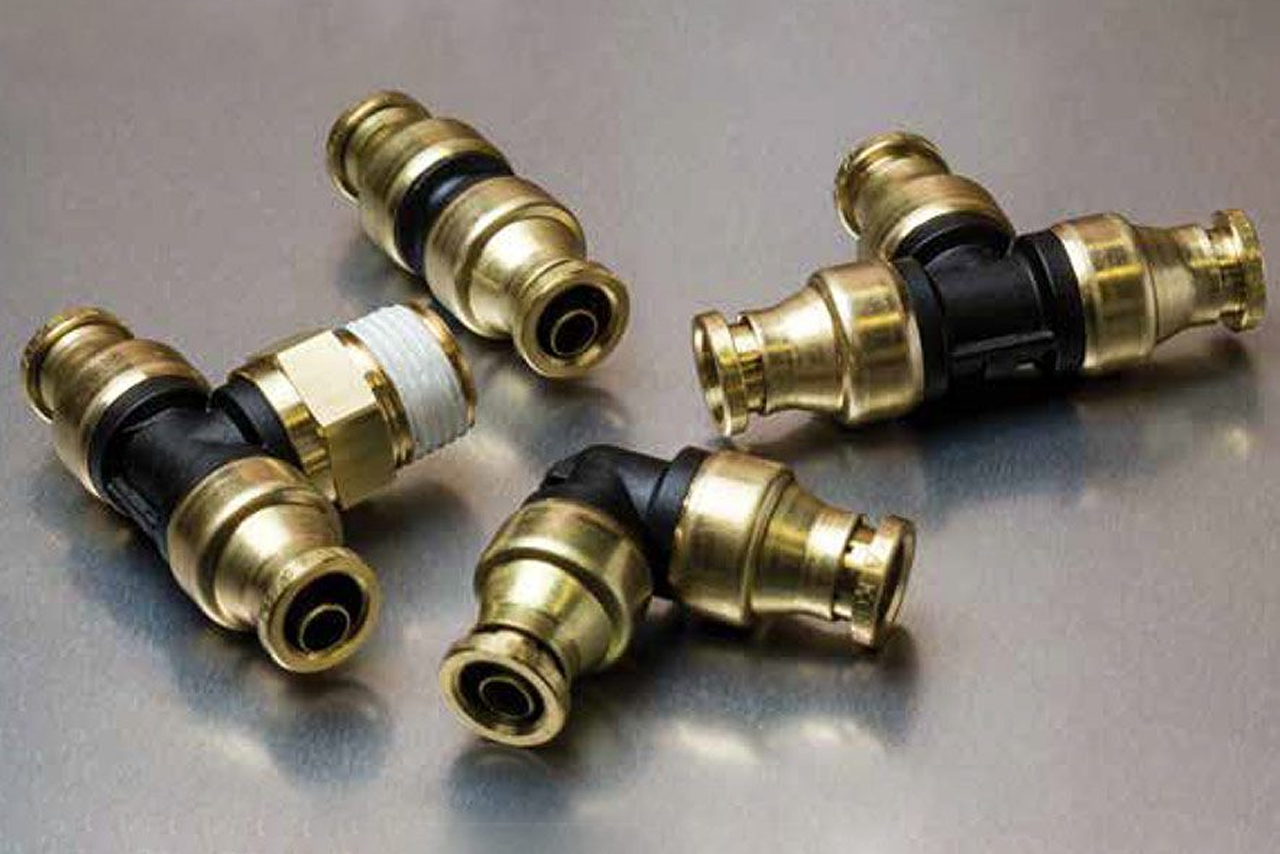
Real-world reference Representative dot air brake fitting
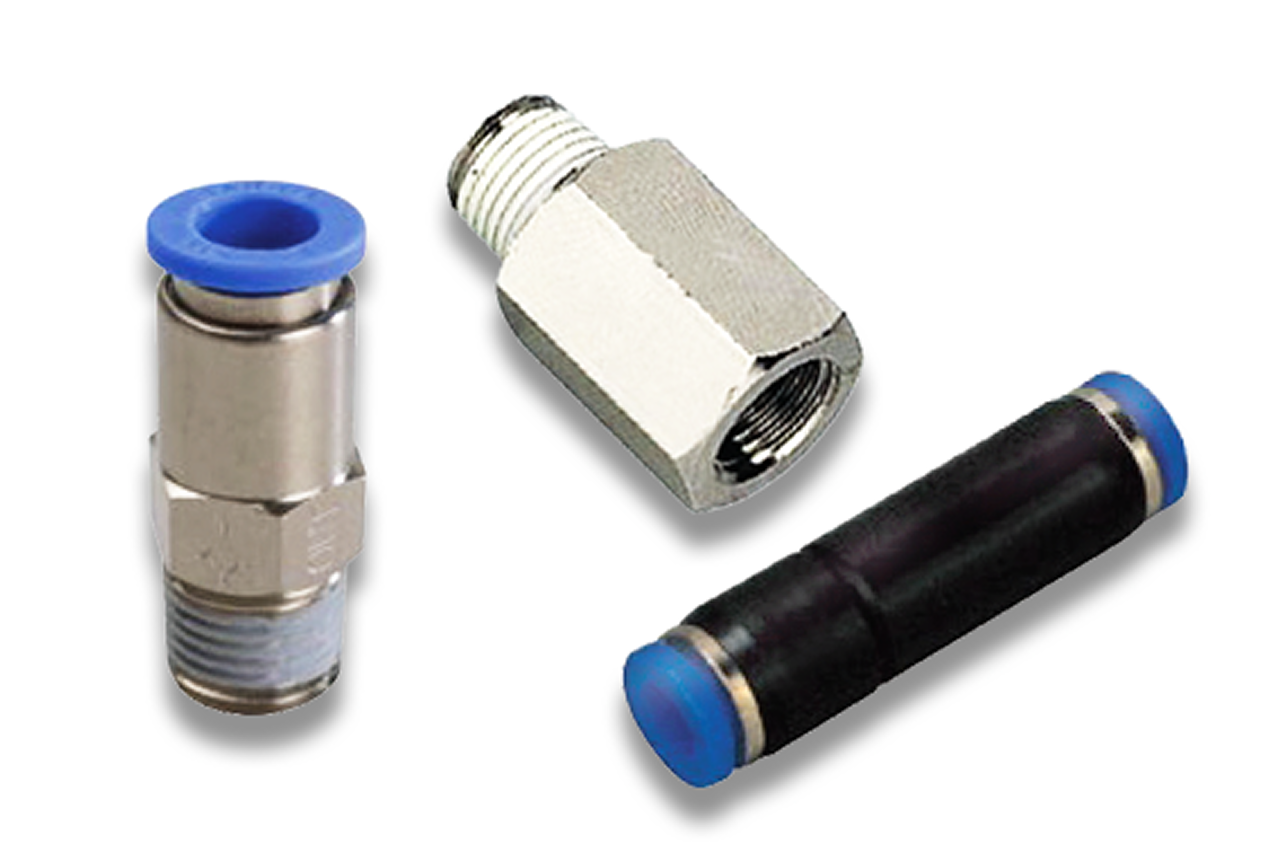
DOT Air Brake Fitting — representative product photo
02Why it's needed

Why this matters.

Tips and pointers on when DOT air-brake fittings are required — and when they''re over-spec. Scroll the strip →

01 · Key point
Federally regulated, not optional.

DOT/FMCSA-governed under 49 CFR Parts 393 + 571; FMVSS 121 governs air-brake on Class 7-8 trucks, trailers, buses over 10,000 lb GVWR. Industrial PTC in a brake line = roadside Out-of-Service, CSA score hit, liability exposure.

02 · Key point
Dimensioned for SAE J844 tube.

Grip ring, tube stop, O-ring engineered against the controlled OD and wall of SAE J844 DOT nylon air-brake tubing. Industrial PTC on J844 = loose grip, marginal seal. The fitting and the tube are matched components.

03 · Key point
Engineered for road service.

Tested to higher pressure-pulse cycle counts than industrial PTC, brass or nylon-over-steel body for road-salt exposure, insertion-depth markers + pull-test geometry for field verification without specialized tools.

04 · Pro tip
Bundle the cert package.

Fleet safety auditors require FMVSS 121, SAE J2494, SAE J1131, DOT/FMCSA compliance documentation on file. Quote the certificate package on the invoice — never accept a "we think it''s DOT" fitting from a supplier who can''t produce paperwork.

05 · Where not to use
Auxiliary air on the same chassis.

Air seat, air horn, suspension dump, fifth-wheel slide are NOT FMVSS 121 governed. → Use composite or metallic brass PTC for non-brake auxiliary — DOT spec is over-spec there.

06 · Where not to use
Industrial machine pneumatics.

Plant pneumatic circuits, factory shop air, automation cells. DOT certification is irrelevant outside transport regulation. → Use composite PTC for factory pneumatics.

07 · Where not to use
Hard tube or non-J844 tubing.

Grip ring won''t hold industrial nylon or rigid tubing. → Pair only with SAE J844 DOT nylon in matched OD (1/4", 3/8", 1/2", 5/8") — substituting industrial nylon into a brake circuit is the same non-compliance as substituting fittings.

03Key selection criteria

What we need to spec it right.

From the machine spec sheet → to the part number. Answer what you know — leave the rest blank — and send.

01 · Input
Measure the DOT air brake tubing in use — SAE J844 tubing OD must match the fitting exactly.
1/4" · 3/8" · 1/2" · 5/8"
02 · Input
Pull from the brake-circuit layout.
Straight · Elbow · Tee · Cross · Bulkhead · Trailer-cord · Reducer · Manifold
03 · Input
Measure the mating port. Air brake fittings use NPT plus DOT-specific connection standards.
NPT: 1/8" · 1/4" · 3/8" · 1/2" · SAE-specific DOT fittings
04 · Input
Ties to tubing color coding — getting this wrong puts the wrong fitting on the wrong circuit, a safety / inspection failure.
Service (blue) · Emergency (red) · Auxiliary
05 · Input
Compliance-sensitive fleet accounts need certs on file at quote, not after delivery.
FMVSS 121 · SAE J2494 · SAE J1131 · DOT / FMCSA compliance statement
06 · Input
Drives whether FMVSS 121 governs the spec — Class 7-8 (>26,000 lb GVWR) is FMVSS 121 territory.
Truck (Class 7-8) · Trailer · Bus · Heavy equipment
07 · Input
Heavy road-salt fleets benefit from nylon-over-steel body over standard brass.
Standard brass · Nylon-over-steel (road-salt fleets) · Stainless (coastal / chemical hauling)
08 · Input
Number of pieces. Multiple sizes? Add separate quote lines per size variant. Fleet PM kits run as recurring stocking programs.
1-10 pcs · 25-100 pcs (counter / truck stock) · 500+ pcs (fleet PM kit / trailer build)

Need different sizes, colors, or quantities? Fill the form, add to quote, then fill again — each click is one quote line.

04Choose your solution tier  ·  core differentiator

Whatever your lever — spec, value, or price — SPC has the right brand.

Most distributors sell one brand per product type. SPC's 60-brand portfolio means every Product Type page surfaces three real options matched to how your customer is buying today. Pick the tier; the quote desk handles the cross-reference.

05How to sell this  ·  distributor talk track

The tier conversation closes the deal. The cross-reference catalog wins the next one.

DOT air-brake fittings are a different lane than industrial pneumatics. The spec is federal regulation, and the question isn't 'which fitting is cheapest' — it's 'which fitting keeps the truck legal and the driver braked.'
The SPC difference · how distributors actually buy

The 30-second positioning

The customer is a fleet maintenance shop (20-500 tractors), a trailer manufacturer, a heavy-equipment dealer, an owner-operator, or a truck OEM service-parts line. Each operates on a single shared premise: the brake system is non-discretionary, the regulatory exposure is real, and the parts must be DOT-certified. The substitution question — "can I just use industrial PTC here" — has one answer.
Tier: Industry Leader tier — established US brand. Full SAE J2494 and J1131 certification, FMVSS 121 conformance, DOT/FMCSA compliance, with the brand recognition fleet safety managers know on sight. PTC family covers the full geometry slate (straights, elbows, tees, crosses, bulkheads, trailer-cord, manifold blocks). Brass and nylon-over-steel construction options. Avoid Emerging/Economical — off-brand DOT-style fittings have unreliable certification documentation; a fleet maintenance manager won't stock a fitting whose paperwork doesn't pass the next safety audit.

Customer cue → talk move

"Running industrial PTC in brake lines, saving money"
Stop the sale. DOT violation + liability exposure. Quote Industry Leader tier DOT replacement for every fitting in the brake circuit + J844 tubing in matched OD + certification package. Explain OOS risk.
"Trailer at inspection station, fittings flagged"
Same-day emergency replacement. Get tubing OD, geometry, quantity. Industry Leader tier ships from stock; truck back on the road same day if order in by mid-day.
"Building a new trailer, what's the BOM?"
Trailer-build BOM. Get the brake-circuit drawing. Quote Industry Leader tier straights/elbows/tees/bulkheads/trailer-cord + matched J844 as a single package.
"Owner-operator doing my own brake work"
Industry Leader tier DOT only in the brake circuit, no exceptions. J844 in his truck's OD (usually 3/8" or 1/2"). Build a spare-fitting kit for road emergencies.
"Previous supplier won't provide cert documentation"
Buying signal. Quote Industry Leader tier with the full certification package (FMVSS 121, SAE J2494, SAE J1131, DOT/FMCSA compliance statement) included on the invoice and COA.
"Stock a fleet PM kit for me"
Yes. Assortment of straight/elbow/tee/bulkhead in fleet OD + coil of J844 + thread sealant + trailer-cord ends. Annuity revenue line.
"Maintenance shop is mixing brands"
Standardize on Industry Leader tier. Mixed-brand DOT fittings make PM cycle slower (techs figure out which fitting they're working on) and create inventory bloat. Quote conversion BOM as a project.
06Where it's used

Industries served.

Each industry below uses this product across the listed areas. Open an industry to see how it fits the rest of its system.

Also applies to Fleet maintenance shops — PM and breakdown service · Brake-fitting consumption is recurring and high-volume · Owner-operator and small-fleet maintenance · buying decision is brand recognition and same-day-ship availability · Aftermarket fleets often substitute Industry Leader tier directly · Specialty applications — air-actuated PTO, suspension dump, fifth-wheel slide · Compliance retrofit projects · NOT used in

09Install · 8 critical steps

The things that matter on the first install.

Step 01
Confirm the application is a DOT-regulated brake circuit BEFORE selecting fittings
Service brake, emergency brake, parking brake, and trailer brake circuits are FMVSS 121 regulated and require DOT-certified fittings. Auxiliary air systems (air seat, air horn, suspension dump) are NOT — those can be served by industrial PTC. Do not mix the two families on a single chassis; flag and segregate the brake circuit explicitly.
Step 02
Prep the SAE J844 tubing
J844 DOT nylon air-brake tubing in OD matched to the fitting (1/4", 3/8", 1/2", or 5/8"). Cut square with a tube cutter — not a knife or hacksaw. Cut perpendicular within 0.5°. Inspect OD for nicks, scoring, or oval distortion. Do NOT chamfer or deburr the OD — J844 fittings are designed for a square cut end.
Step 03
Mark the insertion depth
Each DOT fitting has a published insertion depth — typically 3/4" to 1-1/8" depending on size. Mark with a felt-tip pen at the published depth from the tubing end. This is the visual confirmation during insertion and the field-verification mark for post-install pull test.
Step 04
Insert the tubing fully until the insertion mark reaches the fitting body
Push straight with steady pressure — do not twist, do not push at an angle. Grip ring allows insertion in one direction only. Push until the mark on the tubing reaches the collet face; confirms tubing is at the tube-stop and fully engaged with both grip ring and O-ring. Partial insertion is the most common DOT fitting failure mode.
Step 05
Perform the pull-test on every fitting after install
Pull firmly on the tubing axially — 30-50 lbs of pull force. Fitting must hold; tubing must not move. If it pulls out under hand force, disassemble, inspect, re-make with fresh cut. Pull-test every fitting, every install, no exceptions.
Step 06
Verify FMVSS 121 certification labeling and document
Industry Leader tier DOT fittings carry FMVSS 121 / SAE J2494 / DOT/FMCSA markings on body or COA. Photograph for fleet maintenance record. Record fitting part numbers, J844 lot, install date, mechanic ID, pull-test result in the vehicle's maintenance log. For inspection-station compliance, the maintenance log is the documentation the DOT inspector will request.
Step 07
Pressure-test the brake circuit before returning to service
Charge to operating pressure (120-150 PSI), hold 10 minutes, verify no pressure drop beyond FMVSS-permitted leakdown rate (typically <2 PSI/min tractor-only, <3 PSI/min combination — verify against current FMVSS 121 §S5.7.2). Soap-test every fitting under operating pressure.
Step 08
Document and label for next-PM reference
Chassis tag or maintenance-log note identifying brake-circuit fitting brand and install date. Standardize on a single brand and document dates — makes the 90-day DOT inspection faster. Stock fleet-PM spare kit on shop floor.
10Troubleshoot · top failures

Most returns trace to one of these causes.

Symptom
Most likely cause
Fix
Audible air leak at a brake-line fitting during pressure-up.
Tubing not fully inserted to tube-stop, tubing cut at an angle or with a hacksaw, tubing OD scored or out-of-round, O-ring damaged during install, OR mismatched fitting/tubing brand (industrial fitting on J844).
Disassemble. If cut is angled, re-cut with a proper tube cutter. If OD is scored, cut back to clean tubing. Inspect O-ring; if damaged, replace fitting. Re-insert to marked depth, verify pull test, soap-test.
Tubing pulls out of the fitting on the pull-test.
Partial insertion past the grip ring, tubing chamfered or beveled (grip ring can't bite a beveled OD), tubing not SAE J844 (industrial nylon has different OD tolerances), or grip ring damaged or contaminated.
Cut square with no chamfer. Verify it's J844 with the SAE marking on the tubing. Mark insertion depth, re-insert fully, pull-test again. If pull-out persists, replace the fitting.
Brake circuit shows excessive leakdown on FMVSS pressure test.
Multiple very-small leaks across the circuit, leak at a thread connection (NPT body-to-port) rather than tube end, leak at a separate brake component (chamber, valve, hose), OR leak at the trailer-cord gladhand.
Soap-test every fitting individually under operating pressure. Soap-test thread connections at brake components. Walk the entire circuit including hoses, chambers, valves, trailer-cord. A circuit failing leakdown rarely has one large leak — it's usually 3-5 small ones.
Fitting body cracked or split after installation.
Over-tightening body thread into mating port (cross-threading or excessive torque cracks the fitting body), brass-to-aluminum thread galling, freeze damage (water in the brake circuit froze and expanded), OR road-impact damage.
Replace. Use proper thread torque on body installs — DOT brass fittings have recommended torque (typically 15-25 ft-lb depending on size). For freeze damage, verify the air-dryer is functioning and the brake circuit has been drained per fleet PM. For impact, consider relocating or shielding the fitting.
Fitting corroded or seized after winter service.
Road salt exposure on un-shielded brass, water intrusion (failed air-dryer or saturated desiccant), galvanic corrosion at brass-to-aluminum interface, OR fitting not rated for the corrosion environment (industrial-grade installed in a brake circuit).
Replace with DOT-certified Industry Leader tier — nylon-over-steel bodies available for severe-corrosion service. Service the air-dryer and replace desiccant cartridge. For fleets in heavy salt, standardize on corrosion-resistant body styles.
Premature fitting failures across multiple chassis.
Counterfeit or off-brand fittings entered the parts stream, J844 tubing replaced with a non-J844 substitute, install procedure not standardized across techs (some not pull-testing or marking insertion depth), OR fleet air-dryers producing wet air degrading fittings from inside.
Audit the parts crib — confirm all DOT fittings are Industry Leader tier branded with COA. Confirm tubing is SAE J844 marked. Standardize install procedure with a written shop SOP including pull-test + insertion-mark. Service fleet air-dryers.
Trailer cord (gladhand) leaking.
Gladhand seal damaged or contaminated, mismatched gladhand polarity (service and emergency reversed), thread connection from gladhand body to brake line leaking (not the seal itself), or worn gladhand body.
Inspect the seal — replace if damaged. Verify polarity: service = blue, emergency = red. Soap-test the body-to-line thread; if leaking, re-make with thread sealant. If body is worn, replace the gladhand assembly.

Get the right dot air brake fitting on quote in 24 hours.

Send us the application — a specialist routes you to the correct tier with a configured part. Lead-times and pricing returned within one business day.

Request a quote