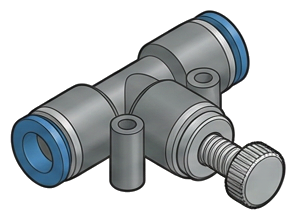
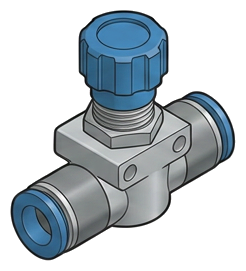
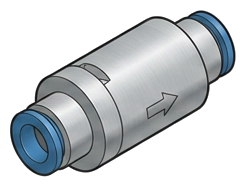
What it is
Sets how fast the actuator moves
Speed controller, flow control, and check valve — the metering half of Motion Control, mounted right at the cylinder port.

Speed and flow controls set how fast the actuator moves and shape the air path that holds it in place — the metering half of Motion Control, mounted right at the cylinder port. The speed controller is the workhorse: two per double-acting cylinder, meter-out, threaded directly int…
Tap any type to jump to its page. The Decision Guide further down asks three questions that funnel the spec to one of these.
Speed controller, flow control, and check valve — the metering half of Motion Control, mounted right at the cylinder port.
Throttle the exhaust, not the supply. Reducing regulator pressure cuts force, not speed — the cylinder just stalls under load.
About 1/3 of flow-control RFQs mean a speed controller. The tell is the integral check: meters one way for cylinder speed, both ways for lines.
Two speed controllers per double-acting cylinder — non-optional and the most common new-install miss. Check valves are the cheapest load-hold insurance there is.
Pilot-operated check valves release on the commanded stroke only if plumbed to the opposite chamber. Reversed install is the #1 field miss.
Check valve, flow control, and speed controller from a single trusted source, priced at the per-cylinder volume the customer consumes.
Distributor-facing reading. The trade-off column is the one that closes the loop — every type buys something and gives something up. Knowing what each type costs you is how the right one gets on the quote without a callback.
Reading the brand bench column — the bar shows how many of SPC's tier slots (Industry Leader · Emerging · Economical · adjacent) carry an option at that product type. Sang-A owns the functional-fitting half of Motion Control — check valve, flow control, speed controller — at the per-cylinder volumes the customer actually consumes; a narrow bench here means the comparison stops being a tier choice and becomes a single trusted source priced for consumable volume.
Draw a line from the customer's answer at the top to the type name at the bottom. This is the page distributors screenshot and send to a customer the day before a quote call — so the customer comes prepared with the answers, and the call is about the brand and the budget, not the basics.
If the customer answers most of these at the first call, the second call is the quote. If they can't answer any, the speed & flow controls are rarely the only spec gap — flag it and push for a site walk.
Motion Control is the layer that turns raw actuator force into controlled, repeatable, machine-safe motion. A cylinder on its own slams from full retract to full extend as fast as the air will move it — too fast to position, too violent to last. This layer tames it: speed controllers meter the exhaust to set stroke speed, flow controls and check valves shape the air path and hold load, and shock absorbers catch the moving mass at the end of every stroke so the kinetic energy goes into a damper instead of the machine frame. It mounts right at the actuator — the speed control threads into the cylinder port, the shock absorber bolts at the hard stop — which is why it reads as point-of-use, not as part of the valve logic upstream. Get it wrong and the machine is either too slow to make rate or beats itself apart in months; get it right and a high-cycle actuator runs smooth and quiet for the life of the line.
Speed controllers, flow control valves, and check valves — the metering and load-hold fittings that set how fast the actuator moves and keep it where it was on a power event.
The deceleration half of Motion Control — what catches the cylinder at end of stroke after the speed controller has set its speed, so the kinetic energy goes into a damper, not the frame.
→Adjacent Actuation layer — the linear-motion workhorse the speed controllers and check valves mount to. Bore, stroke, and load set the metering and load-hold configuration.
→Tell us the end-use, the rough flow, and what climate the unit would sit in. We'll come back with a configured quote — the right type, the right tier, and the upstream gear the warranty assumes.
—. We reply within one business day with pricing, lead-time, and configured parts.