DISTRIBUTOR-FIRST SUPPLY PARTNER · SINCE 1999 Live · Pneumatic Automation System
SPC Company
Pneumatic Automation / Motion Control / Shock Absorbers
System · Pneumatic Automation Layer 5 · Motion Control 2 product types

Shock Absorbers

A cylinder pushing a load at 100 PSI doesn't stop on its own — it stops when the rod hits the cylinder cap, hard. On a low-cycle low-load machine that's fine; on high-cycle production work it destroys the cylinder, the load, the mounting bracket, and the operator's hearing inside…

The Shock Absorbers family 2 types · Motion Control

Tap any type to jump to its page. The Decision Guide further down asks three questions that funnel the spec to one of these.

01What this category is
What it is
The dashpot that catches the cylinder

A hydraulic damper that turns end-of-stroke kinetic energy into heat over the last 10-30 mm of travel — the deceleration half of Motion Control.

The decision
Adjustable vs self-compensating

An operations-mode choice, not a brand choice. Fixed load and speed → adjustable; variable part mix → self-compensating.

Size it first
Energy capacity has to cover ½mv² plus drive force

Get the Nm/cycle number before picking the variant. Undersize and it dies in weeks; oversize and the cylinder still slams.

Why it matters
Protects the frame and the cycle time

Skip it on a high-cycle retrofit and the customer is back in three months with broken brackets and a destroyed cylinder cap.

Watch out
Above 60 cyc/min or 10 kg, it's non-negotiable

Every cylinder past that threshold gets a shock on the quote. The self-compensating compromise burns out too fast on a dedicated line.

02The 2 types · side-by-side

Best-for, key trade-off, capacity, price band, and how deep the brand bench runs.

Download PDF

Distributor-facing reading. The trade-off column is the one that closes the loop — every type buys something and gives something up. Knowing what each type costs you is how the right one gets on the quote without a callback.

Product type
Best for
Key trade-off
Typical capacity
Price band
Brands SPC carries
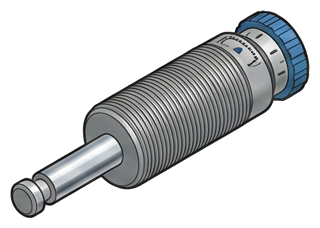
Adjustable Tunable orifice · longest life on fixed-load duty
Fixed load, fixed cycle, longest service life. Dedicated production lines, indexing tables, high-cycle transfer stations — anywhere the load mass and impact velocity stay the same cycle after cycle. SMC RB and KOBA adjustable platforms cover the standard energy capacities; tuning the orifice to the exact duty extends service life dramatically over a self-compensating shock on the same job.
Needs commissioning + re-tune on part change The advantage disappears the minute the part mix changes — every new load mass or cycle speed needs the orifice re-tuned, and a mis-tuned adjustable shock decelerates worse than a properly-sized self-compensating one. Don't quote adjustable for job-shop or variable-mix production; the operator won't re-tune.
Energy capacity 1.5–10,000 Nm/cycle
M8 to M64 thread sizes
$ – $$
1 / 5 · KOBA only
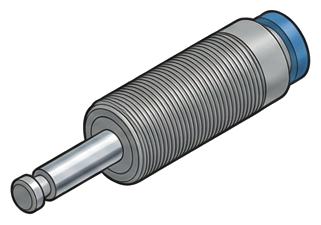
Self-Compensating Auto-tuning across load range · no commissioning
Variable load, job-shop, no operator tuning. Job-shop production, custom fabrication, automated cells running a mix of part weights and speeds. SMC RJ and KOBA self-compensating platforms auto-adjust the orifice across the load envelope — "drop it in and it works" decelerates whatever comes through.
Shorter service life per cycle · narrower energy band The auto-tuning compromise gives up 30-50% of cycle life versus a correctly-tuned adjustable on the same duty, and the rated energy band is narrower per size. Trade-off is worth it when re-tuning isn't realistic; not worth it on a dedicated high-volume line where adjustable wins on TCO.
Energy capacity 1.0–7,500 Nm/cycle
M8 to M50 thread sizes
$ – $$
2 / 5 · KOBA + SMC

Reading the brand bench column — the bar shows how many of SPC's tier slots (Industry Leader · Emerging · Economical · adjacent) carry an option at that product type. A deep bench means a price-driven and a spec-driven option both close cleanly; a narrow bench means the available brands map closely to the technical requirements and the comparison stops being a tier choice.

03Decision guide

2 questions “Funnel the Spec” to one product type.

Download PDF

Draw a line from the customer's answer at the top to the type name at the bottom. This is the page distributors screenshot and send to a customer the day before a quote call — so the customer comes prepared with the answers, and the call is about the brand and the budget, not the basics.

Use this Download the PDF above, print it, drop it in an email to the end customer, or screenshot the tree below. The questions and the type recommendations are designed to stand on their own without the rest of the page.
START AT THE TOP  ·  FOLLOW THE PATH DOWN  ·  END ON THE PRODUCT TYPE
Question 1
Is the load mass and cycle speed fixed, or does it vary across the production mix?
Fixed load · same part, same cycle, every time
Recommend
Adjustable Shock Absorber
Tune the orifice once to the exact load and speed. Longest service life on dedicated production duty — SMC RB or KOBA adjustable. Indexing tables, transfer lines, dedicated assembly stations.
See product type →
Variable load · job-shop, mixed parts, mixed speeds
Recommend
Self-Compensating Shock Absorber
Auto-tunes across the load envelope — no commissioning, no re-tune when the part mix changes. SMC RJ or KOBA self-compensating. Shorter cycle life than adjustable on a fixed-load job, but the right answer when re-tuning isn't realistic.
See product type →

These two products aren't a brand-choice and they aren't a tier-choice — they're an operations-mode choice. The question above is the only thing that decides between them. The other shock-absorber conversation that comes up on every quote is sizing: energy capacity (Nm/cycle) has to cover ½mv² plus any drive force still applied at end-of-stroke. Undersizing destroys the shock in weeks; oversizing decelerates too slowly and the cylinder still slams. Get the energy number first, then pick the variant.

The shock absorber is what keeps the cylinder from beating itself — and the machine — apart. Skip it and the cylinder breaks; size it wrong and the shock breaks. Get both right and neither one disappears.
SPC distributor playbook Motion Control · the deceleration layer
04Questions to ask the customer · before you quote

9 inputs determine the right shock absorber.

Download PDF

If the customer answers most of these at the first call, the second call is the quote. If they can't answer any, the shock absorbers are rarely the only spec gap — flag it and push for a site walk.

01
What's the load mass at end of stroke — the part, the tooling, the cylinder rod itself?
Mass × impact velocity² × ½ = kinetic energy the shock has to absorb. Customers consistently underestimate this — they forget the rod weight, the end-of-arm tooling, and any product the cylinder is carrying. Get total moving mass at end-of-stroke, not just the part being moved.
02
What's the cylinder's velocity at the moment of impact?
A 5 kg load at 0.5 m/s = 0.625 Nm; the same load at 1.5 m/s = 5.6 Nm — nearly an order of magnitude difference. Measure the cylinder's terminal velocity at end of stroke, not its average — air-driven cylinders accelerate continuously until impact unless metered.
03
Is the cylinder still pressurized and pushing when the rod hits the shock?
If yes, add the drive force × stroke into the energy calc. A cylinder still delivering 200 lbf at impact over 25 mm of shock travel adds ~22 Nm of energy on top of the kinetic load. This is the single biggest under-sizing trap.
04
How many cycles per minute is the cylinder running?
Cycle frequency determines whether you need a shock at all (>30 cyc/min is the rule of thumb) and whether you can survive on an under-sized self-compensating model. Above 60 cyc/min on a dedicated line, adjustable is the only spec that holds — the self-compensating compromise burns out too fast.
05
Is this a dedicated production line, or a job-shop / mixed-part cell?
Dedicated → adjustable, tune once, longest life. Job-shop → self-compensating, no re-tune required. The operator-tuning assumption is the hidden cost; if no one is going to re-tune the shock when the part changes, don't quote adjustable.
06
Is the impact axial onto the shock, or at an angle?
Side-loading the shock plunger destroys the seal fast and voids the warranty. Impact has to be ±2° of axial; anything more needs a guided pad on the shock face or an external alignment guide on the cylinder. Photograph the install plane on retrofit jobs.
07
What's the ambient temperature at the install location?
The hydraulic fluid inside the shock thickens cold and thins hot. Standard shocks are rated -20 to +80 °C; outdoor, cold-room, or hot-process installs need temperature-rated variants. Cold-start a standard shock at -30 °C and it won't compress on the first hit; the cylinder slams.
08
How is the shock mounted — threaded into the machine, or in a separate bracket?
Thread size + mounting nut style + jam nut clearance all have to match the machine bracket. Most installs are M12 to M27 threaded with a single jam nut; flange-mount variants exist for larger capacities. Measure the bracket before quoting; wrong thread is the #1 returns reason.
09
How will the customer know the shock is wearing out?
Failure mode is degraded deceleration — the cylinder starts slamming again, gradually. No warning, no leak, no alarm in most installs. Quote a spare with every shock on a dedicated high-cycle line; replace at the first sign of harder end-of-stroke sound, not when the cylinder finally breaks.
05Where this category lives

Motion Control is the layer that turns raw actuator force into controlled, repeatable, machine-safe motion. A cylinder on its own slams from full retract to full extend as fast as the air will move it — too fast to position, too violent to last. This layer tames it: speed controllers meter the exhaust to set stroke speed, flow controls and check valves shape the air path and hold load, and shock absorbers catch the moving mass at the end of every stroke so the kinetic energy goes into a damper instead of the machine frame. It mounts right at the actuator — the speed control threads into the cylinder port, the shock absorber bolts at the hard stop — which is why it reads as point-of-use, not as part of the valve logic upstream. Get it wrong and the machine is either too slow to make rate or beats itself apart in months; get it right and a high-cycle actuator runs smooth and quiet for the life of the line.

Categories in this layer

Not sure which type? Send us the use case.

Tell us the end-use, the rough flow, and what climate the unit would sit in. We'll come back with a configured quote — the right type, the right tier, and the upstream gear the warranty assumes.