DISTRIBUTOR-FIRST SUPPLY PARTNER · SINCE 1999 Live · Pneumatic Automation System
SPC Company
Pneumatic Automation / Sensing & Feedback / Sensors & Switches
System · Pneumatic Automation Layer 6 · Sensing & Feedback 3 product types

Sensors & Switches

Three feedback questions, one machine. Did the cylinder reach position, is the pressure where it should be, and did the vacuum gripper actually grab? This page walks the spec from "the machine needs to confirm what it just did" to the right sensor on the quote — what each one watches, where it mounts, and what it streams back to the PLC.

The Sensors & Switches family 3 types · Sensing & Feedback

Tap any type to jump to its page. The Decision Guide further down asks three questions that funnel the spec to one of these.

01What this category is

The valves and cylinders make the motion happen — this layer confirms it did, and tells the PLC.

What it is
The machine's eyes — position, pressure, vacuum

Three sensors that each watch one physical variable and stream a discrete or analog signal back, closing the control loop to the PLC.

The decision
Pick by the variable being sensed

Rod position → cylinder-position sensor. Supply or filter → pressure sensor. Suction grip → vacuum switch. The three don't substitute.

Why it matters
Turns an open-loop machine into a monitored one

Without feedback the controller is guessing — a missed stroke or dropped part propagates downstream as scrap or a crash.

Watch out
Match the output to the PLC input card

PNP vs NPN, switched vs analog vs IO-Link, supply voltage — a mismatch is the #1 cause of a dead sensor at commissioning. Pull the card spec first.

02The 3 types · side-by-side

Best-for, key trade-off, capacity, price band, and how deep the brand bench runs.

Download PDF

Distributor-facing reading. The trade-off column is the one that closes the loop — every type buys something and gives something up. Knowing what each type costs you is how the right one gets on the quote without a callback.

Product type
Best for
Key trade-off
Typical capacity
Price band
Brands SPC carries
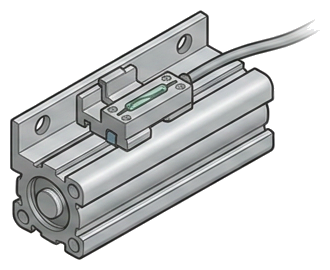
Cylinder Position Sensor Magnetic auto-switch · reads the piston magnet through the cylinder wall
Confirming a cylinder reached end-of-stroke. Any cylinder whose extend or retract the PLC needs to confirm before the next step runs. Mounts on the outside of the cylinder body and detects the piston's built-in magnet through the barrel wall — no port, no air connection, a purely electrical add-on. Two per cylinder (one at each end of stroke) is the standard install, making this the highest-volume electrical line in the cylinder ecosystem.
Selected to the cylinder series, not chosen independently The mount geometry and the piston magnet match a specific cylinder family — a groove style (T-slot / rail groove on a profile cylinder) or a band / strap mount on a tie-rod or round-body cylinder. Reed switches are simpler and lower cost but the mechanical contact limits them in high-cycle duty; solid-state has no moving contact, faster response, and much longer life — the correct choice for high-cycle and safety-critical motion.
Reed or solid-state · one end / both ends / mid-stroke
2-/3-wire PNP or NPN · NO or NC
$
1 / 5 · SMC only
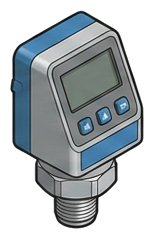
Pressure Sensor Reads system pressure at a point · or filter differential across two taps
Basic system feedback and control. Answering a status question — is the system at setpoint, is a filter loaded, has the compressor cut out. Two install patterns: single-point reading off the line (one tap), or differential check across a filter (two taps, one each side). The entry-tier monitoring instrument: output is either a visual gauge an operator reads by eye, or an electrical signal (4-20 mA, Modbus, or IO-Link) to a controller.
Status-grade, not audit-grade The simplest of the monitoring instruments — suited to answering a status question rather than producing the audit-grade precision a logged historian needs. Matched to the job: ±1% of range for compressor-discharge control, ±0.5 PSI absolute for filter-differential alarms, ±0.25% with a calibration certificate for audit-grade work. Selected by the system working-pressure range and the port thread at the install point.
Single-point or differential · gauge or electrical output
4-20 mA · Modbus · IO-Link
$
1 / 5 · Adsens only
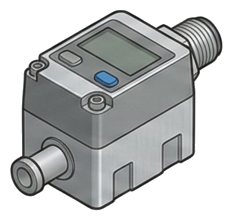
Vacuum Sensor / Switch Verifies the workpiece is gripped before the robot moves
Confirming the vacuum pick actually latched. The verification device on a pick-and-place vacuum circuit — monitors the live vacuum level and tells the PLC whether the workpiece is gripped before the robot moves. Carries two adjustable set points: grip-confirm (releases the machine to move) and drop-detect (alarms a part lost mid-cycle). Mounts on the EOAT plate or in a tee within 6 inches of the cup. One quarter of the vacuum end-effector sub-system.
Range and set points follow the workpiece Response is a few milliseconds between set pressure and output. Set points must be re-verified whenever the workpiece changes — grip and drop thresholds shift with cup volume and surface. Vacuum-only models fault on positive pressure; circuits that alternate vacuum grip with blow-off need the compound (vacuum + low positive pressure) variant.
Two set points · grip-confirm + drop-detect · –20 to –27 inHg typical
NPN / PNP · analog · IO-Link · IP40 / IP65 / IP67
$
1 / 5 · SMC only

This isn't a tier comparison — the three rows watch three different physical variables (rod position, line pressure, circuit vacuum), so there's no substituting one for another. Read it as "what each device watches, where it mounts, and what it streams to the PLC." What they share is the one rule that breaks installs: the output type (PNP vs. NPN, switched vs. analog vs. IO-Link, voltage) has to match the PLC input card — confirm that before quoting any of the three.

03Decision guide

3 questions “Funnel the Spec” to one product type.

Download PDF

Draw a line from the customer's answer at the top to the type name at the bottom. This is the page distributors screenshot and send to a customer the day before a quote call — so the customer comes prepared with the answers, and the call is about the brand and the budget, not the basics.

Use this Download the PDF above, print it, drop it in an email to the end customer, or screenshot the tree below. The questions and the type recommendations are designed to stand on their own without the rest of the page.
START AT THE TOP  ·  FOLLOW THE PATH DOWN  ·  END ON THE PRODUCT TYPE
Question 1
What does the machine need to sense?
Cylinder position · did the rod reach end-of-stroke
Recommend
Cylinder Position Sensor
Magnetic auto-switch reads the piston magnet through the cylinder wall and confirms extend / retract to the PLC. Two per cylinder is standard. Match the mount to the cylinder series and reed-vs-solid-state to the duty; solid-state for high-cycle and safety-critical motion.
See product type →
Air pressure · system setpoint or filter differential
Recommend
Pressure Sensor
Single-point reading off the line, or a differential check across a filter (two taps). Gauge output for status-only; 4-20 mA, Modbus, or IO-Link to feed a controller. Selected by the working-pressure range and the port thread at the install point.
See product type →
Vacuum · did the pick-and-place gripper latch the part
Recommend
Vacuum Sensor / Switch
Monitors live circuit vacuum with two set points — grip-confirm releases the move, drop-detect alarms a lost part. Mount within 6 inches of the cup. Use the compound variant where the circuit also runs positive blow-off; re-verify set points whenever the workpiece changes.
See product type →

The root question — what physical variable does the machine need to confirm — picks the device cleanly; the three don't substitute for one another. The call that actually breaks at commissioning is electrical, and it's the same for all three: match the output type to the PLC input card (PNP vs. NPN, switched vs. analog vs. IO-Link, and the supply voltage). Pull the input card spec before quoting any sensor on this page.

04Questions to ask the customer · before you quote

5 inputs determine the right sensors & switche.

Download PDF

If the customer answers most of these at the first call, the second call is the quote. If they can't answer any, the sensors & switches are rarely the only spec gap — flag it and push for a site walk.

01
Which variable does the machine need to confirm — cylinder position, air pressure, or vacuum grip?
This is the root sort. Rod position → cylinder position sensor (magnetic auto-switch on the cylinder body). System or filter pressure → pressure sensor (single-point or differential). Pick-and-place grip → vacuum sensor / switch. Each watches one physical variable; there's no one device that covers all three.
02
What's the output type and voltage on the PLC input card?
The most common cause of a dead sensor at commissioning is a mismatched signal type. PNP vs. NPN, switched vs. analog vs. IO-Link, and the supply voltage all have to match the input card. Pull the card spec sheet before quoting — and on safety circuits, confirm normally-open vs. normally-closed.
03
For a position sensor — what cylinder series is it mounting on, and what's the duty cycle?
The sensor is selected to the cylinder series, not chosen independently — the mount (groove / T-slot, or band / strap) and the piston magnet match a specific family. Then set reed vs. solid-state by duty: solid-state for high-cycle and safety-critical motion, reed for lower-cycle, cost-sensitive work.
04
For a pressure sensor — single-point reading, or a differential across a filter?
Single-point system pressure needs one tap; filter differential needs two taps (a pair, or one differential sensor). It changes the count and the part. Then size to the working-pressure range and the port thread at the install point, and pick gauge output for status-only vs. an electrical signal where it feeds control logic.
05
For a vacuum switch — what's the steady-state vacuum, and does the circuit also run positive blow-off?
Set points sit relative to steady-state vacuum (grip-confirm and drop-detect), and they re-verify whenever the workpiece changes because cup volume and surface shift the thresholds. If the same line alternates vacuum grip with positive pressure, spec the compound variant — a vacuum-only switch faults on positive pressure.
05Where this category lives

Everything upstream of this layer commands motion; nothing upstream knows whether the motion succeeded. Sensing & Feedback is the layer that turns an open-loop pneumatic machine into a controlled one. A directional valve fires and a cylinder is supposed to extend — but the only way the PLC knows the rod actually reached end-of-stroke, that supply pressure is in spec, or that a vacuum gripper has truly latched onto the part, is a sensor reporting it back. Without that feedback the controller is guessing, cycle timing is open-loop, and a missed stroke or a dropped part propagates downstream as scrap or a crash. This layer is where the air-powered side of the machine meets the electrical control system: magnetic cylinder-position sensors, pressure switches, and vacuum switches each watch one physical variable and stream a discrete or analog signal to the PLC. Get this layer wrong and the machine runs blind — it cycles on a timer and hopes; get it right and every motion is confirmed, every fault is caught at the station that caused it, and the controller has the cycle and diagnostic data to run closed-loop.

Categories in this layer

Not sure which type? Send us the use case.

Tell us the end-use, the rough flow, and what climate the unit would sit in. We'll come back with a configured quote — the right type, the right tier, and the upstream gear the warranty assumes.