What it is
The system's buffer tank
Stored air that decouples the compressor from the demand — four tank types (vertical, horizontal, portable, specialty) over one sizing rule.

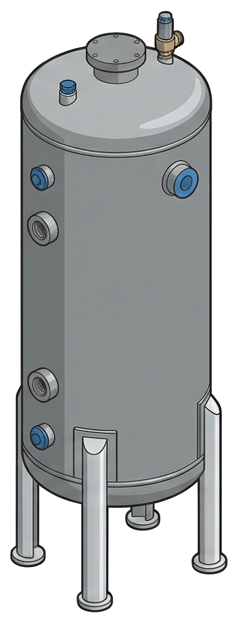
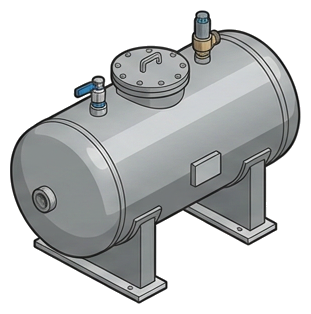
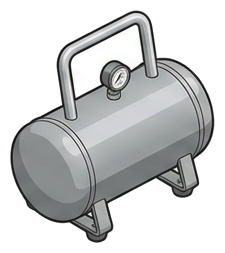
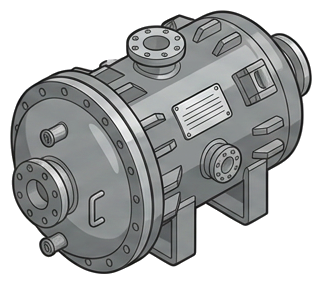
Four tank types, one decision. Where does the tank live — fixed compressor room, low-ceiling install, the back of a service truck, or an engineered spec the catalog can't cover? This page walks the spec from "what size do I need" to the right vessel on the quote — comparison first, decision tree second, questions to ask third. Every quote is a code-stamped vessel with a fresh ASME safety relief valve.
Tap any type to jump to its page. The Decision Guide further down asks three questions that funnel the spec to one of these.
Stored air that decouples the compressor from the demand — four tank types (vertical, horizontal, portable, specialty) over one sizing rule.
4-6 gallons per CFM for fixed-speed, 1-2 for VFD. Set the gallonage, then pick the type that fits where the tank physically lives.
Vertical for normal rooms, horizontal under ~8 ft of ceiling or on a skid, portable where the work moves, specialty where the catalog can't.
The compressor chases every demand swing — short-cycling burns out air-ends and starters. Right-sized storage is the best-payback build.
Above 15 PSI, ASME Section VIII, U-stamped, National Board registered — with a fresh safety relief valve, drain, and gauges on every tank.
Between two catalog sizes, take the larger. The marginal cost is 15-20%; the upside is a compressor that lives its full service life.
Distributor-facing reading. The trade-off column is the one that closes the loop — every type buys something and gives something up. Knowing what each type costs you is how the right one gets on the quote without a callback.
Reading the brand bench column — the bar shows how many of SPC's tier slots (Industry Leader · Emerging · Economical · adjacent) carry an option at that product type. The receiver category runs narrower than dryers or filtration: Manchester Tank and Morganton anchor the stationary side with overlapping coverage on vertical and horizontal, Manchester carries the portable bench alone, and Samuel PVG joins Morganton's engineered-vessel division on specialty work. Code-stamped, U-stamped, National Board registered baseline on every line — SPC does not sell uncoded vessels for above-15-PSI service.
Draw a line from the customer's answer at the top to the type name at the bottom. This is the page distributors screenshot and send to a customer the day before a quote call — so the customer comes prepared with the answers, and the call is about the brand and the budget, not the basics.
If the customer doesn't know the answer to Question 1, start with the install location: "Where is this tank going to physically sit?" Fixed pad in a compressor room → stationary (vertical or horizontal depending on headroom). Trailer, truck, or "wherever the work is today" → portable. The compressor itself is a skid package with the tank bundled → horizontal under the skid. The customer is handing you a spec sheet from their engineering team with a PFD/P&ID → specialty, start the engineering review. The sizing rule (4-6 gal/CFM fixed-speed, 1-2 gal/CFM VFD) runs in parallel to the type decision — size first, then pick the type that fits the install.
Size up at every decision point. The marginal cost is 15-20% on the tank; the upside is a compressor that lives its full service life.
If the customer answers most of these at the first call, the second call is the quote. If they can't answer any, the air receivers are rarely the only spec gap — flag it and push for a site walk.
A compressed-air system without storage is a system that fights itself. The compressor sees every demand swing on the production floor in real time — a press cycling, a paint gun firing, a sandblaster pulling a 200 CFM gulp — and has to chase each one by loading and unloading or by ramping the VFD up and down. Both modes are destructive: short-cycling burns out air-ends, unloader valves, and motor starters in a fraction of their rated life, and constant VFD modulation cycles the air-end thermally even when the motor stays on. The Storage layer breaks that cycle. A properly sized receiver absorbs demand surges, releases stored air to cover the swings, and lets the compressor see a slower-changing average load instead of every floor-level fluctuation — and along the way it dampens reciprocating pulsation, drops out bulk water and oil before the dryer, and sheds heat as the air sits in the steel reservoir. Get this layer wrong and the compressor doesn't live out its service life; get it right once and it disappears.
Upstream pair on every wet-tank install — the tank catches 60-80% of total system condensate before the dryer; oil-water separators and zero-loss drains handle what comes out the drain port legally.
→The system's buffer — stores a reserve of air so the compressor isn't chasing every demand swing, dampens reciprocating pulsation, and drops out bulk water and oil before the dryer.
Downstream on every install — the wet-tank receiver feeds the dryer with cooler, drier air than the aftercooler alone delivers, extending dryer life and reducing dryer energy.
→Final cleanup downstream of the dryer — strips oil, particulate and odor so the air matches what the application can tolerate before it reaches distribution.
→Tell us the end-use, the rough flow, and what climate the unit would sit in. We'll come back with a configured quote — the right type, the right tier, and the upstream gear the warranty assumes.
—. We reply within one business day with pricing, lead-time, and configured parts.