DISTRIBUTOR-FIRST SUPPLY PARTNER · SINCE 1999 Live · Product System

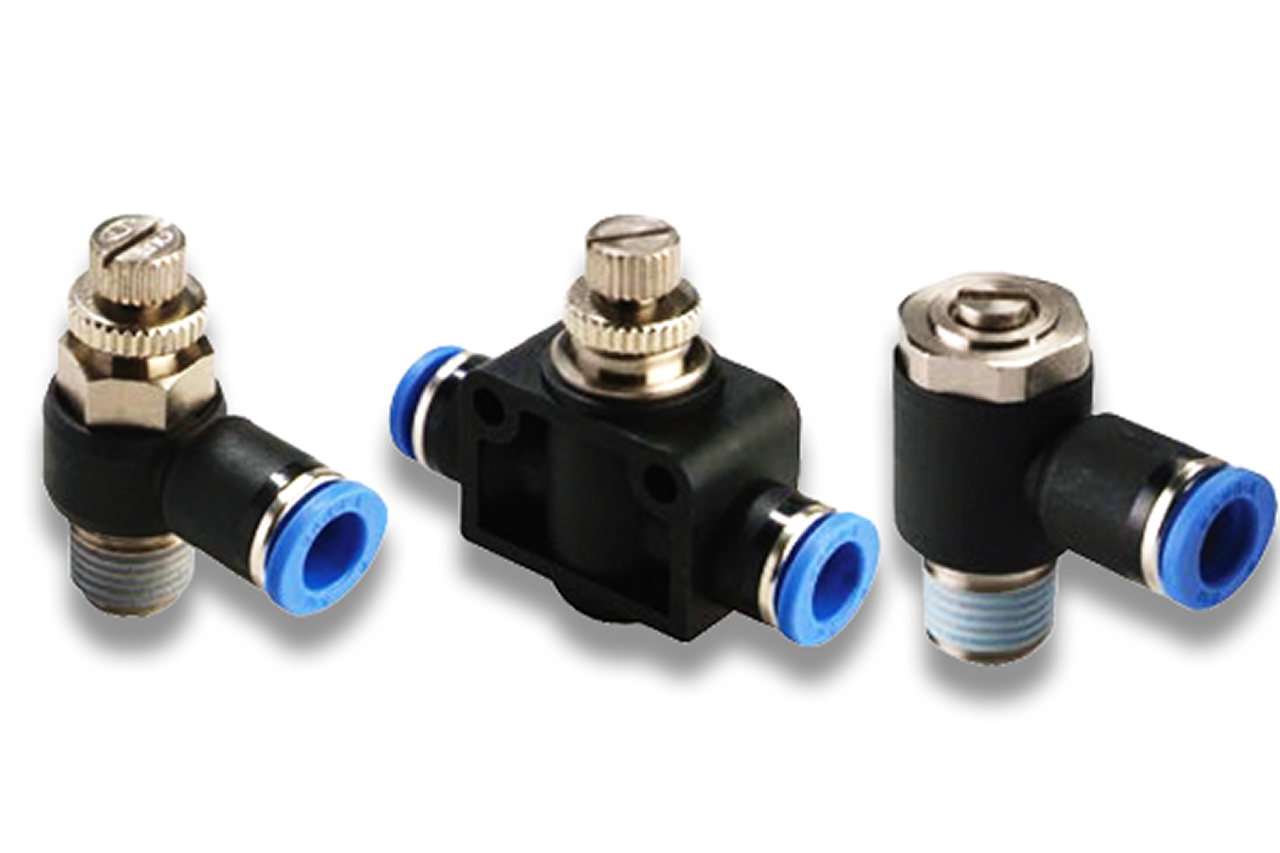
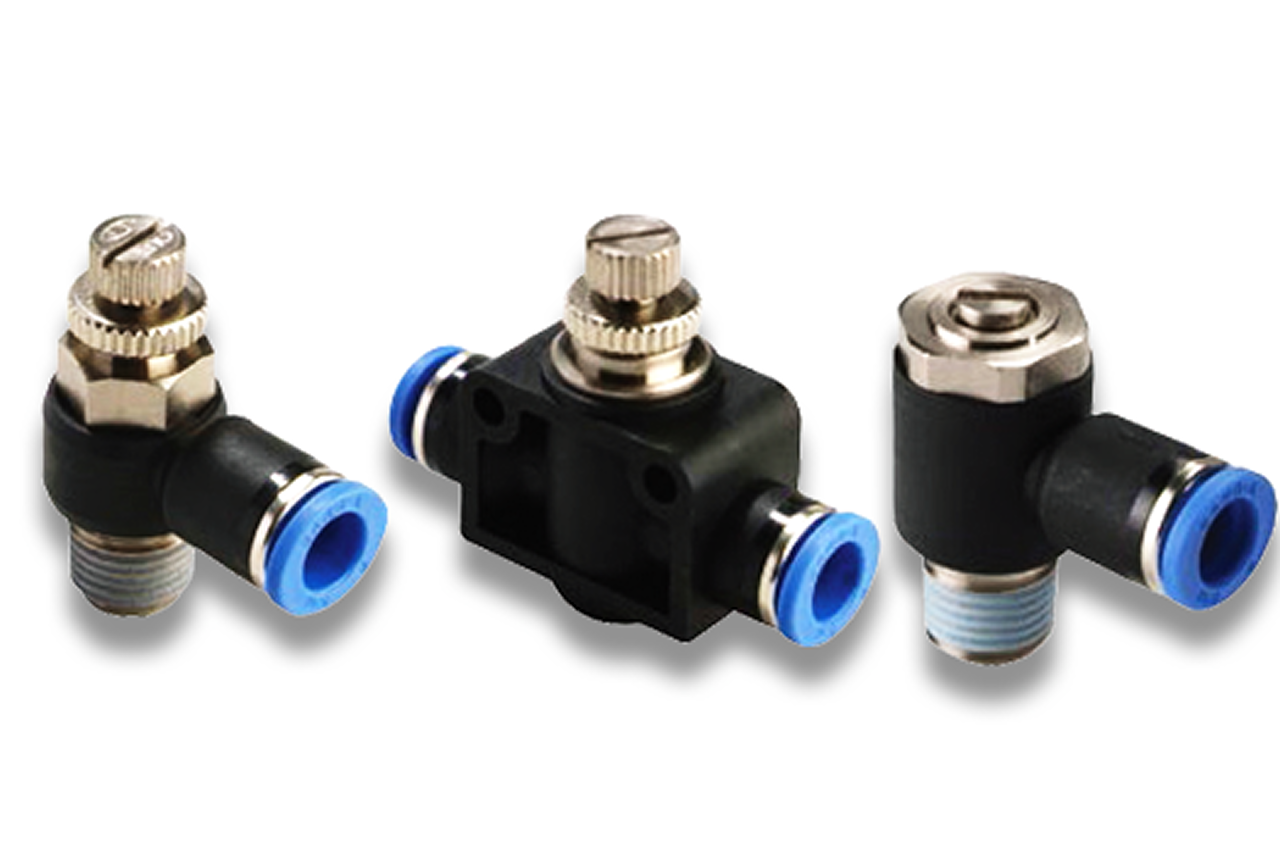
A push-to-connect speed controller is an inline functional fitting that threads into a cylinder port and meters how fast that cylinder extends or retracts. It combines an adjustable metering needle with an integral check valve in one body: air is throttled through the needle in one direction and flows freely past the check in the other, so the controller restricts motion on one stroke and frees it on the return. What sets the PTC version apart is its build for confined spaces — a compact, light composite body that swivels on a metal base. The swivel lets the installer orient the tube run after the fitting is threaded and sealed, so a cylinder buried in a tight machine bay can still take its tube off at the angle the layout needs without breaking the thread seal to re-aim it. The tube seats by hand into a push-to-connect collet (PU or nylon tubing); the threaded end carries the factory Teflon treatment. It is sized to the same tube OD as the surrounding push-to-connect fittings and installs at the cylinder port, between the directional valve and the actuator.
Tips and pointers on when the push-to-connect speed controller is the right call — and when to spec something else. Scroll the strip →
The defining trait: a light composite body that rotates on a metal mounting base so the installer can aim the tube run after the fitting is threaded and sealed — no breaking the thread seal to re-orient. Built for the cramped cylinder bay where the tube has to leave at an awkward angle. The metal base carries the thread load; the composite keeps it light.
A needle valve throttles flow one direction, an integral check lets flow pass freely the other way — meter the exhaust on the working stroke, free flow on the return. No regulator and no plain flow-control valve does this; it is the purpose-built way to tune a cylinder''s speed at the port.
Throttling the exhaust — flow Thread→Sleeve — keeps a column of pressurized air behind the piston, so motion stays smooth across changing loads. Default for any double-acting cylinder. Meter-in (Sleeve→Thread) is the exception, for single-acting / constant-load cases only.
Two per double-acting cylinder (one each port), one per single-acting. A multi-axis machine runs the count up fast. Miss them at quote time and the customer either calls back angry or sources from a competitor — speed control is non-optional on a new cylinder.
Meter-out controls flow Thread→Sleeve (the default, load-stable on double-acting); meter-in is Sleeve→Thread (single-acting / constant-load only); union is piped per the signal on the body. Wrong direction creates jerky load-dependent lurching that worsens at lighter loads — a 5-minute swap, but only if verified before the order ships.
NSS straight, NSE elbow, NSF union; NSE-C / NSF-C compact for the tightest bays; MNSE metallic where a full-metal body is specified; metric GNSE / GNSF. Match the body to the cylinder-port geometry — elbow and compact codes exist precisely for the confined spaces the swivel body is built to serve.
The integral check forces one-direction throttling — wrong for line balancing or pilot-signal timing where both directions must meter equally. → Re-spec to flow control valve when the throttle lives in the line rather than at the cylinder port.
A speed controller is always partly open — it can''t be locked off for OSHA lockout-tagout. → Re-spec to quarter-turn shutoff valve upstream of the FRL when the job is deliberate manual isolation, not cylinder-port speed tuning.
From the machine spec sheet → to the part number. Answer what you know — leave the rest blank — and send.
Most distributors sell one brand per product type. SPC's 60-brand portfolio means every Product Type page surfaces three real options matched to how your customer is buying today. Pick the tier; the quote desk handles the cross-reference.
Every cylinder sale is two speed-controller sales — and when the cylinder is buried in a tight bay, the swivel-body PTC version is the one that goes in without a fight. Miss them at quote time and the customer either calls back angry or sources them from a competitor.
Each industry below uses this product across the listed areas. Open an industry to see how it fits the rest of its system.
Also applies to Cylinders in confined machine bays · composite swivel body aims the tube after the thread is sealed · Every double-acting cylinder install · Single-acting / spring-return cylinders · Air motors + rotary air tools · Bench-mounted pneumatic presses + clamping fixtures · Cylinder retrofits on legacy machines
Every entry is a real product on this site — linked, not just named. Quote them on the same line item.
Stock push-to-connect speed controllers in 25- or 50-count cases on the repair cart, organized by tube OD and split by control type — meter-out and meter-in are different SKUs and the call is non-negotiable per cylinder (load behavior sets it). A multi-axis cylinder machine consumes one at every port; cylinder-heavy lines run through cases.
Send us the application — a specialist routes you to the correct tier with a configured part. Lead-times and pricing returned within one business day.
—. We reply within one business day with pricing, lead-time, and configured parts.