DISTRIBUTOR-FIRST SUPPLY PARTNER · SINCE 1999 Live · Product System

SPC Company
Emerging · Sang-A
01What it is

PTC Check Valve

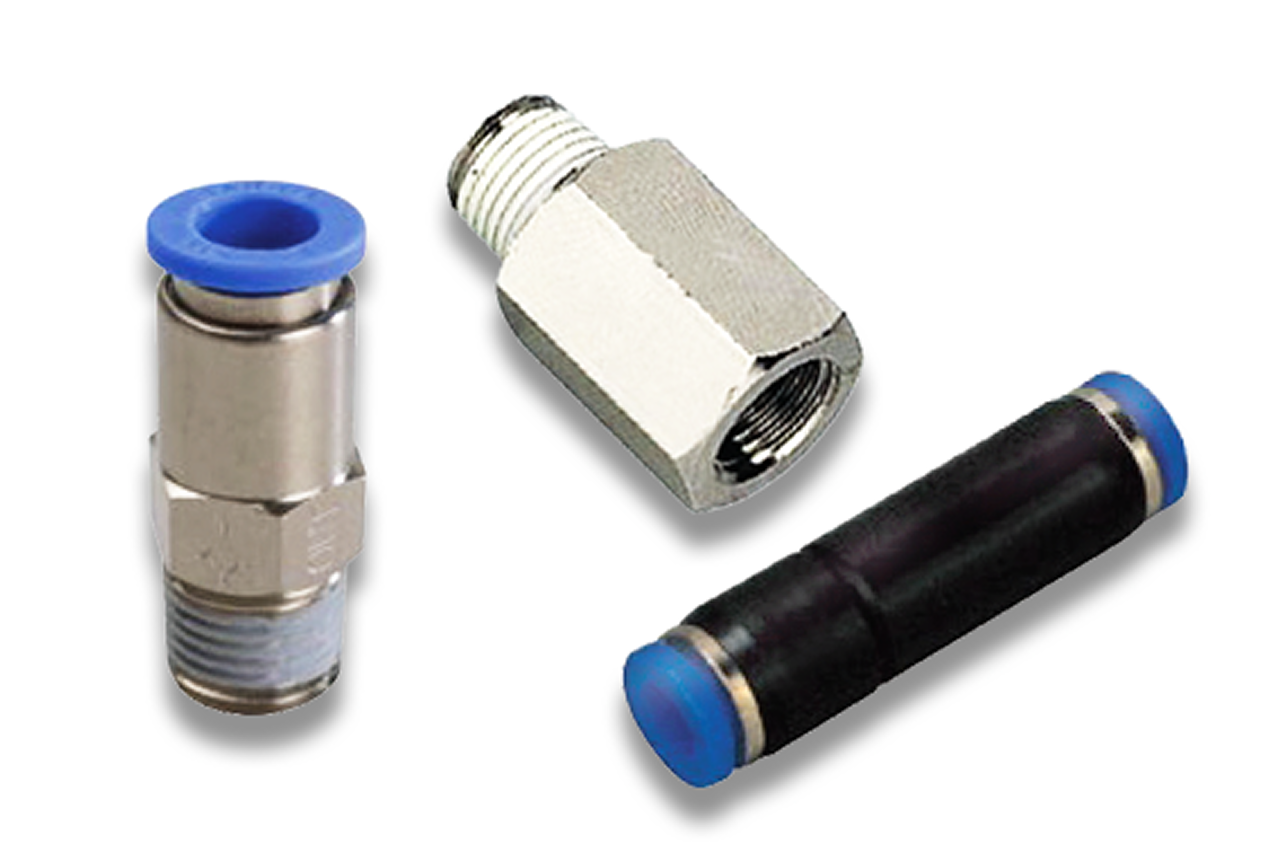
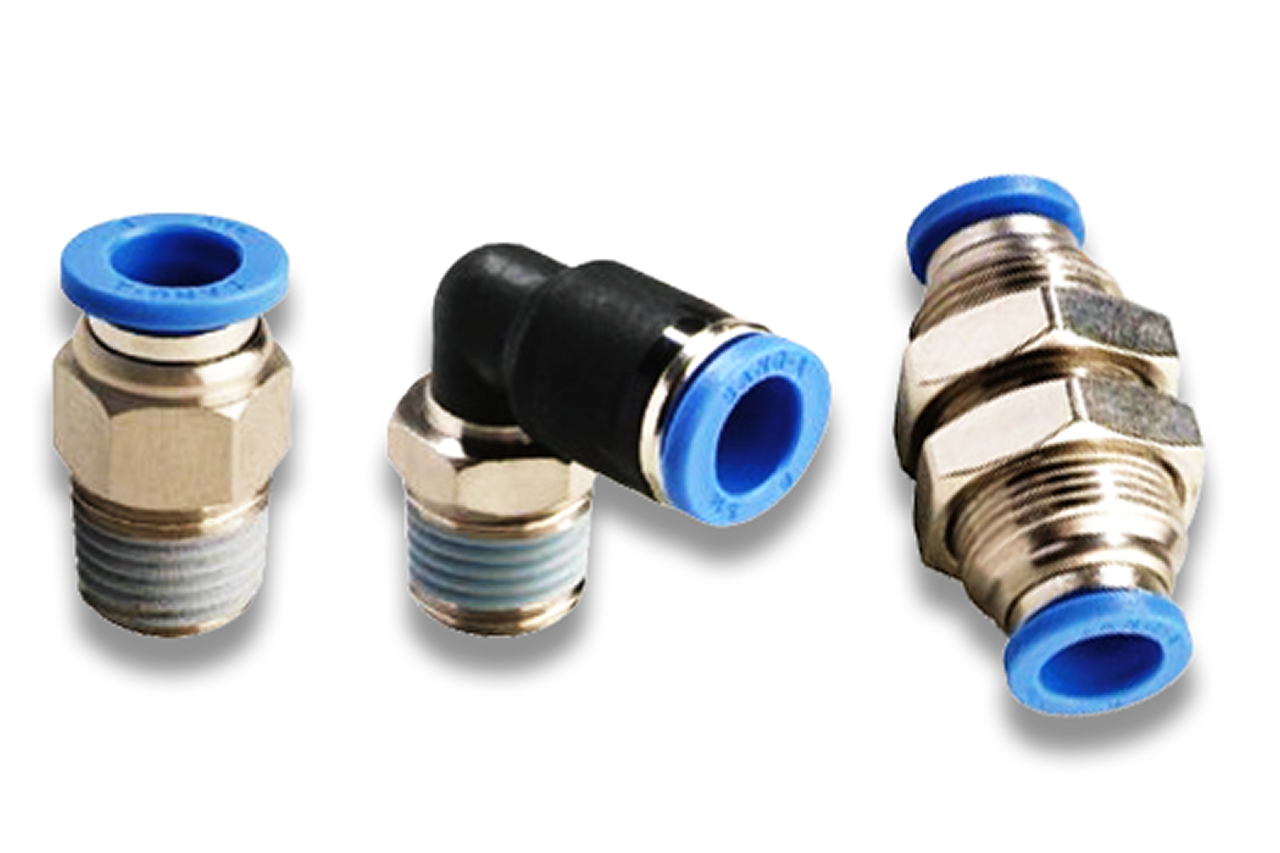
A check valve is a compact inline one-way valve with push-to-connect (PTC) ends that drops directly into a tubing run to permit airflow in one direction and seal against reverse flow — no threading, no tools, no pipe wrench. Air pushes the poppet open above a low cracking pressure in the free-flow direction; the instant flow reverses, the poppet reseats and blocks back-feed. Its defining trait is the tool-less push-to-connect body that installs in seconds anywhere a tubing-based system needs automatic one-way protection — preventing back-feed on a shared-supply branch, building simple pneumatic logic, protecting a sub-circuit against reverse flow. It is sized to the same tube OD (the outside diameter of the air line) as the rest of the system's PTC fittings, and flow direction is set by how the body is piped: meter-out runs tube→thread, meter-in runs thread→tube. It is automatic and one-way only — a tubing-native back-feed device, not a manual isolation valve and not a load-holding pilot-operated check at a cylinder.
Where it's used General Manufacturing
General Manufacturing application
02Why it's needed

Why this matters.

Tips and pointers on when the push-to-connect check valve is the right call — and when to spec something else. Scroll the strip →

01 · Key point
Tool-less one-way protection.

Push-to-connect ends seat the tube by hand — no threading, no tape, no wrench. Drops into any PTC tubing system in seconds and automatically blocks reverse flow. The retrofit-friendly back-feed device for machines and skids built from push-to-connect fittings.

02 · Key point
Low cracking, holds vacuum.

The poppet opens at low pressure so it barely costs you flow in the free direction, yet seals tight in reverse — it holds 1.42 PSI in vacuum, so it doubles as a non-return on negative-pressure take-offs down to −14.5 PSI. Working range 0–284 PSI, 32–176°F.

03 · Key point
Stops back-feed on shared supply.

Two or more drops on the same line — a check in each branch keeps one drop''s exhaust or pressure from back-feeding into adjacent circuits and causing unexpected motion. The tool-less fix for "strange behavior" on multi-drop tubing skids, dropped straight into the run.

04 · Pro tip
Flow direction is set by how you pipe it.

Read the signal on the body: meter-out = tube→thread, meter-in = thread→tube. Union and bush bodies (PCVU / PCVF) get piped per that signal — get it backwards and the line won''t pass flow at all. Confirm the direction against the schematic before seating the tube.

05 · Where not to use
Load-holding at a cylinder.

This is a tubing-native non-return — it blocks back-feed but it is not a pilot-operated load-holding check at a cylinder port. → Re-spec to the generic / pilot-operated check valve when the job is trapping air on both sides of a piston to hold a rod on power loss. Different body, different job.

06 · Where not to use
Manual lockable isolation.

A check is automatic and one-way — it doesn''t isolate for lockout-tagout. → Re-spec to the quarter-turn shutoff valve when the job is deliberate, manual, lockable isolation. For tool-less on/off in the same tubing run, the PTC ball valve is the hand-operated counterpart.

07 · Where not to use
Tunable flow throttling.

A check blocks reverse flow but does not meter the forward direction. → Re-spec to a flow control valve for bidirectional throttling, or a speed controller for one-direction cylinder metering. Run the check as a one-way gate, never as a throttle.

03Key selection criteria

What we need to spec it right.

From the machine spec sheet → to the part number. Answer what you know — leave the rest blank — and send.

01 · Input
The PTC end must match the line's tube OD exactly. Inch-vs-metric mismatch is the #1 at-install miss — photo or measure the existing fitting; a verbal "1/4 inch" can mean inch tube, metric, or a thread size.
Inch: 5/32" · 1/4" · 3/8" · 1/2" · Metric: 4mm · 6mm · 8mm · 10mm · 12mm
02 · Input
Read off the schematic or trace the line, then match the body signal. Installing backwards is the #1 field mistake — the line won't pass flow at all.
Meter-out (tube→thread) · Meter-in (thread→tube)
03 · Input
Pick the geometry that matches the run. Union bodies splice inline without cutting the whole tube; bush bodies thread into a component; straight bodies splice an inline run.
PCVC straight · PCVF bush · PCVU union
04 · Input
Verify the line stays inside the rated envelope — both ends. This is an air-only check; confirm the service is air, not water.
Pressure: 0–284 PSI (0–1958 kPa) · Negative: to −14.5 PSI (holds 1.42 PSI vacuum) · Temp: 32–176°F (0–80°C)
05 · Input
Only relevant on bodies with a threaded port. Read off the mating component. Threads are Teflon-treated from the factory.
NPT (North American) · BSPT "R" (tapered) · BSPP "G" (parallel, face-seal)
06 · Input
Count the one-way points on the tubing build — every shared-supply branch, sub-circuit, and vacuum take-off that needs back-feed protection. PTC tubing builds quote the checks in the same box quantities as the fittings.
1–10 pcs (specific install) · 10/25/50 box (multi-drop machine / skid build) · 100+ (infrastructure refresh)

Need different sizes, colors, or quantities? Fill the form, add to quote, then fill again — each click is one quote line.

04Choose your solution tier  ·  core differentiator

Whatever your lever — spec, value, or price — SPC has the right brand.

Most distributors sell one brand per product type. SPC's 60-brand portfolio means every Product Type page surfaces three real options matched to how your customer is buying today. Pick the tier; the quote desk handles the cross-reference.

05How to sell this  ·  distributor talk track

The tier conversation closes the deal. The cross-reference catalog wins the next one.

The push-to-connect check valve is a one-question close: what's the tube OD, and which way does air need to flow? The body does the rest — it drops into the run by hand and blocks back-feed automatically.
The SPC difference · how distributors actually buy

The 30-second positioning

Quoting is a tube-OD and flow-direction conversation. Read the tube OD off the existing fittings (5/32"–1/2" inch or 4–12mm metric) and confirm the free-flow direction against the schematic. Then match the body to how it's piped: PCVC straight for an inline splice, PCVF bush to thread into a component, PCVU union to drop into a run without cutting the whole line. Flow direction is set by the signal on the body — meter-out = tube→thread, meter-in = thread→tube.

Tier: Economical tier is the value default — full inch-and-metric tube coverage, full body-style coverage (straight / bush / union), competitive pricing on high-volume sizes. Industry Leader tier for matched-vendor builds where the rest of the push-to-connect train is single-brand.

The differentiator is tool-less one-way protection in the tubing layer. Most checks are threaded or live at a cylinder port; this one drops into a push-to-connect run by hand and blocks back-feed on shared-supply branches — the simplest line-protection device on a tubing skid. The low cracking pressure and 1.42 PSI vacuum hold also make it a non-return on negative-pressure take-offs.

Where it is NOT the answer: if the customer needs to hold a cylinder load on power loss, that's the pilot-operated variant of the generic check valve at the cylinder ports — not this inline tubing check. If the job is manual lockable isolation, that's the quarter-turn shutoff; for tool-less hand-operated on/off in the same tubing run, that's the PTC ball valve. Steer the spec rather than forcing the PTC check into a load-holding or isolation role.

The recurring lever is the tubing-system build itself — when a machine or skid is assembled from push-to-connect fittings, the one-way points are part of the same BOM and quoted in the same box quantities as the fittings, typically 10–50 per build on a multi-drop system.

Customer cue → talk move

"Need a one-way fitting on a push-to-connect air line"
PTC inline check, matched tube OD. Tool-less, drops straight in. Confirm flow direction.
"Two drops on a shared line, strange behavior"
Back-feed through the shared supply. Check in each branch immediately downstream of the tee.
"Need a non-return on a vacuum take-off"
Yes — low cracking pressure, holds 1.42 PSI in vacuum, rated to −14.5 PSI negative. Match tube OD.
"Cylinder has to hold a load when air drops"
Wrong valve — that's the pilot-operated check at the cylinder ports. Quote the generic check valve's pilot-op variant instead.
"Need to lock the line out for service"
That's the quarter-turn shutoff (manual, padlock-hole lever). For tool-less hand on/off, the PTC ball valve.
"Which way do I pipe it"
Read the signal on the body: meter-out = tube → thread, meter-in = thread → tube. Union/bush bodies pipe per that signal.
"Replacing a tubing check valve"
Match tube OD and body geometry (PCVC / PCVF / PCVU); confirm flow direction and thread spec NPT / BSPT "R" / BSPP "G" if a threaded port is involved.
06Where it's used

Industries served.

Each industry below uses this product across the listed areas. Open an industry to see how it fits the rest of its system.

Also applies to Push-to-connect machine and skid air drops · Shared-supply branches on multi-drop tubing systems · Simple pneumatic logic in tubing builds · Vacuum and negative-pressure take-offs · Inline tubing splices for back-feed protection

09Install · 5 critical steps

The things that matter on the first install.

Step 01
Confirm the free-flow direction before you seat anything
Read the signal on the body — meter-out = tube→thread, meter-in = thread→tube — and match it to the schematic. Installing a check backwards is the #1 field mistake: the line won't pass flow, the drop won't actuate, and the diagnosis burns an hour. On union (PCVU) and bush (PCVF) bodies, set orientation so the flow arrow / signal points the right way before final make-up.
Step 02
Match the PTC end to the tube OD exactly
The valve's push-to-connect ends must equal the line's tube OD — 5/32"–1/2" inch or 4–12mm metric. Mixing inch and metric is a common at-install miss; a 5/32" tube does not seat reliably in a 4mm collet even though they look close. Read the OD off the existing fittings or measure the tube; do not go by a verbal "quarter inch."
Step 03
Confirm the fluid and the working range
This is an AIR-only check — verify the line is air, not water. Working range is 0–284 PSI (0–1958 kPa), 32–176°F (0–80°C), with negative-pressure capability to −14.5 PSI (−100 kPa) and a 1.42 PSI vacuum hold. Confirm the system stays inside that envelope — both pressure and temperature — before installing.
Step 04
Seat the tube fully into the collet
Cut the tube square and clean (PU or nylon tubing), push it straight in past the collet until it bottoms on the internal shoulder, then tug to confirm the grab ring has set. A partially-seated tube leaks or blows out under pressure. If a threaded port is present, seal by thread type: NPT / BSPT "R" on the threads (threads are Teflon-treated from the factory); BSPP "G" seals on the face, no tape on the threads.
Step 05
Cycle and pressure-check at commissioning
Apply low shop air in the free-flow direction — the poppet should open with a click; reverse the line and it should stop immediately, no passing. Pressurize and check every PTC joint and the NBR O-ring seal for leaks at working pressure. A weep at the collet means the tube isn't fully seated — depressurize, re-seat, re-test. On logic or multi-drop builds, sketch and label each check and run before plumbing.
10Troubleshoot · top failures

Most returns trace to one of these causes.

Symptom
Most likely cause
Fix
Line won't pass flow / drop won't actuate after install
Check installed backwards (most common at new install) — the body piped against the signal (meter-out = tube→thread, meter-in = thread→tube), OR debris jamming the poppet, OR tube not fully seated narrowing the path.
Trace the flow path and verify the body signal matches the schematic's free-flow direction; re-orient if reversed. If direction is right, depressurize and bench-check the poppet for debris. Re-seat any partially-inserted tube.
Tube leaks or blows out at the push-to-connect end
Tube not fully seated past the collet (most common at new install), OR the tube end was cut at an angle / nicked, OR wrong tube OD forced into the wrong-size collet, OR tube material outside spec (must be PU or nylon).
Depressurize, pull the tube, square-cut and clean the end, push it fully home until it bottoms, tug to confirm the grab ring sets, re-pressurize. Verify tube OD matches the valve's rated size — inch vs. metric mismatch is the usual culprit.
Reverse flow passes when the check should seal
Debris in the seat (#1 cause — particulate from a degraded upstream coalescing filter, scale, or install-time debris not flushed), OR elastomer seat chemical damage, OR the poppet spring fatigued / broken.
Remove and inspect the seat. Light contamination can reverse-flush with shop air; severe damage = replacement (the commodity PTC body is not field-rebuildable). If failures recur at one location, service the upstream coalescing filter — air quality, not the valve, is usually the root cause.
Won't hold vacuum / negative-pressure take-off leaks back
Cracking pressure effectively too high after seat wear, OR debris holding the poppet open a crack, OR service outside the rated −14.5 PSI negative envelope.
Confirm the line stays within the rated negative-pressure range and that the service is air (not water). Clean or replace the check if the seat is passing — a worn seat loses the 1.42 PSI vacuum hold first.
Audible chatter or pulsing during forward flow
Valve sized below the tube OD (poppet partially open, oscillating in the stream), OR cracking pressure too high for a low-pressure signal, OR partial tube insertion narrowing the path.
Match the check's tube OD to the line. If sizing is right and the signal is low-pressure, the poppet is hunting — verify full tube insertion and confirm the application pressure clears the cracking pressure with margin.

Get the right ptc check valve on quote in 24 hours.

Send us the application — a specialist routes you to the correct tier with a configured part. Lead-times and pricing returned within one business day.

Request a quote