DISTRIBUTOR-FIRST SUPPLY PARTNER · SINCE 1999 Live · Compressed Air System
SPC Company
Compressed Air / End-Use / Nitrogen Generation
System · Compressed Air Layer 6 · End-Use 3 product types

Nitrogen Generation

Three formats, one PSA core, one decision. Where is the nitrogen consumed — at plant pressure, in cylinders, or on a remote site with no building? This page walks the standard plant generator, the high-pressure cylinder-fill system, and the containerized turnkey package — comparison first, decision tree second, questions to ask third — so a vendor-supplied gas line item turns into an on-site capital asset with a calculated payback.

The Nitrogen Generation family 3 types · End-Use

Tap any type to jump to its page. The Decision Guide further down asks three questions that funnel the spec to one of these.

01What this category is

Nitrogen Generation turns the compressed air you already make into the nitrogen the customer is currently buying — at the format their site demands.

What it is
On-site nitrogen from your own air

One PSA core — carbon molecular sieve takes oxygen out, nitrogen passes — in three formats. The air you already make becomes a process gas.

The decision
Where does the nitrogen leave the system?

At plant pressure (standard generator), in cylinders (high-pressure fill system), or on a remote site with no building (containerized).

Sizing
Three numbers size every install

Required purity, peak flow, and current monthly nitrogen spend. Size to peak, never average — the buffer smooths swings but doesn't erase them.

Why it matters
It turns a vendor invoice into a capital asset

A line item the customer buys every month becomes an owned generator with a calculated payback — often 18-30 months at steady spend.

Non-negotiable
Feed-air treatment is not optional

Desiccant dryer to ‑40°F PDP plus a coalescing filter, on every format. A refrigerated dryer destroys the CMS beds in months, not years.

Quote the system
Sell the chain, not the generator

Every PSA install needs the dryer, coalescing filter, buffer vessel, and on-line purity analyzer — selling the generator alone misses spec.

02The 3 types · side-by-side

Best-for, key trade-off, capacity, price band, and how deep the brand bench runs.

Download PDF

Distributor-facing reading. The trade-off column is the one that closes the loop — every type buys something and gives something up. Knowing what each type costs you is how the right one gets on the quote without a callback.

Product type
Best for
Key trade-off
Typical capacity
Price band
Brands SPC carries
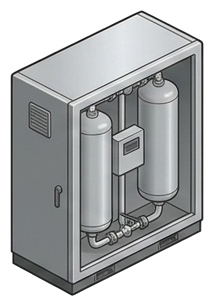
PSA Generator — Standard Plant pressure · 95% to 99.999%+ purity
The workhorse of on-site nitrogen. Laser cutting, food and beverage packaging, plastics and electronics blanketing, tire fill, heat treating, chemical and pharma process work, wineries — any application where nitrogen is consumed at standard plant pressure. The right format for the large majority of industrial demand.
Plant pressure only Delivers nitrogen at standard plant pressure, a few PSI below feed. Cylinder filling, aircraft servicing, and any high-PSIG application needs the high-pressure format. Available on a portable skid or trailer chassis as a packaging variant — same machine, not a separate Product Type here.
A few hundred SCFH to hundreds of SCFM
skid · cabinet · compact · portable chassis
$$ – $$$
3 / 5 · solid
High-Pressure Generator PSA + booster + fill stand · 2,200–3,500+ PSIG
Cylinder filling and mission-critical defense work. Aircraft tire and strut servicing, military and defense maintenance, munitions handling, industrial gas-charging (accumulators, gas springs), specialty cylinder filling for distributors, hypoxic fire suppression with high-pressure cylinder reserves. The only format engineered to fill bottles.
Capital cost + safety engineering Materially higher capital than a standard-pressure generator — the booster, fill stand, pressure-rated piping, and safety relief set add real cost. Heavier documentation and compliance overhead, especially in defense and aviation work. Manufacturer financing often relevant.
Single cylinder to 6+ cylinders / 24 hr
deployable wheeled · stationary fill skid
$$$
1 / 5 · South-Tek only
Containerized System ISO container · generator + compressor + treatment + buffer
Remote sites and rapid-deployment installs. Oil and gas fields, mining, remote chemical plants, modular pharma and food facilities, expansion projects with no indoor floor space, multi-year construction projects, defense forward operating bases, multi-site corporate standardization, paired Enclosed Air Systems deployments. Plug-and-play in days, not months.
Site services + remote-service economics Customer is responsible for pad, power (voltage + phase confirmed), ambient HVAC if outside the equipment's operating envelope, and the nitrogen-line piping out to the point of use. Service trips to remote sites cost more, which pushes the economics toward bundled annual service contracts and on-site spare-parts stocking.
Same envelope as standard format
nitrogen · compressed-air · paired configurations
$$$
1 / 5 · South-Tek + build partner

Reading the brand bench column — the bar shows how many of SPC's tier slots (Industry Leader · Emerging · Economical · adjacent) carry an option at that product type. A deep bench means a price-driven and a spec-driven option both close cleanly; a narrow bench means the available brands map closely to the technical requirements and the comparison stops being a tier choice. Nitrogen generation runs narrow by design — South-Tek anchors every format, with Ozen Air and Great Lakes Air as second-tier alternates only on the standard-pressure format.

03Decision guide

2 questions “Funnel the Spec” to one product type.

Download PDF

Draw a line from the customer's answer at the top to the type name at the bottom. This is the page distributors screenshot and send to a customer the day before a quote call — so the customer comes prepared with the answers, and the call is about the brand and the budget, not the basics.

Use this Download the PDF above, print it, drop it in an email to the end customer, or screenshot the tree below. The questions and the type recommendations are designed to stand on their own without the rest of the page.
START AT THE TOP  ·  FOLLOW THE PATH DOWN  ·  END ON THE PRODUCT TYPE
Question 1
Where does the nitrogen have to leave the system — at plant pressure, in cylinders, or on a remote site with no building?
Plant pressure · standard industrial demand
Question 2a
Is there an indoor location with space, power, and a building to house the equipment?
If Yes · permanent indoor install
Recommend
PSA Generator — Standard
The workhorse. Standard plant pressure, 95% to 99.999%+ purity, sized on a specific purity-and-flow pair. Available as skid, cabinet, or compact — and as a portable chassis variant when the demand needs to move.
See product type →
If No · remote site, no indoor space, or rapid deployment
Recommend
Containerized System
The full chain — generator, feed compressor, dryer, filter, buffer — inside an ISO container. Set on a pad, connect power, run in days. Also the right answer for asset- relocation optionality.
See product type →
Cylinder pressure · 2,200 PSIG and above
Question 2b
Is this aviation, defense, munitions, or specialty cylinder filling?
If Yes · mission-critical fill operations
Recommend
High-Pressure Generator
PSA core plus a gas booster and a cylinder-fill stand — the only format engineered to fill bottles. Deployable wheeled package or stationary fill skid. South-Tek is the anchor brand for this segment.
See product type →
If Industrial gas-charging (accumulators, gas springs, refrigeration)
Recommend
High-Pressure Generator
Same fill-system format — booster + fill stand — sized to the customer's cylinder demand. Clean payback against bottled-gas deliveries for any customer running these operations at volume.
See product type →

Three structural rules behind the tree: feed-air treatment is not optional — a desiccant dryer to ‑40°F PDP plus a coalescing filter upstream of every PSA install, on every format (refrigerated dryers destroy CMS beds). Size to peak, never average — the buffer vessel smooths swings but does not erase them, and a generator that can't hit peak ends in supplemental cylinder deliveries that erode the payback case. Quote the system, not the generator — every PSA install needs the dryer, the coalescing filter, the buffer vessel, and the on-line purity analyzer; selling the generator alone leaves the customer with capital that can't hit spec.

The format is decided by where the nitrogen leaves the system — plant pressure, cylinder pressure, or remote site. After that, every PSA sizing conversation is the same three numbers: purity, peak flow, monthly spend.
SPC distributor playbook Nitrogen Generation · how to qualify in one call
04Questions to ask the customer · before you quote

9 inputs determine the right nitrogen generation.

Download PDF

If the customer answers most of these at the first call, the second call is the quote. If they can't answer any, the nitrogen generation are rarely the only spec gap — flag it and push for a site walk.

01
What's the customer currently spending on nitrogen each month — cylinders, dewars, or bulk liquid?
This is the denominator on the entire payback case. Pull the last 12 months of supplier invoices, not the customer's memory — most customers underestimate by 30-50% because hazmat fees, demurrage, and rentals show up on separate invoice lines. The full- spend number drives the case; without it the conversation stays theoretical.
02
What nitrogen purity does the application actually need — PPM O2 or %?
Sets the generator size and the feed-air ratio. Tire fill and electrical-cabinet purge run at 95-99%, food packaging and laser cutting at 99.5-99.9%, electronics and pharma at 99.999%. Higher purity costs more feed air per unit of nitrogen — roughly 10× feed air at 99.999% versus 3-4× at 99% — so under- or over-specifying purity directly affects capital cost and operating economics.
03
What's the peak nitrogen flow rate (SCFM), and how long does the peak last?
Size to peak, never average. The buffer tank smooths but does not erase peaks, and an undersized generator ends in supplemental cylinder deliveries that erode the payback case. Get the peak SCFM and the duration so the generator and buffer vessel are sized together.
04
Where is the nitrogen consumed — at plant pressure, in cylinders, or somewhere with no building?
This is the format decision. Plant pressure = standard PSA. Cylinder pressure (2,200-3,500 PSIG) = high-pressure fill system. Remote site or no indoor space = containerized. Get this answer before sizing anything; it determines the entire product family and the price band.
05
What's the existing compressor's available SCFM at the PSA's required inlet pressure?
PSA needs roughly 3-4 SCFM of treated feed air per 1 SCFM of nitrogen at standard purity, and the ratio rises sharply with purity. If the existing plant compressor can't supply that on top of current demand, the install is dead before it starts — quote a compressor upgrade alongside the generator. SPC has the compressor under the same umbrella.
06
Is a desiccant dryer (‑40°F PDP) and a coalescing filter already in place upstream of where the PSA will sit?
Mandatory. Carbon molecular sieve is destroyed by moisture and oil — a refrigerated dryer will not protect the beds, and a missing coalescing filter dumps oil aerosol into the generator. If either is absent or undersized, quote the upgrade as part of the install scope. This is protecting the customer's capital investment in the sieve beds, not an upsell.
07
What's the install footprint — indoor floor space, outdoor pad, or no building at all?
Drives format. Indoor floor space → standard skid or cabinet. Outdoor pad → containerized or enclosed standard. No building → containerized is the answer. Confirm pad rating, power (voltage + phase), ambient conditions, and the nitrogen-line routing out to the point of use.
08
What ROI horizon is the customer expecting — and is there CFO appetite for capital?
Steady-state customers in the $3K-$8K/month nitrogen-spend range typically land 18-30 month payback on a standard PSA install. Mission-critical customers (aviation, defense, remote sites) often have non-financial drivers (supply-chain independence, mission readiness) that dominate the decision regardless of payback math. Match the talk track to the customer's actual decision driver.
09
Is the customer planning to relocate this asset later, or is this a permanent install?
Optionality matters on long-life capital. Fixed installs are effectively stranded if the site closes; containerized packages can be lifted onto a truck and relocated to the next site. Multi-site corporate customers and operations planning facility consolidation often choose containerized for the optionality alone.
05Where this category lives

End-Use is the layer where compressed air stops being compressed air and becomes something else — nitrogen, vacuum, pneumatic motion, the actual output the plant was built to produce. Every layer upstream of this one exists to deliver clean, dry, properly-pressured air to this boundary; everything downstream of this boundary is whatever the customer is making or doing with that air. Nitrogen Generation is the canonical End-Use add-on inside the compressed-air system: the same air the plant already produces gets pushed through a carbon-molecular-sieve PSA generator, oxygen comes off, nitrogen stays, and what was a utility becomes a process gas the customer used to buy from a vendor. Get the End-Use spec wrong and the upstream investment is wasted — the dryer, the filters, the compressor are all sized to feed this layer, and an undersized feed-air chain shows up as a generator that can't hit purity or a vacuum pump that can't hold draw. Get it right and the customer captures every dollar the upstream layers were engineered to enable. End-Use is also the bridge to the broader pneumatic ecosystem — vacuum, pneumatic automation, and other add-on systems pick up where this layer ends.

Categories in this layer

Not sure which type? Send us the use case.

Tell us the end-use, the rough flow, and what climate the unit would sit in. We'll come back with a configured quote — the right type, the right tier, and the upstream gear the warranty assumes.