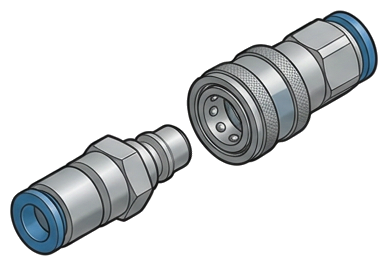
What it is
The tool-changeover connection at the hose end
Three halves cover the plant — industrial socket, safety-vented socket, and the plug. The most-handled connection in the building.

Three coupler types, one safety decision and one profile match. Safety-vented socket is the recommended default on every new install with audit or safety-program exposure; standard industrial only where budget is the override; and the plug is the male half every tool and hose end needs — many per socket. The profile must match, and the safety choice carries the hose-whip liability either way.
Tap any type to jump to its page. The Decision Guide further down asks three questions that funnel the spec to one of these.
Three halves cover the plant — industrial socket, safety-vented socket, and the plug. The most-handled connection in the building.
Default to the safety socket on every new install with audit or safety-program exposure; standard only where budget is the override.
It releases the plug while pressure is still in the line — the OSHA 1910.242(b) hose-whip condition. The two-stage safety socket vents first.
Industrial, CA, Tru-Flate, ARO, Euro all mismatch. Confirm the facility standard, and quote plugs at several per socket.
SPC cross-lists Prevost and Aignep across all three coupler types — industrial socket, safety socket, and plug.
Distributor-facing reading. The trade-off column is the one that closes the loop — every type buys something and gives something up. Knowing what each type costs you is how the right one gets on the quote without a callback.
Reading the brand bench column — the bar shows how many of SPC's tier slots carry an option at that product type. All three coupler types run two brands deep: Prevost and Aignep across industrial socket, safety socket, and plug. The spec decision here isn't brand depth — it's safety-vented vs. standard industrial on the socket, and matching the installed profile on the plug. Default to the safety-vented socket on every new install with audit or safety-program exposure; the hose-whip liability stays with the plant when "standard" is chosen.
Draw a line from the customer's answer at the top to the type name at the bottom. This is the page distributors screenshot and send to a customer the day before a quote call — so the customer comes prepared with the answers, and the call is about the brand and the budget, not the basics.
If the customer answers most of these at the first call, the second call is the quote. If they can't answer any, the quick couplers are rarely the only spec gap — flag it and push for a site walk.
Distribution is the layer that turns a treated, regulated air supply into air at the actuator — and the layer that's invisible when it works and catastrophic when it doesn't. Every leak, every pressure drop, every blown hose, every machine-down call traced back to "the air just stopped" ultimately lives in this layer. A pneumatic system is a thousand-plus connections — header to drop leg, drop leg to FRL, FRL to manifold, manifold to valve, valve to cylinder, plus every hand-tool coupler in between — and each one is a candidate failure point. Industry audits consistently put facility-wide leak rates at 20-30% of compressor output, with the majority of those losses at fittings and joints, not at the equipment. Distribution is also where material spec meets regulatory and audit exposure — food contact, NSF certification, ATEX classification, DOT/FMCSA brake circuits, B31.3 instrumentation. Spec it right at the connection level and the rest of the system can deliver what it was designed to deliver; spec it wrong and the customer is patching leaks for the life of the plant.
Tool changeover at the hose end — industrial socket, safety-vented socket, and the profile-matched plug. Cross-listed to Prevost and Aignep.
The standard PTC tiers — composite, technopolymer, brass, stainless, NSF food-grade. The Sang-A flagship core of the Distribution layer.
→Push-to-connect bodies that also perform a function — rotary joints and stop fittings. The Sang-A functional-fitting line.
→Instrumentation double-ferrule and DOT air-brake — regulatory connection families governed by code.
→The line itself — PE, PU, nylon, and FEP/PTFE matched to chemistry, pressure, and motion. The hose the coupler terminates.
→The plant header — extruded aluminum mains replacing legacy black iron, upstream of every coupler drop.
→Downstream in Control & Valving — the valving on the machine side of the hose-end tool drop.
→Tell us the end-use, the rough flow, and what climate the unit would sit in. We'll come back with a configured quote — the right type, the right tier, and the upstream gear the warranty assumes.
—. We reply within one business day with pricing, lead-time, and configured parts.